

June 16th, 2026
Written by Lucas Tittle
Multiple solutions to the same problem
If you’ve ever been to an escape room, you know that you have to work quickly with your group to solve the puzzles and escape. You may have also noticed that people will have different strategies to solve the same problem or puzzle. Well, neurons in the brain are no different! In this post, we will discuss how neurons work together to solve problems (like how to chew food), how these problem-solving strategies vary between individuals, and how studying crabs (yes, crabs) has revealed why these differences matter.
Why crabs?
A big part of neuroscience research focuses on understanding how neurons work together to produce actions, like moving our arms or chewing. However, these groups of neurons, called neural circuits, are often hard to study, largely because there are so many neurons! Humans have between 86-100 billion neurons.1 Even mice have 75 million neurons.2 This makes it hard to identify what each individual neuron does.
In comparison, neuroscientists who study crabs have a unique advantage. The part of the crab that they study is called the stomatogastric nervous system (STNS), and it only has 30 neurons!3 These neurons are really big and appear in single copies (ex: there is only one Neuron A) so scientists have been able to understand how each individual neuron contributes to a given action. Interestingly, crabs have teeth in their stomach, and the STNS controls chewing. Luckily, the circuit controlling chewing can be simplified into just two neurons!
In the crab “chewing circuit”, neurons A and B are connected. When Neuron A is active, Neuron B is quiet, and the crab pulls its teeth apart. When Neuron B is active, Neuron A is quiet, and the crab’s teeth are pulled together. It’s this seesaw of activity between Neuron A and Neuron B that produces chewing (Figure 1).
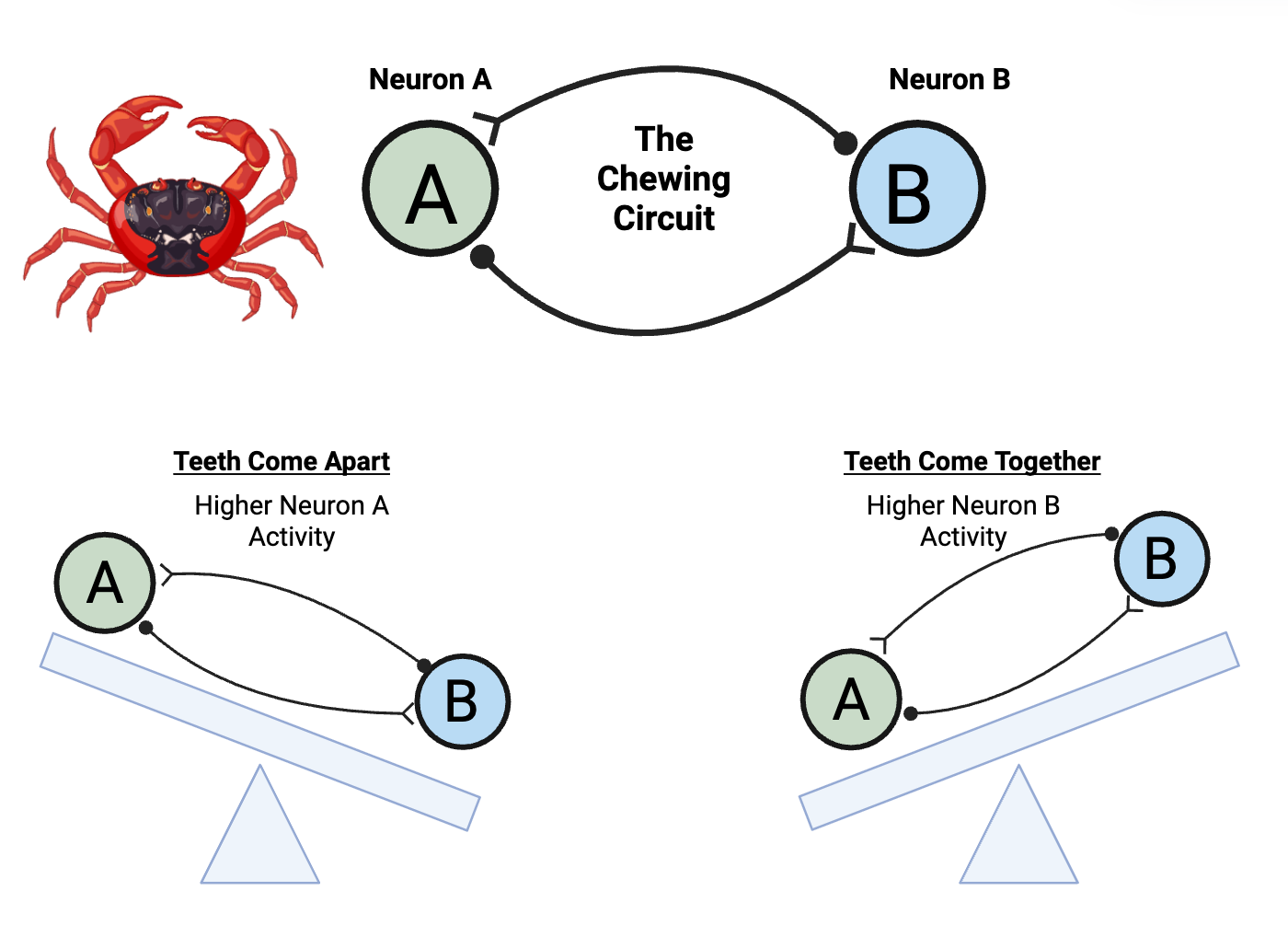
The chewing circuit is a good example of how neurons work together to solve a problem (in this case, chewing). But the chewing circuit has also given scientists a good idea for how neurons can use different strategies to solve the same problem. This is because the same neuron isn’t actually the same neuron! While two crabs may each have the same circuit, Neurons A and B in the first crab aren’t necessarily the same as Neurons A and B in the second crab. Let’s talk about why.
The same neuron is not the same neuron
Neurons of the same kind might generate the same pattern of activity, but they might be made up of a different pattern of molecules that makes them very unique! Kind of like how the color blue has many different shades.
Neurons have small molecules called ion channels that allow small, electrically charged particles called ions to enter or exit them. Some ions enter neurons, and some exit. When ions are moving into or out of a neuron, this generates an electrical current, kind of like the current of a river (Figure 2).
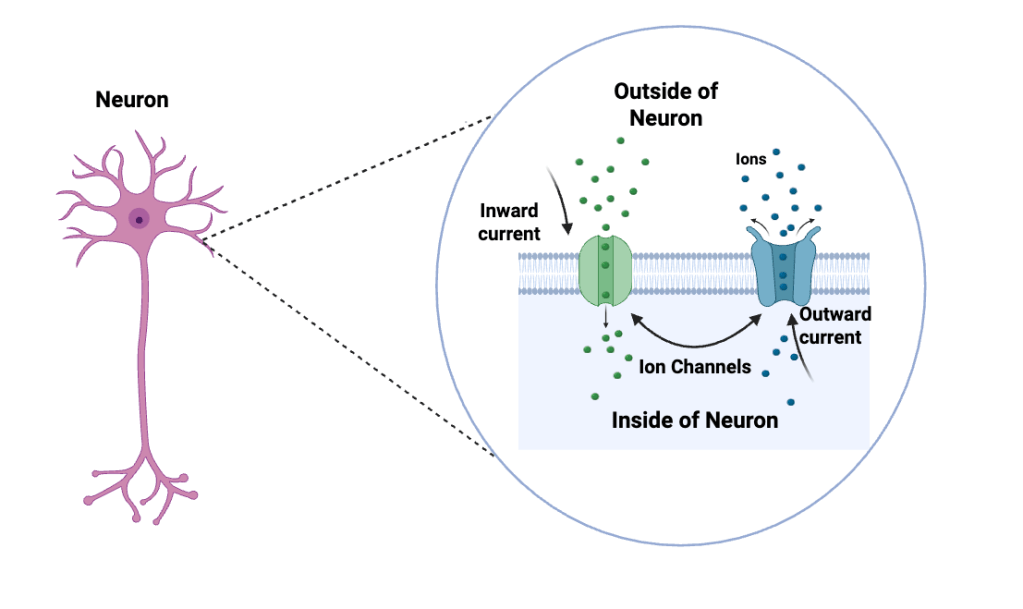
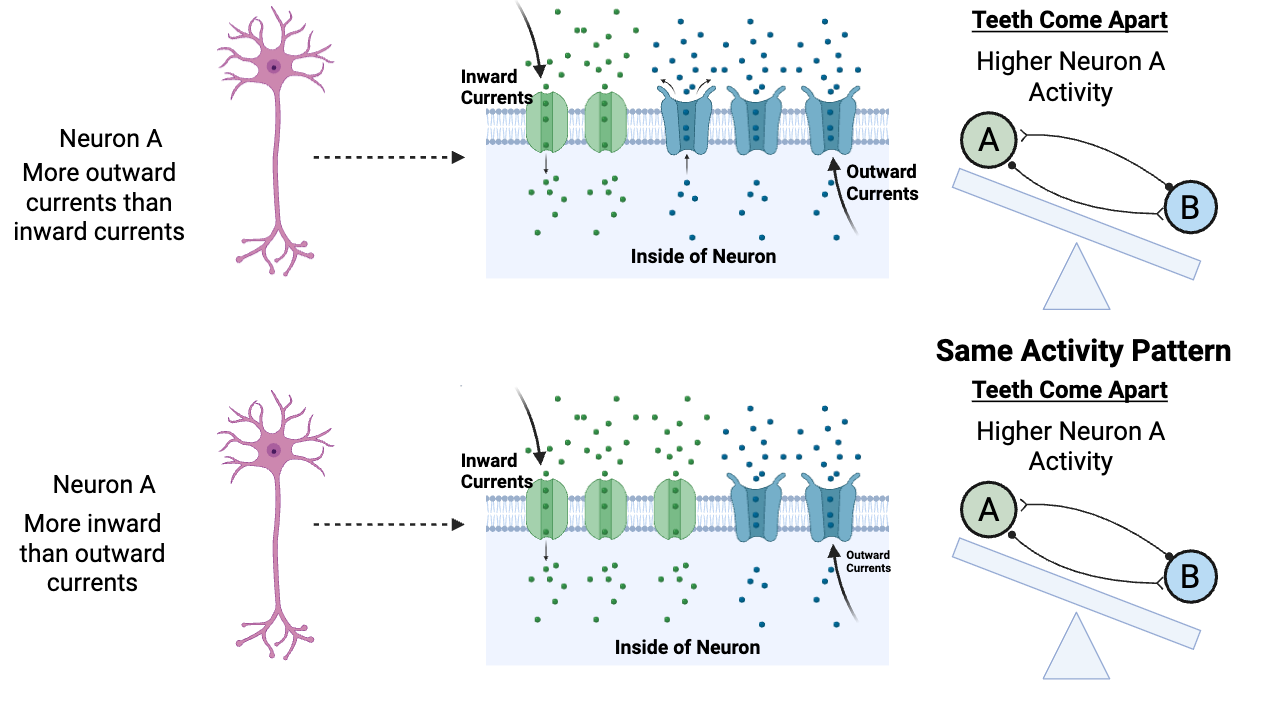
Each neuron has its own makeup of ion channels and as a result, electrical currents.4 Some neurons might have more inward currents, and some might have more outward currents. Going back to crabs, one crab’s Neuron A might have different amounts of inward and outward electrical currents than another crab’s. As a result, one crab’s Neuron A might take more ions coming into the neuron to create the activity that is required to pull the crab’s teeth apart. Another crab’s Neuron A might take less ions coming in to create the same activity (Figure 3).
Nevertheless, both versions of Neuron A successfully pull the crab’s teeth apart, so both crabs are able to chew even though their neurons are slightly different. Just like how two different people can come to the same conclusion for how to solve a puzzle in an escape room, two neurons might have unique ways to achieve the same output.
When do individual differences in circuit structure matter?
So, if Neuron A does the same thing across both crabs, why does it matter if the Neuron A in one crab is different from the Neuron A in another crab? Well, it might matter in some contexts and not others, like in cases where there are changes in the environment.
One challenge crabs have to face is changing water temperatures in the sea. Crabs need to be able to chew, walk, breathe, and so forth, no matter how hot or cold it gets. But since each crab has unique neurons A and B, some crabs might do better with changing temperatures than others. To test if this is the case, scientists studying crab circuits have turned up the heat.
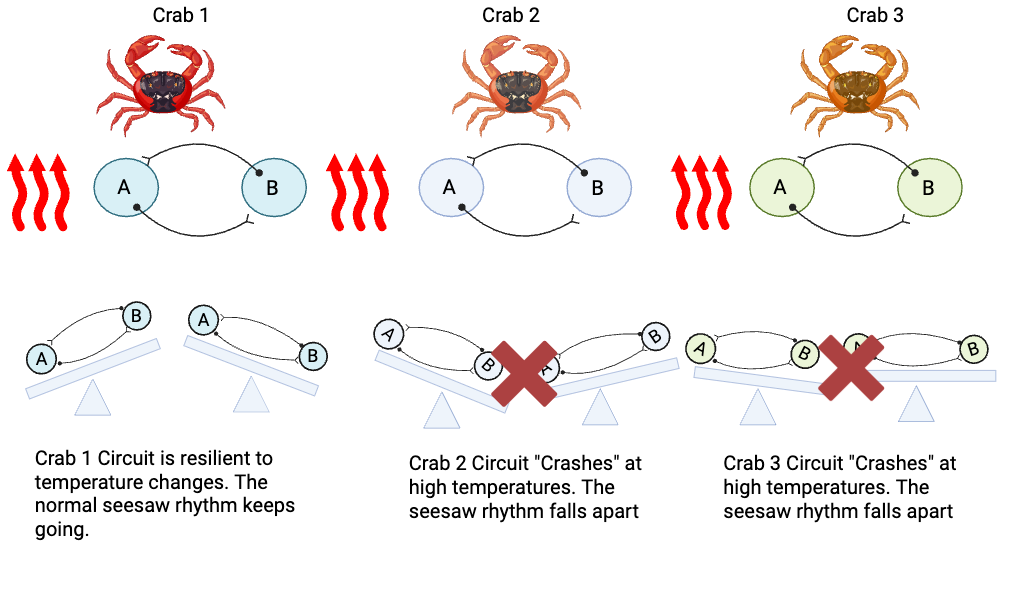
In one study, scientists looked at three crabs of the same species and found that their chewing circuits responded differently to increasing the temperature.4–6 As the chewing is ongoing, raising the temperature makes the chewing circuit of each crab “crash” at different points (Figure 4). One crab’s circuit isn’t fazed, it remains resilient to the change in temperature. But the other two crash as things get really hot! This means that two out of the three crabs would have a lot of trouble chewing in hot water, but the third crab would be able to chew regardless of the temperature. This is because each crab has the same neurons, but with different ion channel makeups. The heat affects how fast the electrical currents happen, which makes the seesaw rhythm of chewing fall apart. So while the individual differences in ion channel makeup usually produces the same rhythm, in some scenarios, like changing temperatures, those differences start to matter.
There are multiple solutions to problems, whether it is how to solve a clue from an escape room or neurons working together to create a pattern of activity. This research has implications for why different people respond differently to the same thing. One example is medications. Normally, neural circuits with different ways of working together carry out every day functions. When you take a medication that affects the brain, this creates a new environment for the neurons it affects. Different people might have a different ion channel makeup that could lead to a medication having side effects for some and not others.7 We are all made up of similar parts, but their underlying structures could differ considerably!
References
- Goriely, A. Eighty-six billion and counting: do we know the number of neurons in the human brain? Brain 148, 689–691 (2024).
- List of animals by number of neurons. Wikipedia (2026).
- Marder, E. & Bucher, D. Understanding Circuit Dynamics Using the Stomatogastric Nervous System of Lobsters and Crabs. Annu. Rev. Physiol. 69, 291–316 (2007).
- Prinz, A. A., Bucher, D. & Marder, E. Similar network activity from disparate circuit parameters. Nat. Neurosci. 7, 1345–1352 (2004).
- Marder, E. & Rue, M. C. P. From the Neuroscience of Individual Variability to Climate Change. J. Neurosci. 41, 10213–10221 (2021).
- Calabrese, R. L. & Marder, E. Degenerate neuronal and circuit mechanisms important for generating rhythmic motor patterns. Physiol. Rev. 105, 95–135 (2025).
- Grashow, R., Brookings, T. & Marder, E. Reliable neuromodulation from circuits with variable underlying structure. Proc. Natl. Acad. Sci. 106, 11742–11746 (2009).
Claude was used to identify inconsistencies and helped to re-word the blurb.
Cover photo by Andrew_Rix on Pixbay
Figures made by Lucas Tittle on Biorender

