
June 30th, 2026
Written by Anna Kasper
The relationship between hearing loss and dementia
Among my closest friends and family, I am notorious for misplacing items. Despite being able to keep running lists in my head all day, remembering where I put items is a #work-in-progress. However, for people with dementia, memory impairment is often severe and irreversible.
Dementia is a condition that broadly describes the steep decline of cognition, which is the ability to perform mental tasks related to memory, learning, and reasoning. In the United States, dementia affects more than 6 million Americans and has an economic burden of at least $600 billion every year1.
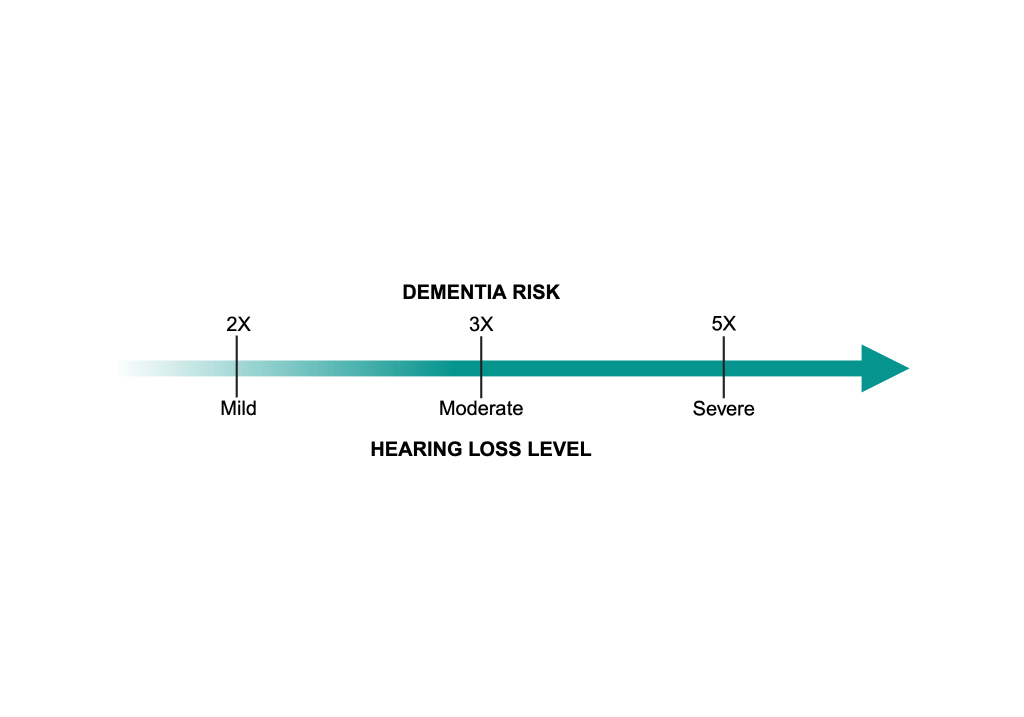
Surprisingly, one of the most prominent risk factors for developing dementia is hearing loss. Studies have found that adults who experience hearing loss later in life and become deaf or hard-of-hearing (D/HH) are at higher risk of developing dementia compared to adults who kept their hearing2–4. Additionally, those with more severe hearing loss were up to five times more likely to develop dementia5 (Figure 1). As it’s suggested that up to 9% of dementia cases can be attributed to hearing loss5, researchers want to understand what drives this relationship.
What connects hearing loss to dementia?
In early research, researchers proposed the auditory deprivation hypothesis to explain the link between hearing loss and dementia. This hypothesis suggests that reduced sound stimulation from hearing loss causes neurons (cells that enable brain function) to deteriorate, damaging the brain regions that aid cognition. Supporting this idea, one study found that adults who became D/HH later in life (late-deafened) had more brain shrinkage in the temporal lobe, which contains the auditory cortex, responsible for sound perception, and the hippocampus, a brain region critical for cognition and memory6. Additionally, when researchers caused hearing loss in adult mice, they found more neuron deterioration in the hippocampus compared to hearing mice7.
However, there is a caveat to this hypothesis: it’s unclear if auditory deprivation directly causes these brain changes or imposes its effect indirectly by impairing social interactions, a known protective factor against dementia3,5,8. Social interactions encompass positive contact with others and are primarily mediated through speech, but for D/HH people, increased difficulty in speech perception can cause withdrawal from social interactions9. Furthermore, multiple studies have linked hearing loss with social isolation in late-deafened adults10 and social isolation in hearing participants is similarly linked to shrinkage of the hippocampus11. Thus, separating the effects of hearing loss and social interaction on cognition may be beneficial to understanding how dementia develops.
Another hypothesis researchers have proposed is that hearing loss exhausts cognitive reserve by redistributing mental resources toward listening, at the expense of other cognitive tasks like memory. Cognitive reserve is the ability of the brain to cope with damage or age-related changes, such as dementia 5,12,13. Researchers suggest that because late-deafened people face increased difficulty in understanding speech, they must devote more mental resources toward this task, leaving fewer resources for other cognitive functions5,14,15.
In other words, think of the brain’s cognitive reserve like a battery: the more charge is used up for speech comprehension, the less there is available for everything else. Neuroimaging and behavioral studies support this, as late-deafened participants showed increased frontal lobe (a brain region that directs attention) activity during listening tasks16 and couldn’t remember spoken words as well as hearing participants17, indicating that effortful listening redirects cognitive resources.
Effortful listening has also been shown to increase activity in the hippocampus, and some researchers suspect that this excess activity may promote the development of Alzheimer’s Disease, the primary cause of dementia5. Interestingly, when researchers caused hearing loss in adult mice, they found increased levels of phosphorylated tau in the hippocampus7,18. Tau is a key protein implicated in Alzheimer’s Disease and when it’s phosphorylated (a type of protein modification), it misfolds and becomes toxic to neurons19. Additionally, these late-deafened mice had decreased cognitive performance as well, postulating a potential link to dementia symptoms7,18.
The missing community in hearing loss and dementia research
These fascinating theories have dominated the field of hearing loss and dementia research for years. However, as I reviewed the literature, I couldn’t help noticing that the studies focused primarily on late-deafened adults who became D/HH later in life. Where were the early-deafened people, who were born deaf or became deaf during childhood? Surprisingly, this gap in the research has only recently begun to receive attention in the United States20–22.
In the United States, many early-deafened people identify as culturally Deaf (with a capital D) which commonly signifies their social engagement in the D/HH community and usage of American Sign Language, which is distinct in grammar and syntax from English. In contrast, other early-deafened individuals see themselves as integrated with hearing society, predominantly using spoken language. Some may even identify as bilingual and bicultural23,24. However, data on dementia incidence in early-deafened individuals is incredibly sparse.
Researchers think that one of the main reasons for lack of data on early-deafened individuals with dementia stems from language barriers posed by the cognitive tests used for diagnosis – these tests rely on spoken English, and written forms do not guarantee accurate diagnosis25,26, particularly since early-deafened individuals experience diverse levels of language exposure27. Additionally, Deaf people are nearly seven times more likely than hearing people to have inadequate health literacy, which is the ability to obtain and understand health-related information28. This can result in misdiagnosis or delayed treatment20 in healthcare. However, if we could address these barriers and understand how dementia impacts early-deafened adults, could that help illuminate the link between hearing loss and dementia?
Maybe early-deafened people hold the answers scientists seek
As data on dementia incidence in early-deafened populations is scarce and the current literature is primarily limited to thematic and narrative reviews, I offer my own (mostly) speculative perspectives for how studying these communities could contribute new insights to the relationship between hearing loss and dementia.
First, in regard to the potentially confounding experiences of auditory input and social interactions on dementia risk, I suggest that studying individuals who identify as Deaf could help separate the effects of acoustic deprivation from social isolation on dementia risk. Studies show that early-deafened individuals who identify as Deaf report increased social interactions compared to early-deafened adults who did not29, but how they compare to late-deafened or hearing adults is less defined. Furthermore, unlikes studies reporting hippocampus shrinkage in late-deafened adults, one study reported that children deaf from birth did not show hippocampus shrinkage. Rather, there appeared to be a reorganization of neurons in the hippocampus instead of a loss30. Together, these findings may indicate that early-deafened adults may adapt differently to auditory deprivation, but whether this influences dementia risk is unknown.
Second, in regard to the cognitive reserve hypothesis and how effortful listening may exhaust cognitive reserve, I would suspect that Deaf individuals who primarily socialize in Deaf spaces do not have the same attentional demands on spoken language that late-deafened people do. But recent evidence surprisingly demonstrated for the first time that cognitive reserve in early- and late-deafened individuals did not seem to be dependent on whether they used ASL or spoken English23. Understanding what influences cognitive reserve in the early-deafened community would be of great interest to dementia research.
Third, I think that early-deafened people who primarily use spoken communication could experience similar “effortful listening” as late-deafened adults since they’d primarily operate within hearing spaces. Thus, it would be interesting to study if effortful listening in early-deafened mouse models also increases hippocampus activity and phosphorylated tau levels, or if the biological events are restricted to late-onset hearing loss.
Conclusion: It’s time to include more early-deafened people in dementia research
To recap, although there is some evidence that supports the current hypotheses between acquired hearing loss and dementia, it’s unknown how much applies to the broader D/HH community. The inclusion of early-deafened people in dementia research is more complicated than it sounds (pun intended), but research is beginning to address existing barriers; the lack of accurate and appropriate cognitive screening tests, reduced health literacy, and distrust among the D/HH community of healthcare researchers and professionals due to previous experiences of feeling unseen20. Ultimately, studying early-deafened people will inform a deeper understanding of how hearing loss and dementia intersect.
References
- Fang M, Hu J, Weiss J, et al. Lifetime risk and projected burden of dementia. Nat Med. 2025;31(3):772-776. doi:10.1038/s41591-024-03340-9
- Gallacher J, Ilubaera V, Ben-Shlomo Y, et al. Auditory threshold, phonologic demand, and incident dementia. Neurology. 2012;79(15):1583-1590. doi:10.1212/WNL.0b013e31826e263d
- Lin FR, Metter EJ, O’Brien RJ, Resnick SM, Zonderman AB, Ferrucci L. Hearing Loss and Incident Dementia. Arch Neurol. 2011;68(2):214-220. doi:10.1001/archneurol.2010.362
- Deal JA, Betz J, Yaffe K, et al. Hearing impairment and incident dementia and cognitive decline in older adults: The health ABC study. J Gerontol Ser A Biol Sci Med Sci. 2017;72(5):703-709. doi:10.1093/gerona/glw069
- Griffiths TD, Lad M, Kumar S, et al. How Can Hearing Loss Cause Dementia? Neuron. 2020;108(3):401-412. doi:10.1016/j.neuron.2020.08.003
- Armstrong NM, An Y, Doshi J, et al. Association of Midlife Hearing Impairment With Late-Life Temporal Lobe Volume Loss. JAMA Otolaryngol Head Neck Surg. 2019;145(9):794-802. doi:10.1001/jamaoto.2019.1610
- Shen Y, Hu H, Fan C, et al. Sensorineural hearing loss may lead to dementia-related pathological changes in hippocampal neurons. Neurobiology of Disease. 2021;156:105408. doi:10.1016/j.nbd.2021.105408
- Chen Y, Grodstein F, Capuano AW, Wang T, Bennett DA, James BD. Late-life social activity and subsequent risk of dementia and mild cognitive impairment. Alzheimer’s & Dementia. 2025;21(1):e14316. doi:10.1002/alz.14316
- Hughes SE, Hutchings HA, Rapport FL, McMahon CM, Boisvert I. Social Connectedness and Perceived Listening Effort in Adult Cochlear Implant Users: A Grounded Theory to Establish Content Validity for a New Patient-Reported Outcome Measure. Ear and Hearing. 2018;39(5):922. doi:10.1097/AUD.0000000000000553
- Shukla A, Harper M, Pedersen E, et al. Hearing Loss, Loneliness, and Social Isolation: A Systematic Review. Otolaryngol Head Neck Surg. 2020;162(5):622-633. doi:10.1177/0194599820910377
- Lammer L, Beyer F, Luppa M, et al. Impact of social isolation on grey matter structure and cognitive functions: A population-based longitudinal neuroimaging study. eLife. 12:e83660. doi:10.7554/eLife.83660
- Chern A, Golub JS. Age-related hearing loss and dementia. Alzheimer Dis Assoc Disord. 2019;33(3):285-290. doi:10.1097/WAD.0000000000000325
- Use it or lose it: How a lifetime of challenging our brains may slow the onset of dementia symptoms. PennNeuroKnow. June 23, 2026. Accessed June 27, 2026. https://pennneuroknow.com/2026/06/23/use-it-or-lose-it-how-a-lifetime-of-challenging-our-brains-may-slow-the-onset-of-dementia-symptoms/
- Boyle PA, Wilson RS, Schneider JA, Bienias JL, Bennett DA. Processing resources reduce the effect of Alzheimer pathology on other cognitive systems. Neurology. 2008;70(17):1534-1542. doi:10.1212/01.wnl.0000304345.14212.38
- Martini A, Castiglione A, Bovo R, Vallesi A, Gabelli C. Aging, Cognitive Load, Dementia and Hearing Loss. Audiology & Neuro-otology. 2015;19(1):2-5. doi:10.1159/000371593
- Rosemann S, Thiel CM. The effect of age-related hearing loss and listening effort on resting state connectivity. Sci Rep. 2019;9(1):2337. doi:10.1038/s41598-019-38816-z
- Tun PA, McCoy S, Wingfield A. Aging, Hearing Acuity, and the Attentional Costs of Effortful Listening. Psychol Aging. 2009;24(3):761-766. doi:10.1037/a0014802
- Park SY, Kim MJ, Kim HL, Kim DK, Yeo SW, Park SN. Cognitive decline and increased hippocampal p-tau expression in mice with hearing loss. Behav Brain Res. 2018;342:19-26. doi:10.1016/j.bbr.2018.01.003
- Rawat P, Sehar U, Bisht J, Selman A, Culberson J, Reddy PH. Phosphorylated Tau in Alzheimer’s Disease and Other Tauopathies. Int J Mol Sci. 2022;23(21):12841. doi:10.3390/ijms232112841
- Lattimer TA, Tenzek KE, Ophir Y. Alzheimer Disease and Related Dementias in the Deaf Community: A Scoping Review. Public Health Rep. Published online January 24, 2026:00333549251403899. doi:10.1177/00333549251403899
- Migliaccio MM, Benites NM, Rodrigues B, et al. Prolonged non-traumatic early auditory deprivation increases hearing thresholds, leads to memory deficits, and reduces doublecortin-positive neurons in mice. Neuroscience. 2026;604:50-63. doi:10.1016/j.neuroscience.2026.03.053
- Broome EE, Calvert S, Heffernan E, et al. Dementia and hearing loss: from risk to mechanisms and management. Front Dement. 5:1736003. doi:10.3389/frdem.2026.1736003
- Allaby OB. Cognitive Reserve in the Deaf/Hard of Hearing Community: An Exploration of Contributing Factors.
- Flower I, Heffernan E, Dening T. Dementia and the Deaf community: prevalence, assessment and management in people with hearing loss since childhood. Aging & Mental Health. 2025;29(5):757-766. doi:10.1080/13607863.2024.2430533
- Stockleben L, Woll B, Atkinson J. Screening for Acquired Cognitive Impairment and Dementia in Deaf Users of German Sign Language: The Cognition Test German Sign Language. Arch Clin Neuropsychol. 2026;41(2):acaf094. doi:10.1093/arclin/acaf094
- Dean PM, Feldman DM, Morere D, Morton D. Clinical Evaluation of the Mini-Mental State Exam with Culturally Deaf Senior Citizens. Arch Clin Neuropsychol. 2009;24(8):753-760. doi:10.1093/arclin/acp077
- Hrastinski I, Wilbur RB. Academic Achievement of Deaf and Hard-of-Hearing Students in an ASL/English Bilingual Program. J Deaf Stud Deaf Educ. 2016;21(2):156-170. doi:10.1093/deafed/env072
- McKee MM, Paasche-Orlow M, Winters PC, et al. Assessing Health Literacy in Deaf American Sign Language Users. J Health Commun. 2015;20(0 2):92-100. doi:10.1080/10810730.2015.1066468
- Radford A, Bignell S, Barker AB, Hamilton IS. Exploring sign language, social connectedness, and life satisfaction of deaf adults. Journal of Deaf Studies and Deaf Education. Published online January 21, 2026:enaf087. doi:10.1093/jdsade/enaf087
- Xu Q, Yao J, Xing C, et al. Structural and covariance network alterations of the hippocampus and amygdala in congenital hearing loss children. Neuroscience. 2024;562:182-189. doi:10.1016/j.neuroscience.2024.10.037
ChatGPT version 5.5 was used to help with finding initial sources and rewording some sentences.
Cover photo “Hands with ear” by soboone on Flickr.
Figure 1 made by Anna Kasper in BioRender.

