
July 14th, 2026
Written by Eve Gautreaux
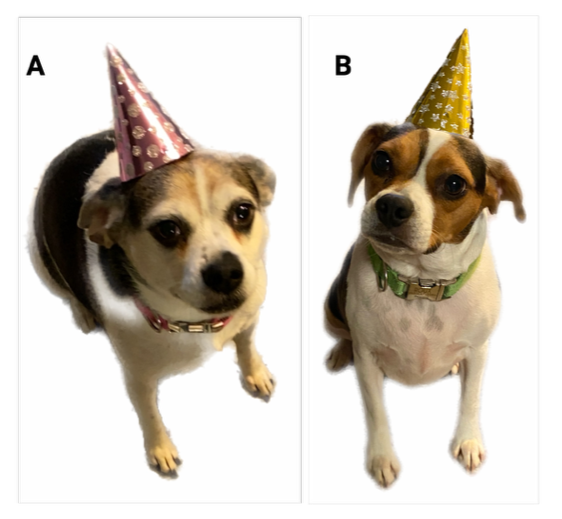
A few weeks ago, I was painstakingly balancing party hats on my puggle (pug and beagle) rescues, Peanut and Roux, to take yet another adorable photo to add to the collection of a million other adorable photos in my camera roll (Figure 1). I thought to myself: how is it possible that these dogs evolved the patience to tolerate my silly antics? This question continued to bounce around in my head for the following weeks as I drove by cows in pastures and was approached by fearless pigeons in the park. Many animals manage to coexist with—or in some cases even rely on—humans. How did this come to be?
On the origin of domestic species
Evolution is the process by which the traits of a species, ranging from physical traits such as tooth size or wingspan to behavioral traits such as mating rituals, change over time. This change in traits occurs through the process of natural selection: animals that fail to survive or reproduce do not pass on their traits to offspring while animals that thrive and survive longer are more likely to successfully reproduce and pass on their better-adapted traits, leading to an increase of those traits in the overall population of the species.
In order for an animal to survive, it must have traits that are especially advantageous within its environment. Thus, the environment drives which traits are naturally selected within a species. For example, tigers originally had spots, but the portion with vertically elongated spots camouflaged better in tall grass, leading to better survival and selection over time that eventually became the famous tiger stripes we see today.
The environment not only includes factors such as foliage, temperature, or disease, but also fellow inhabitants. Roughly 12,000 years ago there was a significant change in the environment: humans. More specifically, permanent humans1. Prior to this change, humans were nomadic, meaning they continuously moved rather than permanently settling in one location. It is around when humans formed permanent settlements that we see major shifts in the evolution of many species in physical forms and, perhaps most strikingly, in the form of behavior.
Some species, such as wolves, horses, and cattle, evolved traits suitable to captivity and coexistence with humans called domesticated behaviors1. The key shift in behavior shared across domesticated species is the tolerance, and in some cases fearlessness, of humans. But what is the neurobiology behind the evolution of domestication?
The biology that created man’s best friend
Traits are passed on to offspring through genes which are strings of DNA that essentially act as instructions for the design and function of an organism, thus giving rise to its traits. Each gene can vary either in presence, number of copies, or the version of the gene, altogether leading to different traits or versions of traits. For example, version “1” of gene “A” leads to brown fur while version “2” of gene “A” leads to black fur. This variability in genes lends to the variability of individuals within a species as well as the distinction between species. Therefore, if we want to understand more about how a species evolved certain traits, we can begin by looking at its genes.
Many species have evolved domestic traits, but the most extreme and well-known example is that of the modern-day dog1. The closest relative of the domestic dog is the wolf, both of which evolved from a common ancestor, an ancient wolf if you will2. The diverging evolution of dogs and wolves resulted in dogs displaying less fear or avoidance of humans, less aggression, and the ability to both communicate and bond with humans2. Scientists theorize that at the start of this divergence, some ancient wolves that were less fearful of humans began approaching human villages, likely drawn by their food waste and the opportunity for shelter during harsh conditions. These benefits ultimately led to these wolves’ improved survival and the natural selection for the “less fearful” trait over time. Three key biological processes have been proposed to be responsible for underlying such traits of domestication, each process being controlled by one or more genes that have been found to differ between modern dogs and their ancestors.
Cortisol
The first biological process proposed to underly the “less fearful” behavior is cortisol, the hormone responsible for the body’s response to stress. Specifically, scientists have hypothesized that less cortisol and a dampened stress response could have allowed ancient wolves to tolerate human interaction. One research study compared the behavior and genetics of two groups of dogs that are more versus less closely related to wolves. The researchers found that these modern breeds that are more distantly related to wolves looked at humans more while performing a difficult task, a behavior that is interpreted as communication with humans, specifically a request for assistance. Importantly, the modern dogs’ ability to communicate with humans was accompanied by differences in two genes that control the production of cortisol, suggesting that the biological basis of the more domesticated behavior is in part related to altered cortisol production2.
While there have been mixed findings in research directly comparing the levels of cortisol in dogs and wolves—some studies finding less cortisol in dogs with others finding no difference or an elevation—a separate study measured cortisol levels in a close, non-domestic relative of dogs and wolves: the silver fox. This extensive study set out to replicate evolved domestication in dogs by selectively breeding foxes with low aggression and low fear of humans over the span of 40 years. Within three generations, the foxes displayed not only lower aggression and less fearful avoidance of humans, but some even exhibited dog-like behaviors such as tail wagging. By the sixth generation, some actively sought out human contact3! Importantly, as foxes became tamer their cortisol levels significantly decreased, providing support for the idea that a lower stress response is involved in domestication.
Brain development and sociability
The third key neurobiological factor implicated in domestication is a gene known as GALNT17 that regulates both brain development and behavior, especially social behavior. In humans, deletion of this gene is linked to Williams-Beuren syndrome, a condition characterized by extreme friendliness and lack of social fear. One common symptom of this syndrome is being especially trusting of strangers, so it makes sense that this gene is altered in dogs given that the hallmark distinction from wolves is less fear of humans4. Specifically, extra elements of DNA are inserted near the GALNT17 gene in dogs which affect the function of the gene. Importantly, these changes are specific to dogs and highly common regardless of breed, suggesting that GALNT17 was an early and key piece in the evolution of the domestic dog.
Oxytocin
While cortisol and genes controlling sociability such as GALNT17 may explain the biology behind the selection for the “less fearful” trait in wolves, the third key neurobiological factor is proposed to have aided in the evolution from tolerant cohabitant to beloved companion. This neurobiological factor is oxytocin, a hormone responsible for bonding in mammals, both between mother and young as well as between mates. The same study that found a variation in genes controlling cortisol in modern dogs also found variations in the genes that control both the production and function of oxytocin2. Interestingly, dogs are not the only species that evolved this change during domestication. The silver foxes that were bred for low aggression and fear had more oxytocin receptors, the proteins that bind and carry out the hormone’s function, suggesting more oxytocin is linked to greater tameness3.
Typically, oxytocin has been associated with social bonds formed within the same species. However, research has shown that it also plays a role in bonding between different species, such as dogs and humans. Humans have higher levels of oxytocin when dogs, but not wolves, look at them. Moreover, the dogs belonging to humans with higher oxytocin during interactions also have higher oxytocin2. Maybe this is just a coincidence or correlation, right?
Researchers took experiments a step further by nasally administering oxytocin to dogs which allows the hormone to easily enter the brain. They found that dosing dogs with oxytocin increased behavior associated with communication and bonding to humans, such as seeking contact with them or gazing at them while struggling with a task. The evidence doesn’t end there—this increase in gazing from dogs with extra oxytocin consequently led to increases of oxytocin in the humans they gazed at2! Together, these findings demonstrate a cause-effect relationship between oxytocin and the connection between modern dogs and humans that we cherish today. I’d like to think Peanut and Roux were flooded with oxytocin while I admired them in their party hats.
So, processes such as decreased stress response, increased sociability, and stronger social bonding may explain the biological “how” of domestication of dogs from wolves. But what about the cow I drove by or the pigeon on my bench?
What about other domestic species?
Dogs are the most striking and well-researched example of domestication, but other species have experienced domestication too, including livestock—such as cattle and sheep—or even pigeons. However, the pressures driving which traits are selected differ slightly between the ancestors of dogs and these animals.
Wolves are believed to have been the original drivers of their domestication as they initiated coexistence with humans due to the benefits of food waste or shelter. Meanwhile, the ancestors of cattle or sheep did not initiate domestication, but rather humans likely began with managing the animals’ populations to avoid running out of prey, which developed into captivity resembling the use of livestock today1. Likewise, pigeons have been deliberately bred by humans for thousands of years, originally as food sources, then as messengers, followed by aesthetic breeding as “fancy” pets for the elite, and finally abandoned due to propaganda falsely accusing them of carrying disease, resulting in the leftover modern day pigeons that wander our city parks5.
These different pathways to domestication likely result in similar, but not identical selection of traits. For example, lower aggression is a trait that would increase chances of survival or reproduction in both pathways. Therefore, it is likely that some neurobiological processes are shared between the evolution of dogs and livestock into similarly gentle creatures. However, research is needed to truly confirm these similarities.
A best friend and a good neighbor
Just like any other species, humans are a part of the environment. Perhaps unlike any other species, we’ve learned just how much humans impact the environment and therefore other animals through the process of natural selection. While our impact has gifted our planet with loveable creatures like dogs, it’s important to consider how such a significant influence on the environment can go wrong when that influence is harmful—stay tuned for a future post exploring how non-domestic species evolve to survive in a rapidly expanding manmade world. After all, we aren’t alone in our environment, so let’s be a best friend to our domesticated animals and a good neighbor to all the rest.
References
- Teletchea, F. Animal Domestication: A Brief Overview. in Animal Domestication (ed. Teletchea, F.) (IntechOpen, 2019).
- Tonoike, A. et al. Identification of genes associated with human-canine communication in canine evolution. Sci. Rep. 12, 6950 (2022).
- Trut, L., Oskina, I. & Kharlamova, A. Animal evolution during domestication: the domesticated fox as a model. Bioessays 31, 349–360 (2009).
- vonHoldt, B. M. et al. Structural variants in genes associated with human Williams-Beuren syndrome underlie stereotypical hypersociability in domestic dogs. Sci. Adv. 3, e1700398 (2017).
- Brookshire, B. Pests How Humans Create Animal Villains. (HarperCollins, London, England, 2022).
- Seto, K. C., Fragkias, M., Güneralp, B. & Reilly, M. K. A meta-analysis of global urban land expansion. PLoS One 6, e23777 (2011).
- Breck, S. W., Poessel, S. A., Mahoney, P. & Young, J. K. The intrepid urban coyote: a comparison of bold and exploratory behavior in coyotes from urban and rural environments. Sci. Rep. 9, 2104 (2019).
- Tryjanowski, P. et al. Urbanization affects neophilia and risk-taking at bird-feeders. Sci. Rep. 6, 28575 (2016).
- Huang, P., St.Mary, C. M. & Kimball, R. T. Habitat urbanization and stress response are primary predictors of personality variation in northern cardinals (Cardinalis cardinalis). J. Urban Ecol. 6, juaa015 (2020).
No LLMs or AI assistance were used in the creation of this post.
Cover photo by The Humantra from Burst.
Figure 1 made by Eve Gautreaux in BioRender.

