

June 2nd, 2026
Written by Stephanie Uroda
“Eating an apple a day keeps the doctor away!” Many of us have heard this phrase since we were children, encouraging us to make healthy food choices. We are often told that eating the right food groups and exercising daily will allow us to live a long, healthy life. But what if I told you that simply checking off every category of the food pyramid each day is not enough to lessen your chances of developing disease later in life? For example, a common source of protein for many people is meat; however, several public health studies have found that people who eat more meat, mainly red and processed meats, tend to have an increased risk of disease, including various types of cancer, cardiovascular diseases, diabetes, and neurodegenerative diseases.1–3
In this article, I will delve deeper into a unique case: Parkinson’s disease, a progressive disorder of the nervous system. Unlike many other diseases linked to meat consumption, where the risk is most strongly associated with red and processed meats, studies of Parkinson’s disease have reported associations with both red and white meat consumption and disease risk.4 This surprising finding has led scientists to investigate whether Parkinson’s disease may have a unique relationship with the foods we eat.
What is Parkinson’s disease?
Parkinson’s disease is a neurological disorder that affects aging individuals all over the world, including more than 1.1 million people in the United States alone.5 It is most notable for its movement-related symptoms, as well as sleep disorders and loss of smell. One hallmark of Parkinson’s disease is that the cells in affected areas of the brain contain large clumps of a protein called alpha synuclein.6 While proteins play an important role in keeping your brain cells healthy and alive, they cannot perform their normal jobs when they clump together. Over time, these protein clumps can damage brain cells and eventually cause them to die.
While scientists know that alpha synuclein clumping is closely linked to the development of Parkinson’s disease, one of the biggest unanswered questions in the field is what causes this normally harmless protein to begin clumping together in the first place. To answer that question, researchers have started looking beyond the brain and toward an unexpected location: the gut.
Alpha synuclein: from gut to brain
Scientists and doctors have spent years trying to understand what causes alpha synuclein to clump together in Parkinson’s disease. An important clue comes from the fact that most patients with Parkinson’s disease do not have a family history of the disease. This suggests that elements people are exposed to during their lives, called environmental factors, may play a major role in triggering Parkinson’s disease. One environmental factor receiving growing attention is diet and gut health.
We know that healthy levels of alpha synuclein are naturally found in the nerves that control the gut and that patients with late-stage Parkinson’s disease have clumped alpha synuclein in their guts.7,8 This suggests that, at some point in the progression of the disease, healthy alpha synuclein may convert into a clumped form. In the early 2000s, scientists came across the striking discovery that clumped alpha synuclein was present in the guts of individuals who had no symptoms of Parkinson’s disease at the time but later went on to develop the disease.9,10 This surprising finding left scientists with a key question: if the clumped alpha synuclein starts in the gut, how does it travel to the brain and lead to symptoms of Parkinson’s disease?
Almost a decade later, scientists conducted a series of public health studies that revealed clumped alpha synuclein may travel from the gut to the brain through a major communication highway called the vagus nerve (Figure 1). In these studies, individuals who had surgeries to remove the vagus nerve for unrelated medical reasons appeared to have a lower risk of developing Parkinson’s disease later in life.11,12 This observation suggests that the vagus nerve must serve as a key route for clumped alpha synuclein to spread from the gut to the brain.
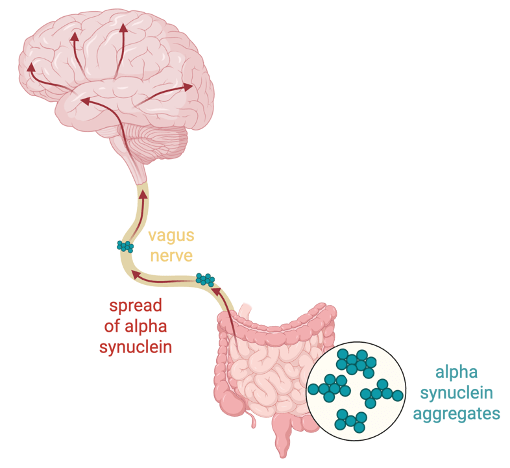
To test the theory that clumped alpha synuclein travels to the brain via the vagus nerve, scientists performed experiments in rodents. In one study, researchers gave rats a chemical that caused healthy alpha synuclein to clump together in the gut. Eventually, these protein clumps also appeared in the brain, which supports theories that clumped alpha synuclein may start in the gut and travel to the brain. Interestingly, when the vagus nerve was cut, the spread of clumped alpha synuclein to the brain no longer occurred because its road to the brain was no longer intact.13 Similar to the public health studies discussed above, this study showed that the vagus nerve is required for clumped alpha synuclein to travel from the gut to the brain. But this discovery raised an even bigger question: what causes alpha synuclein to start clumping in the gut in the first place?
Infection of the gut with synuclein
So far, we have seen that Parkinson’s disease may begin when alpha synuclein forms harmful clumps in the gut and travels to the brain. But what does this have to do with the meat we eat? One clue comes from the fact that most cases of Parkinson’s disease are not inherited and are instead linked to environmental factors. Because food is one of the most common environmental exposures we experience every day, some scientists have begun investigating whether certain dietary habits could contribute to the disease, specifically meat consumption.
When we eat meat, we are not only consuming protein as a nutrient, but we are also consuming the particular proteins that were present in that animal. Many common sources of dietary protein, like cows, pigs, chickens, and fish, produce alpha synuclein just like humans.14 As a result, every bite of meat contains small amounts of animal alpha synuclein. Crucially, alpha synuclein found in animals closely resembles the disease variant of alpha synuclein that is more prone to clumping together.15,16 This means that animal alpha synuclein is also very prone to clumping together.17 Taken together, research suggests that the path to Parkinson’s disease may begin long before symptoms appear. Ingesting animal-derived alpha synuclein through meat consumption may contribute to the formation of protein clumps in the gut, which might then travel to the brain and play a role in Parkinson’s disease.
Can I still eat meat?
So, if you eat meat, will you get Parkinson’s disease? The short answer is no. Parkinson’s disease is complex and develops from a combination of factors rather than a single cause. Many people consume meat regularly, but only a small fraction develop the disease. This strongly suggests that additional factors, such as genetics, aging, gut health, and environmental exposures, play important roles in determining whether alpha synuclein clumps together and how it may spread throughout the body. Many of these factors are thought to affect the integrity of the gut barrier, sometimes described as making the gut “leakier” than normal. In this state, the proteins in our gut, including alpha synuclein, have an increased chance of getting into the vagus nerve and traveling to the brain.4 As scientists continue to unravel the connection between the gut and the brain in Parkinson’s disease, they hope to identify environmental factors that could be targeted to prevent or slow the disease. In the meantime, maintaining healthy habits such as regular exercise and a balanced diet remains one of the best ways to support overall gut and brain health while researchers work toward new prevention strategies.
References
- Chen K qian, Cao W jin, Liu Z, Liu R zhu. Mini-review: Processed red meat intake and risk of neurodegenerative diseases. Front Nutr. 2025;12:1663647. doi:10.3389/fnut.2025.1663647
- Giromini C, Givens DI. Benefits and Risks Associated with Meat Consumption during Key Life Processes and in Relation to the Risk of Chronic Diseases. Foods. 2022;11(14):2063. doi:10.3390/foods11142063
- Pan A, Sun Q, Bernstein AM, et al. Red Meat Consumption and Mortality: Results from Two Prospective Cohort Studies. Arch Intern Med. 2012;172(7):555-563. doi:10.1001/archinternmed.2011.2287
- Killinger BA, Labrie V. Vertebrate food products as a potential source of prion-like α-synuclein. NPJ Park Dis. 2017;3:33. doi:10.1038/s41531-017-0035-z
- Statistics | Parkinson’s Foundation. Accessed May 26, 2026. https://www.parkinson.org/understanding-parkinsons/statistics
- Poewe W, Seppi K, Tanner CM, et al. Parkinson disease. Nat Rev Dis Primer. 2017;3(1):17013. doi:10.1038/nrdp.2017.13
- Chandra R, Hiniker A, Kuo YM, Nussbaum RL, Liddle RA. α-Synuclein in gut endocrine cells and its implications for Parkinson’s disease. JCI Insight. 2(12):e92295. doi:10.1172/jci.insight.92295
- Gelpi E, Navarro-Otano J, Tolosa E, et al. Multiple organ involvement by alpha‐synuclein pathology in Lewy body disorders. doi:10.1002/mds.25776
- Braak H, Rüb U, Gai WP, Del Tredici K. Idiopathic Parkinson’s disease: possible routes by which vulnerable neuronal types may be subject to neuroinvasion by an unknown pathogen. J Neural Transm. 2003;110(5):517-536. doi:10.1007/s00702-002-0808-2
- Navarro-Otano J, Gelpi E, Mestres CA, et al. Alpha-synuclein aggregates in epicardial fat tissue in living subjects without parkinsonism. Parkinsonism Relat Disord. 2013;19(1):27-31. doi:10.1016/j.parkreldis.2012.07.005
- Liu B, Fang F, Pedersen NL, et al. Vagotomy and Parkinson disease. Neurology. 2017;88(21):1996-2002. doi:10.1212/WNL.0000000000003961
- Svensson E, Horváth-Puhó E, Thomsen RW, et al. Vagotomy and subsequent risk of Parkinson’s disease. Ann Neurol. 2015;78(4):522-529. doi:10.1002/ana.24448
- Pan-Montojo F, Anichtchik O, Dening Y, et al. Progression of Parkinson’s Disease Pathology Is Reproduced by Intragastric Administration of Rotenone in Mice. PLOS ONE. 2010;5(1):e8762. doi:10.1371/journal.pone.0008762
- Yuan J, Zhao Y. Evolutionary aspects of the synuclein super-family and sub-families based on large-scale phylogenetic and group-discrimination analysis. Biochem Biophys Res Commun. 2013;441(2):308-317. doi:10.1016/j.bbrc.2013.09.132
- Narhi L, Wood SJ, Steavenson S, et al. Both Familial Parkinson’s Disease Mutations Accelerate α-Synuclein Aggregation *. J Biol Chem. 1999;274(14):9843-9846. doi:10.1074/jbc.274.14.9843
- Rochet JC, Conway KA, Lansbury PT. Inhibition of Fibrillization and Accumulation of Prefibrillar Oligomers in Mixtures of Human and Mouse α-Synuclein. Biochemistry. 2000;39(35):10619-10626. doi:10.1021/bi001315u
- Luk KC, Covell DJ, Kehm VM, et al. Molecular and Biological Compatibility with Host Alpha-Synuclein Influences Fibril Pathogenicity. Cell Rep. 2016;16(12):3373-3387. doi:10.1016/j.celrep.2016.08.053
ChatGPT version 3.5 was used to help with rewording some sentences.
Cover image by Daniel via unsplash.com
Figure 1 made by Stephanie Uroda in BioRender

