

July 27th, 2026
Written by Hayley Lenhard
Picture this: you’re sitting in the front row of your favorite class, listening to a fascinating lecture. You’re paying close attention and taking detailed notes— a model student. But then your friend next to you lets out a big yawn. Even though you’ve had three cups of coffee and aren’t feeling tired in the slightest, suddenly you can’t help but yawn too! Naturally, it’s at that exact moment that your professor decides to make eye contact with you. If you, like me, have ever experienced something like this, you may wish to know why your own yawn reflex would betray you like that. In this article we will explore this common experience of “contagious” yawning and consider a theory for how the brain might be involved.
Why do we yawn anyway? You probably assume that a yawn is a sign that you didn’t get enough sleep last night or that it’s almost time for bed, and though you wouldn’t necessarily be wrong, yawning is actually thought to occur for a variety of reasons. For example, scientists believe that yawning may facilitate “state changes”, such as transitioning between sleeping and waking or boredom and attentiveness.1 It is thought that yawning may assist in these transitions by increasing your heart rate, blood circulation, and the flow of cerebrospinal fluid, a liquid that flows through your brain and acts as a sort of cushion while delivering nutrients and removing debris. This may explain why you yawn a lot in the morning— it’s your body’s way of trying to wake your brain up! Another purpose of yawning is thought to be thermoregulation, or in other words, keeping your brain at the right temperature.1 Scientists have observed that yawns can be triggered by a rise in brain temperature, and that by increasing the flow of cerebrospinal fluid through the brain and promoting air flow through the sinuses, yawning can help cool your brain down and bring that temperature back to normal.
But if yawning typically occurs to promote these state changes or keep your brain cool, why would simply seeing someone yawn make you yawn? Contagious yawning, or yawning that is triggered by seeing someone else yawn, isn’t just an urban legend or an excuse I used to justify my ill-timed yawn in class— research has shown that yawns actually can be contagious! One such study found that people were more than twice as likely to yawn while watching a video of someone yawning than while watching a video of someone smiling.2 Contagious yawning has even been shown to occur in many animal species such as chimpanzees, orangutans, rats, wolves, pigs, lions, some species of birds, and even elephants.3 Clearly it is possible to “catch” a yawn— but how? Some scientists hypothesize that a group of neurons in your brain, called mirror neurons, might be the culprits behind this phenomenon.
What are mirror neurons?
Mirror neurons are a type of brain cell that are active not only when you feel an emotion or perform an action yourself, but also when you watch someone else feel that emotion or perform that action. These special neurons have been found to exist in a few different brain regions and are aptly named for their ability to “mirror” the activity that is occurring in someone else’s brain. Mirror neurons were first discovered in 1992 in the context of movement. Researchers compared the brain activity of monkeys while they grasped an object with the brain activity of monkeys that watched a scientist grasp an object and found that some of the same neurons were active.4 You can think of it like this— it’s possible that some of the same neurons that are active when you perform an action, such as swinging a baseball bat, are also active when you’re watching a Phillies game and see Kyle Schwarber swing the bat (Figure 1).
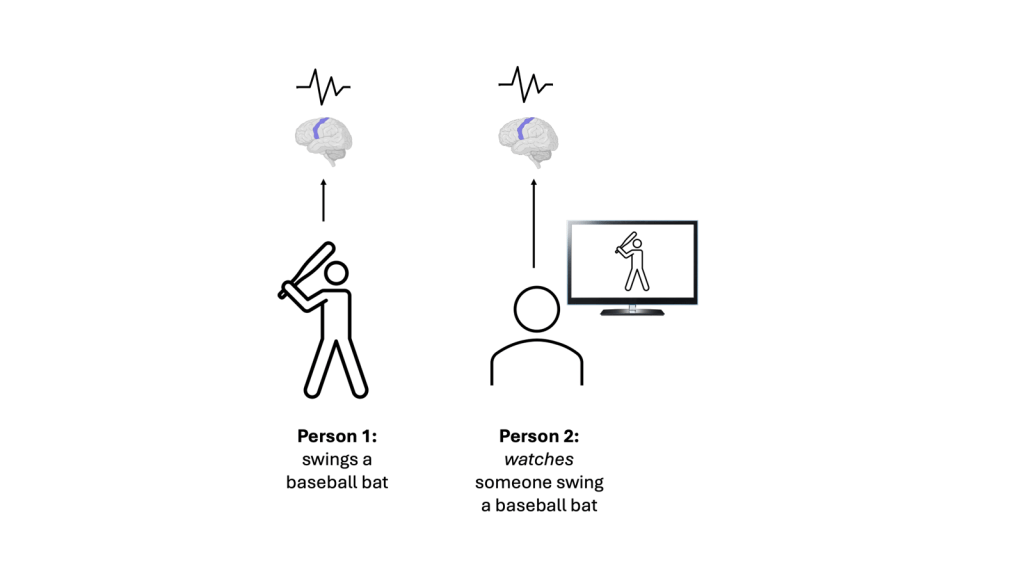
Another function that mirror neurons are thought to be involved in is empathy, the ability to understand how another person feels— often by experiencing similar emotions as them.5,6 In other words, empathy is the ability to put yourself in someone else’s shoes (or brain in this case). When you watch a movie like The Notebook and you feel sad for Noah when *SPOILER ALERT* Allie loses her memories of their relationship, you’re experiencing empathy! Even though you aren’t going through that experience yourself, you understand that it must be heartbreaking for Noah, and watching someone else go through it makes you sad. Similar to how mirror neurons are thought to function in motor activity, it’s possible that some of the same neurons that are active when you feel an emotion yourself are also active when you witness someone else experience that emotion.
Are mirror neurons involved in contagious yawning?
Now you might be thinking that’s all very interesting but how does this relate to yawning? Well, some scientists have hypothesized that mirror neurons could explain the pesky phenomenon of contagious yawning. One study tracked blood flow through the brain of people while they watched a video of someone else yawning, and found that more blood was flowing to brain regions that have been found to contain mirror neurons, such as the inferior frontal gyrus, indicating that those regions were active (Figure 2).7 Similarly, another study compared the brain activity of people watching a video of someone yawning with the brain activity of people watching a video of someone making a neutral expression (not yawning). They found that people watching the video of someone yawning exhibited brain waves at a frequency associated with mirror neuron activity, more so than people watching the video of someone making a neutral expression.8 Interestingly, they found that this effect was even more prevalent among participants who scored higher on an empathy test, suggesting a link between empathy, yawning and mirror neurons!
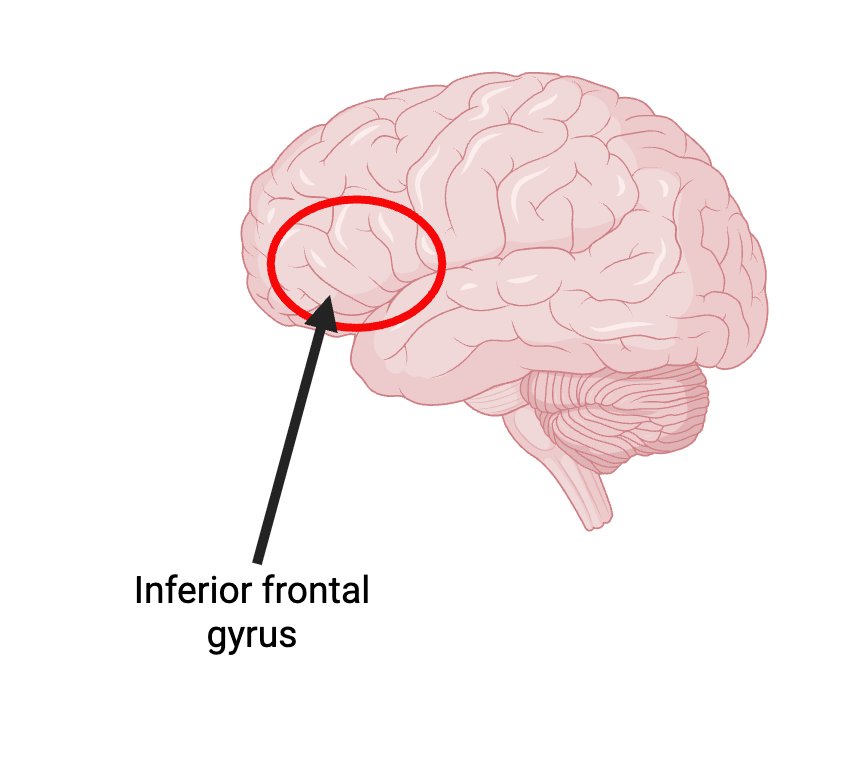
But don’t go blaming your mirror neurons just yet! Though the results from these studies would suggest that mirror neurons are the primary suspect behind contagious yawning, other studies have found conflicting evidence— so the role of the mirror neuron system in contagious yawning remains debated. For example, one study tracked blood flow through the brain, a proxy for brain activity, while subjects watched videos of people yawning, laughing, or making a neutral expression. They found that subjects who viewed the video of someone yawning had higher brain activity in regions associated with empathy compared to subjects who viewed the video of someone laughing. However, they saw no activation in brain regions that are known to contain mirror neurons such as the inferior frontal gyrus. This means it is possible that empathy, but not mirror neurons, may play a role in contagious yawning.9 A similar study also found that when subjects viewed another person yawning there was no increase in brain activity in core brain regions associated with the mirror neuron system.10
We’ve all experienced “catching” a yawn from someone. But why does this happen? Is it due to mirrored neurological activity? Do you empathize with that person and yawn because you are vicariously experiencing their tiredness? Or are you just plain tired yourself? Mirror neurons are one promising explanation for why yawns can be contagious, but scientists are still working to fully understand the biology behind “catching” a yawn.
References
- Gallup, A. C. The causes and consequences of yawning in animal groups. Anim. Behav. 187, 209–219 (2022).
- Provine, R. R. Yawning as a Stereotyped Action Pattern and Releasing Stimulus. Ethology 72, 109–122 (1986).
- Gallup, A. C. & Wozny, S. Interspecific Contagious Yawning in Humans. Anim. Open Access J. MDPI 12, 1908 (2022).
- di Pellegrino, G., Fadiga, L., Fogassi, L., Gallese, V. & Rizzolatti, G. Understanding motor events: a neurophysiological study. Exp. Brain Res. 91, 176–180 (1992).
- Schulte-Rüther, M., Markowitsch, H. J., Fink, G. R. & Piefke, M. Mirror neuron and theory of mind mechanisms involved in face-to-face interactions: a functional magnetic resonance imaging approach to empathy. J. Cogn. Neurosci. 19, 1354–1372 (2007).
- Pfeifer, J. H., Iacoboni, M., Mazziotta, J. C. & Dapretto, M. Mirroring others’ emotions relates to empathy and interpersonal competence in children. NeuroImage 39, 10.1016/j.neuroimage.2007.10.032 (2008).
- Haker, H., Kawohl, W., Herwig, U. & Rössler, W. Mirror neuron activity during contagious yawning—an fMRI study. Brain Imaging Behav. 7, 28–34 (2013).
- Cooper, N. R. et al. Bridging a yawning chasm: EEG investigations into the debate concerning the role of the human mirror neuron system in contagious yawning. Cogn. Affect. Behav. Neurosci. 12, 393–405 (2012).
- Platek, S. M., Mohamed, F. B. & Gallup, G. G. Contagious yawning and the brain. Cogn. Brain Res. 23, 448–452 (2005).
- Schürmann, M. et al. Yearning to yawn: the neural basis of contagious yawning. NeuroImage 24, 1260–1264 (2005).
No AI was used to create this post.
Cover photo by sammywilliams from Unsplash.
Figure 1 created by Hayley Lenhard with PowerPoint.
Figure 2 created by Hayley Lenhard using Biorender

