
September 9th, 2025
Written by: Jafar Bhatti
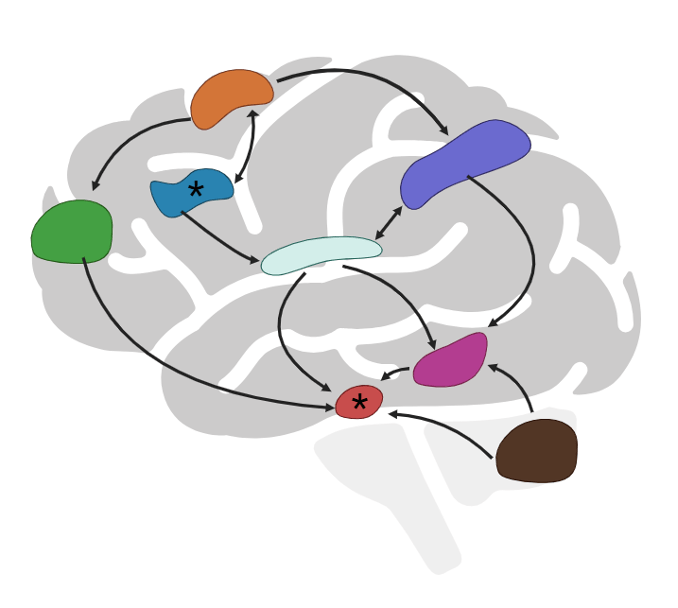
As we move through our environment, we experience a miraculously steady stream of visual information – as if our eyes were steady video cameras recording the scenes around us. However, unlike a video camera, when taking in a visual scene our eyes perform rapid, directed eye movements called saccades1. Most of the time, saccades are unconscious, but just like breathing or blinking, we can very quickly become aware and in control of these saccades (Video 1). While saccades may seem simple, it takes several different brain areas to control them (Figure 1), many of which are known to be involved in cognition and some of which are also implicated in disease. This makes studying eye movements an unexpectedly powerful tool for understanding things like cognition, differences between individuals, and disease, all of which we will dive into in today’s post.
Eye Movements and Cognition
As previously mentioned, many parts of the brain are involved in generating saccades (Figure 1) and, interestingly, there is a large overlap between the areas involved in making eye movements and the areas involved in cognition. Two examples of these brain areas are starred Figure 1, the frontal eye field in blue and the superior colliculus in red. Both these areas are known to be involved in the generation of saccades. We know this because when we artificially activate these brain areas, we can generate saccades. At the same time, neurons in frontal eye field and superior colliculus have activity patterns that reflect a decision-making process2,3. These experiments suggest an intimate relationship between cognitive processes and saccades. Given that eye movements can be seen as a widow into cognition, and that the areas involved in generating eye movements are broadly dispersed, scientists have begun to investigate how eye movements may differ across individuals.
Individual Differences in Eye Movements
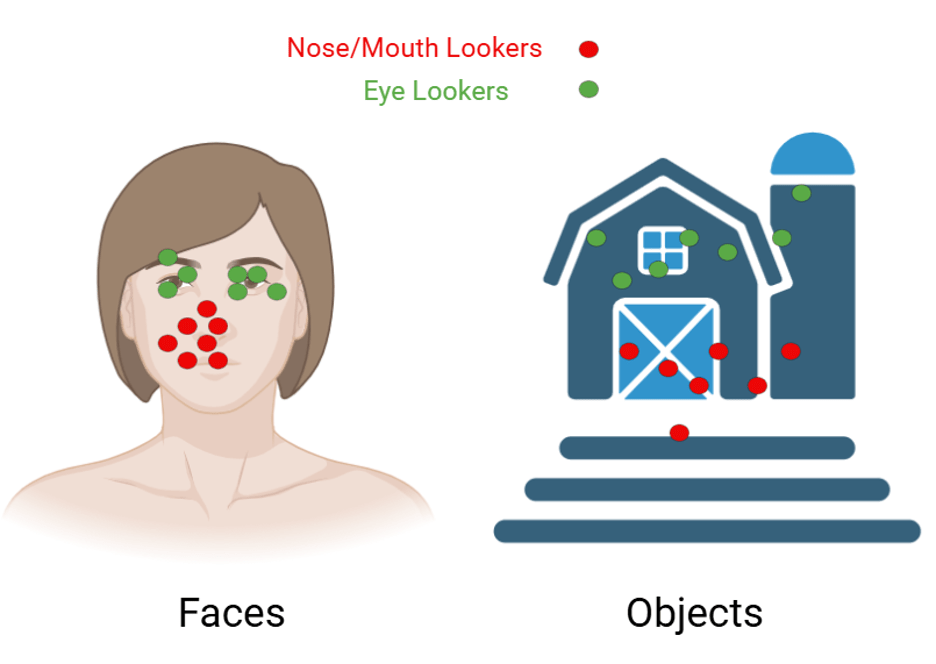
As we look around the world, our eyes are naturally drawn towards looking at faces. That’s because our brains are wired to recognize and process faces quickly. Interestingly, there are differences in what parts of the face people unconsciously focus on. Scientists can measure which features people focus on by measuring how long their gaze holds after making a saccade. This is called a fixation and typically lasts around a quarter of a second. When looking at a face, some people tend to fixate on the eyes whereas others tend to fixate on the mouth and nose4. Scientists believe these fixations can help an individual quickly recognize a person’s identity, emotional state, or gender5. A recent study wanted to see if these differences in eye movements (fixating on eyes vs. nose/lips) extended beyond just looking at faces6. To do this, the scientists asked 405 individuals to examine scenes with both faces and objects and analyzed over 1.8 million of their fixations. They showed once again that some individuals preferred to look at eyes whereas others preferred to look at mouths and noses. More interestingly, they found that the individuals who preferred looking at eyes also tended to fixate higher up on objects and vice versa for individuals who tended to look at mouths and noses (i.e., they tended to fixate lower on objects). Their findings suggest that these individual differences in saccade target and fixations seem to generalize beyond just faces (Figure 2).
Differences in eye movements can also be appreciated when comparing the gaze of young children to adults. Amazingly, adults with normal vision can efficiently recognize scenes and understand what is happening in about 200ms, and in some cases, as little as 8ms7. One reason for this is because adults tend to look at an image broadly, making sweeping eye movements from one end to the other. Children, on the other hand, tend to focus on one part of the scene, resulting in small saccades and longer fixations8. Also, the gaze of young children tends to be focused on parts of the scene that stand out, like objects that have bright colors or fun shapes. As we get older, and our visual system becomes better trained, we become less focused on these attention-grabbing features and more focused on understanding the meaning of the scene. This means that as we get older, our eye movements become less directed towards randomly bright, protruding features of the scene (as it might for young children), and more directed towards the most informative regions of the scene – even after only a quick glance.
You might be wondering at this point: Why is there so much variability in eye movements? Studies have shown that our eye movements are heavily influenced by our genetic backgrounds. The strongest evidence for this comes from studies on identical twins who have the same DNA but different lived experiences (click the hyperlink to see a video of twins for yourself!). These studies have shown that twins have remarkably similar eye movement patterns, particularly when it comes to gaze preference for faces versus objects9, suggesting that these movement patterns are due to genes rather than environment. More recent work studying the eye-movements of identical and non-identical twins has extended these findings to show that even specific features of eye movements, such as the duration of fixations and number of saccades to objects in motion, are strongly influenced by our genetics regardless of whether the scenes contain faces or not10.
Eye Movements and Health
Not only are there interesting differences in eye movements between healthy individuals, but differences in patterns of eye movements can also help doctors to detect and diagnosis some diseases. One prominent example is how eye movements (particularly the preference for faces versus objects) have been extensively studied within the context of autism spectrum disorder, which is a social neurodevelopmental disorder that is largely driven by genetics. A prevailing view is that autistic people, who are known to look at faces less often than neurotypical people, avoid looking at social stimuli because they have low social motivation. However, a recent study examining eye movements in autistic people proposes an alternative view in which individuals with autism are instead affected by eye-movement problems (i.e., smaller/briefer saccades) which interfere with their ability to shift attention fluidly to social stimuli11. This result challenges the traditional view of autism that autistic people avoid eye-contact due to lower social drives and instead paves the way for more in-depth studies of eye-movements. Future studies of autism and eye movements will hopefully build off this work to develop a more complete understanding of this disorder.
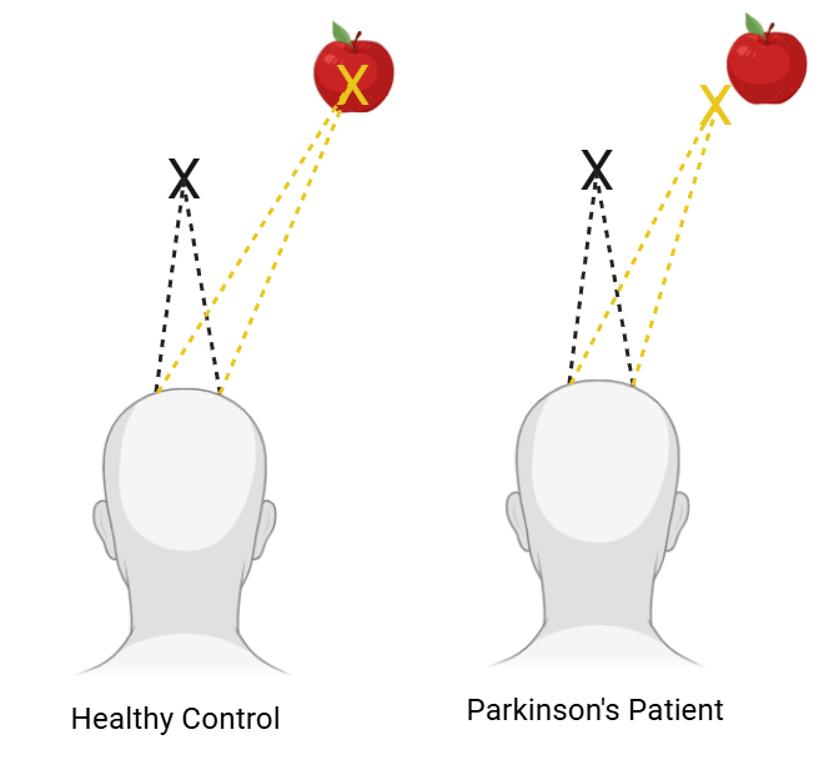
Abnormal eye movements also occur with numerous diseases. One example is Parkinson’s Disease, a neurodegenerative disease that affects motor control. Patients with Parkinson’s have trouble making saccades to a specified goal location, often undershooting, despite taking longer to perform the saccade12 (Figure 3). Other diseases in which saccade abnormalities also emerge include cerebellar degeneration, dystonia (involuntary muscle control disorder), metabolic dysfunction, and stroke. Therefore, examining eye movements during clinical evaluations is increasingly viewed as an essential diagnostic tool for identifying and tracking the progression of diseases.
Conclusion
In summary, we have learned that eye movements are much more complex than they may seem on the surface. They can vary between individuals and their patterns can change as we grow older, reflecting our growing understanding of how the world works. Furthermore, eye movements can also serve as an important marker for numerous disorders and diseases. These findings make sense given the overlap in brain areas involved in generating eye movement and in cognition. However, one unresolved question is why this overlap exists in the first place. Is it purely coincidental that areas involved in generating eye movements are also involved in cognition? Or is there something more fundamental that links these two seemingly distinct processes? Nevertheless, eye movements clearly play a critical role in how we see and interact with the world around us and future studies on this topic will certainly shed more light on these unanswered questions.
References
- Wolfe, J. M., Alvarez, G. A., Rosenholtz, R., Kuzmova, Y. I. & Sherman, A. M. Visual search for arbitrary objects in real scenes. Atten. Percept. Psychophys. 73, 1650–71 (2011). [This is also the citation for the fact stated in the blurb]
- Ding L, Gold JI. Neural correlates of perceptual decision making before, during, and after decision commitment in monkey frontal eye field. Cereb Cortex. 2012 May;22(5):1052-67. doi: 10.1093/cercor/bhr178. Epub 2011 Jul 17. PMID: 21765183; PMCID: PMC3328342.
- Horwitz GD, Batista AP, Newsome WT. Representation of an abstract perceptual decision in macaque superior colliculus. J Neurophysiol. 2004 May;91(5):2281-96. doi: 10.1152/jn.00872.2003. Epub 2004 Jan 7. PMID: 14711971.
- M. F. Peterson, M. P. Eckstein, Individual differences in eye movements during face identification reflect observer-specific optimal points of fixation
- Peterson MF, Eckstein MP. Looking just below the eyes is optimal across face recognition tasks. Proc Natl Acad Sci U S A. 2012 Nov 27;109(48):E3314-23. doi: 10.1073/pnas.1214269109. Epub 2012 Nov 12. PMID: 23150543; PMCID: PMC3511732.
- Broda MD, de Haas B. Individual differences in human gaze behavior generalize from faces to objects. Proc Natl Acad Sci U S A. 2024 Mar 19;121(12):e2322149121. doi: 10.1073/pnas.2322149121. Epub 2024 Mar 12. PMID: 38470925; PMCID: PMC10963009.
- Furtak, M., Mudrik, L., & Bola, M. (2022). The forest, the trees, or both? Hierarchy and interactions between gist and object processing during perception of real-world scenes. Cognition, 221, 104983.
- Helo A, Pannasch S, Sirri L, Rämä P. The maturation of eye movement behavior: scene viewing characteristics in children and adults. Vision Res. 2014 Oct;103:83-91. doi: 10.1016/j.visres.2014.08.006. Epub 2014 Aug 23. PMID: 25152319.
- Portugal AM, Viktorsson C, Taylor MJ, Mason L, Tammimies K, Ronald A, Falck-Ytter T. Infants’ looking preferences for social versus non-social objects reflect genetic variation. Nat Hum Behav. 2024 Jan;8(1):115-124. doi: 10.1038/s41562-023-01764-w. Epub 2023 Nov 27. PMID: 38012276; PMCID: PMC10810753.
- Portugal AM, Taylor MJ, Tammimies K, Ronald A, Falck-Ytter T. Dissociable genetic influences on eye movements during abstract versus naturalistic social scene viewing in infancy. Sci Rep. 2025 Feb 3;15(1):4100. doi: 10.1038/s41598-024-83557-3. PMID: 39900629; PMCID: PMC11791049.
- Bast N, Mason L, Freitag CM, Smith T, Portugal AM, Poustka L, Banaschewski T, Johnson M; EU-AIMS LEAP Group. Saccade dysmetria indicates attenuated visual exploration in autism spectrum disorder. J Child Psychol Psychiatry. 2021 Feb;62(2):149-159. doi: 10.1111/jcpp.13267. Epub 2020 May 25. PMID: 32449956.
- Pretegiani E, Optican LM. Eye Movements in Parkinson’s Disease and Inherited Parkinsonian Syndromes. Front Neurol. 2017 Nov 9;8:592. doi: 10.3389/fneur.2017.00592. PMID: 29170650; PMCID: PMC5684125.
Cover Photo and Figures 1-3 were generated by Jafar Bhatti using BioRender.com

