
May 5th, 2026
Written by: Nita Rome
Have you ever gotten over a cold only to develop a cough that takes forever to go away? I have been dealing with this recently, and as I was trying to figure out what type of cough medicine to get, I started to wonder what coughing is at a biological level, how the brain is involved, and how cough medicines work.
Why we cough
Coughing is important to ensure our airways stay clear. I’m sure you’ve had the awful experience just the tiniest bit of food or water “going down the wrong way” and ended up coughing and spluttering. That’s because our airways are extremely sensitive, and our body automatically tried to eject any potential blockages. Food and water are physical objects that our airways immediately recognize as “do not belong!”. While the immediate response can be strong and violent coughing, usually this resolves after the object is clear. In contrast are the coughs we get during a cold or allergies, which may be less intense, but can last a while. The culprit for this: mucus.
Producing mucus is one way our immune system responds to allergens, viruses, or lung damage caused by smoking, and it is also one of the most common causes of cough1. If you’ve had a stuffy or runny nose, you’ve probably also had that unpleasant feeling of the mucus just constantly in the back of your throat. Not only does that postnasal drip cause coughing in of itself, but it can also make your airway extra sensitive, leading you to cough even more2.
The cough response
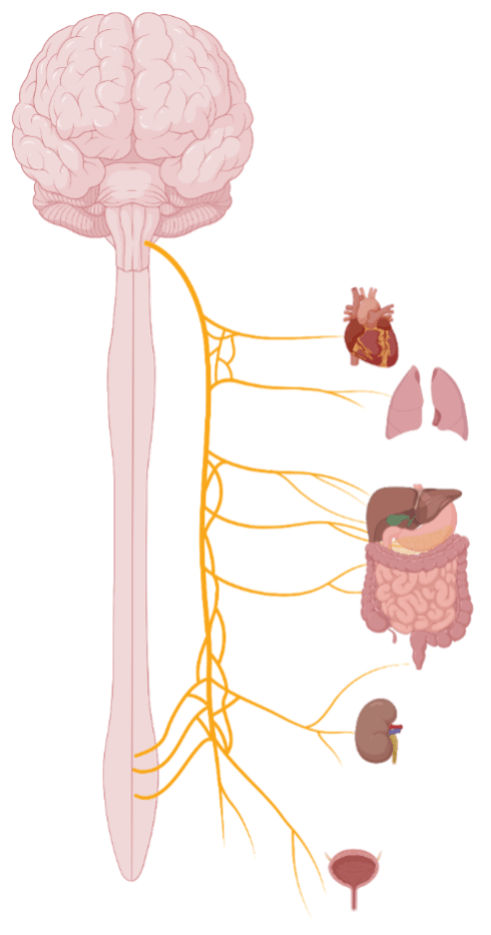
The reflexive action of coughing can be broken down into two parts: what triggers the cough, and the cough itself. Stimuli that trigger coughing, such as food and mucus, activate nerves around our airways, and this information then travels to the brain by way of the vagus nerve. This nerve is one of the main neural pathways that connects the brain to other organs in the body (Figure 1) (Fun fact: since part of the vagus nerve branches near the ear, there have been rare cases where stimulating an area around the ear can cause coughing3). From the vagus nerve, the information then travels to the medulla, an area at the base of the brain that controls many of the basic functions that keep us alive, such as breathing and heart rate.
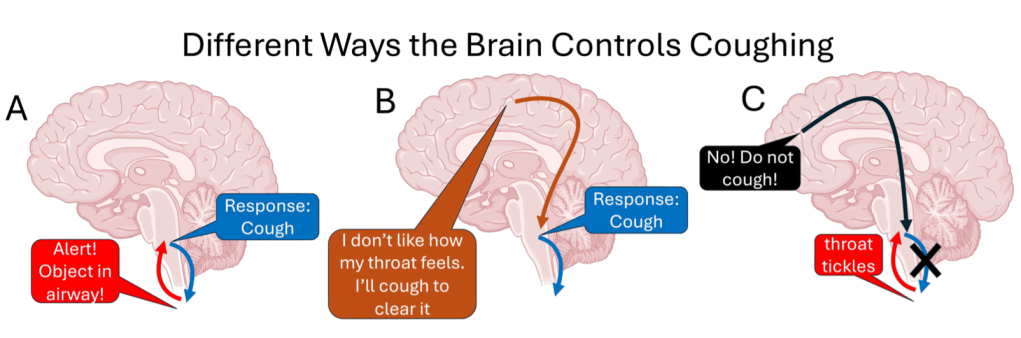
Now that the brain has information that there is something going on in the airways, what happens next? Well, it’s a bit less cut and dry. Somehow, the brain needs to order the body to cough, but where that signal comes from seems to vary. In the most direct pathway, the information coming into the medulla directly triggers a “cough center” in the same region, and the command to cough is sent back down to the body4. In cases where this happens, the reaction to cough is automatic (Figure 2A).
However, a lot of times we can control whether we cough or not. This voluntary control comes from other areas in the brain that regulate activity in the medulla, either by activating the cough center (Figure 2B) or blocking its activity4 (Figure 2C).
Once the brain gives the cough signal, the information is sent back down to the body. Muscles are activated in a very specific and rapid order to first create a lot of pressure in your lungs and then suddenly release it, which produces that distinctive cough sound.
Since the act of coughing is controlled by the brain, this system can be disrupted in certain neurological disorders, such as Parkinson’s Disease and Dementia. Decreased cough sensitivity or the inability to cough can be dangerous as it increases the risk of infections like pneumonia5. On the other hand, sometimes this system can become overly sensitive such as in the case of chronic obstructive pulmonary disease, asthma, or even just long lasting allergies and postnasal drip6. The combination of that increased sensitivity along with lingering mucus/ snot is why that post-virus cough just won’t go away! This is where treatments that work to reduce the need to cough can be helpful.
Cough remedies
When it comes to remedies and over-the-counter medicines for easing coughing, they can be broken down into three strategies: 1) targeting the cough-related neural pathways, 2) soothing the throat/airways, and 3) helping your body get rid of the mucus driving the coughing.
1) Reducing sensitivity: cough suppressants: Since chronic cough can sometimes be caused by the related neural pathways becoming overactive, reducing the sensitivity of those pathways can be an effective way to combat persistent coughing.
Dextromethorphan (DXM), a common over-the-counter cough suppressant found in many cold and flu medicines, works by effectively raising the threshold of what makes you cough. It is believed that DXM does this by decreasing the overall activity of neurons in the medulla that drive coughing, specifically by changing how excitable, or easily activated, these neurons are. Interestingly, the effects of DXM are not limited to coughing, and research has shown that this drug may even be helpful in treating mood disorders, such as depression, as well as stroke and other brain injury7.
Since it works at level of the brain, where the signal to cough ultimately comes from, DXM can be helpful for many different types of coughs, including the more wet-sounding cough caused by mucus (productive cough) and the dry cough that tends to be caused more by irritation or allergies (non-productive cough).
2) Soothing: Since a sensitive throat can also lead to more coughing, especially in the case of a dry, non-productive cough, soothing that irritation can be helpful. Many of us may automatically reach for cough drops when we have a sore throat and cough. Sucking on these lozenges leads to more saliva production, which in turn can help soothe an irritated throat8.
If saliva production is indeed the way that cough drops help, that raises a question as to whether cough drops are any better than hard candy when it comes to helping a cough. A unique feature of many cough drops is that they contain menthol, which creates a cooling sensation by activating receptors that typically respond to cold temperatures9. Studies have found that menthol may indeed help reduce coughing10,11. However, the subjects in these studies inhaled vapor containing menthol, rather than consumed it via a candy, so it’s unclear if the same benefits apply to cough drops containing menthol.
To muddy the waters even more, another study even found that people who used cough drops had longer lasting coughs12. But before you go and throw away your Halls Lozenges, we should note that this was only one study showing a correlation, meaning we do not know for certain if the prolonged cough was because of the cough drop use.
So, are cough drops particularly helpful? The bottom line is we don’t know, especially since there hasn’t been a lot of research on this topic. As for me, I will probably stick with my lemon mint Ricola cough drops, but it’s good to know Jolly Ranchers may do the trick as well!
If you are looking for home remedy alternatives, honey, hot tea, and steam may also help sooth that irritated and dry throat that often accompanies a dry cough. On top of that, these remedies can also be helpful with that annoying mucus in wet cough as well.
3) Coughing up the gunk: Many of the treatments for a wet cough work by making the cough more “productive”, i.e. helping you get rid of that mucus that is making you cough in the first place. The trick is basically watering down the mucus to make it looser and easier to cough up. So in addition to being soothing, this is why drinking tea and water, breathing in steam, and using a humidifier can help with a cough.
Guaifenesin, another common ingredient in cold and allergy medications, also works in a similar way. Guaifenesin is an expectorant, meaning it helps thin and loosen the mucus in your airways, allowing you to cough up that phlegm13. It’s maybe a little gross, but it’s productive.
So the next time you get one of those stubborn coughs, hopefully you can take some comfort in understanding what is going on in both your brain and body. Plus, you will be able to walk into the cold and flu section at the drug store with a better understanding of what those medicines actually do.
Now if you will excuse me, I am going to go take my combination Guaifenesin and Dextromethorphan medicine and make myself a cup of tea.
References
1. COPD: Chronic Coughing | UMass Memorial Health. https://www.ummhealth.org/health-library/copd-chronic-coughing.
2. Iwata, T. et al. Mechanical Stimulation by Postnasal Drip Evokes Cough. PLoS One 10, e0141823 (2015).
3. Ryan, N. M., Gibson, P. G. & Birring, S. S. Arnold’s nerve cough reflex: evidence for chronic cough as a sensory vagal neuropathy. J Thorac Dis 6, S748–S752 (2014).
4. Mazzone, S. B., Cole, L. J., Ando, A., Egan, G. F. & Farrell, M. J. Investigation of the Neural Control of Cough and Cough Suppression in Humans Using Functional Brain Imaging. J Neurosci 31, 2948–2958 (2011).
5. Al-Biltagi, M., Bediwy, A. S. & Saeed, N. K. Cough as a neurological sign: What a clinician should know. World J Crit Care Med 11, 115–128 (2022).
6. Communication, M. and. Solving Your Chronic Cough: Symptoms, Diagnosis & Treatments | University of Utah Health. https://healthcare.utah.edu/healthfeed/2025/04/solving-your-chronic-cough-symptoms-diagnosis-treatments (2025).
7. Oh, S., Sabir, S., Patel, P. & Taylor, A. Dextromethorphan. in StatPearls (StatPearls Publishing, Treasure Island (FL), 2026).
8. Wetchler, B. H. & DO. How to Choose Cough Drops That Actually Work. Verywell Health https://www.verywellhealth.com/ways-to-stop-a-cough-770345.
9. McKemy, D. D. TRPM8: The Cold and Menthol Receptor. in TRP Ion Channel Function in Sensory Transduction and Cellular Signaling Cascades (eds Liedtke, W. B. & Heller, S.) (CRC Press/Taylor & Francis, Boca Raton (FL), 2007).
10. Laude, E. A., Morice, A. H. & Grattan, T. J. The antitussive effects of menthol, camphor and cineole in conscious guinea-pigs. Pulm Pharmacol 7, 179–184 (1994).
11. Wise, P. M., Breslin, P. A. S. & Dalton, P. Sweet Taste and Menthol Increase Cough Reflex Thresholds. Pulm Pharmacol Ther 25, 236–241 (2012).
12. Johnson, D., Mead, R., Kennelty, K. & Hahn, D. Menthol Cough Drops: Cause for Concern? J Am Board Fam Med 31, 183–191 (2018).
13. What Can I Expect From an Expectorant? Cleveland Clinic https://my.clevelandclinic.org/health/drugs/22078-expectorant.
ChatGPT was used as an advanced search engine and Dalle was used to generate the cover image.
Figure 1 and corresponding legend from Vagus nerve stimulation: A new frontier written by Joseph Stucynsk.
Figure 2 made by Nita Rome in BioRender and PowerPoint

