
April 21st, 2026
Written by Victoria Subritzky Katz
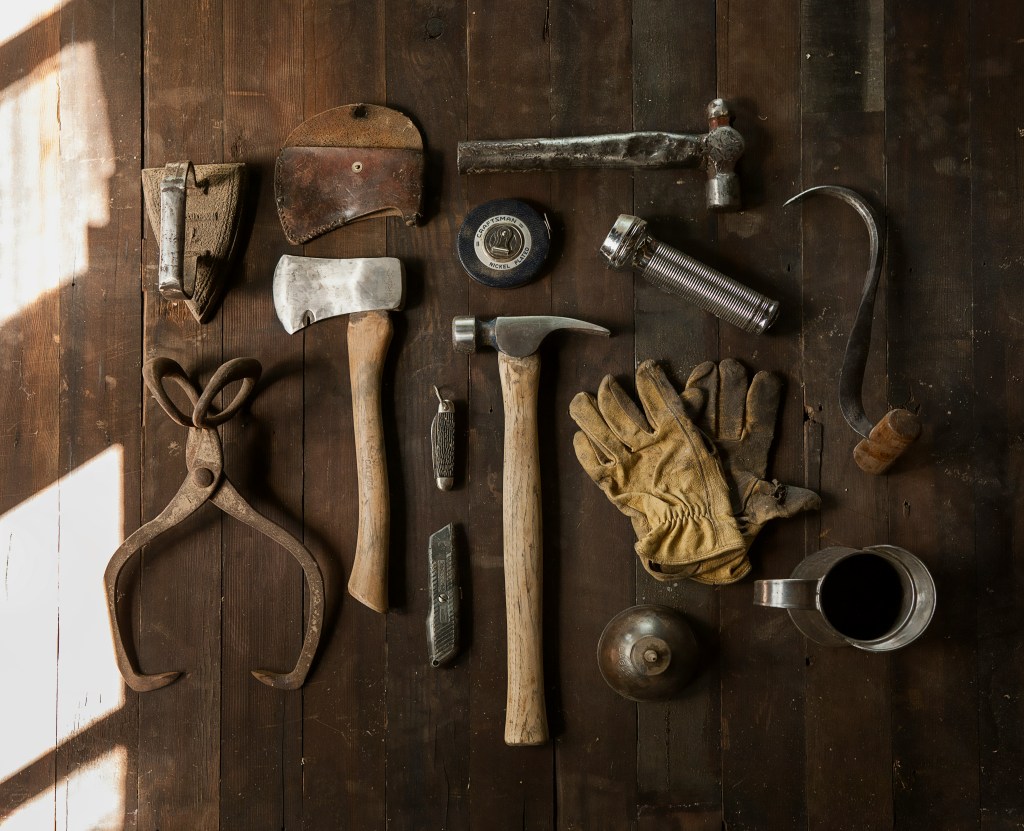
Tool use has often been romanticized as a fundamental turning point in the evolution of man that sets us apart from other animals. Director Stanley Kubrick immortalized this popular idea in his 1968 film 2001: A Space Odessey, where “THE DAWN OF MAN” is portrayed as the pivotal moment a bone is first used as a tool, set to an appropriately dramatic soundtrack. But is this true? In short—not at all. This belief was perhaps most famously dispelled by Jane Goodall in 1964 (four years before the movie) when she observed chimpanzees fashioning tools from sticks to better extract termites from their nests in Gombe Stream National Park in Tanzania1. Since then, there have been countless documented examples of tool use across animal species, ranging from birds to fish!
While tool use is not specific to humans, it is still used as a hallmark of sophisticated behavior thought to require heightened cognitive flexibility and planning (read: smarts) and thus serves as a window into animal intelligence. However, defining what constitutes a tool and tool usage is not a simple task; does a bird dropping a shell onto rocks to break it open constitute using the rock as a tool? What about if the bird dropped the rock onto the shell?2 These nuances are still debated in the field, but for the purposes of this piece we can think of tool use as physically manipulating an external object to achieve a mechanical goal3. Now that we have a general definition for tool use, let’s explore a few of the species who have demonstrated their mental prowess and dabbled in the art.
Primates: The masters of the tool
Non-human primates—including species of chimpanzees, orangutans, great apes, capuchins and macaques—use a variety of tools to aid in the accomplishment of various goals from feeding to more comfortable sleeping arrangements. Jane Goodall’s seminal findings in the sixties showed chimpanzees using sticks and plant stalks to aid in termite and ant eating (Video 1), using leaves to drink water and wipe mud or urine off the body, and throwing objects to ward off unwanted visitors1. Since then, the variety and number of documented cases of tool use by chimpanzees has exploded. Scientist have defined 22 different tool uses (things like probe, wipe, and dig), four classes of methods for manufacturing tools (detaching, reducing, reshaping, and combining), and seven different functional classes for tool use (from amplifying force and extending reach to controlling substances and enhancing comfort). Chimpanzees have been observed using tools in all 22 different ways, manufacturing tools using all four methods, and leveraging the tools for six out of the seven identified functional classes (just missing camouflage!)4. Observed chimpanzee tool use extends from constructing more comfortable sleeping platforms with flexible tree bows and leaves to using a coconut shell to carry water. This wide range of behaviors reveals just how versatile and deeply ingrained tool use is in chimpanzee life.
New Caledonian crow: The clever craftsman
A South Pacific island native, the New Caledonian crow does not have the famed opposable thumbs of its distant primate relatives, but that hasn’t stopped it from using tools. These crows have been observed in the wild grasping small sticks in their beaks and using them to fish bugs from holes in wood—much like how chimpanzees use sticks to fish for termites. They even engage in tool manufacturing, altering the stick by plucking off leaves with their beaks and carefully shaping the end into a hook to better fish out their desired meal (Video 2). This behavior fascinates researchers because it reveals advanced cognitive abilities: crows must recognize the problem (how to obtain tasty bugs from impossible to reach crevices), plan a multi-step solution, and create a properly shaped tool from their environment to achieve their goal. Using the same classification system mentioned above regarding primates, so far crows have been documented using tools in four of the 22 possible ways, manufacturing tools in three out of the four ways, and using the tools for two out of seven possible functions4. While not as extensive as chimpanzees, the New Caledonian crow’s use of tools still shows clear goal-directed behavior that exemplifies their intelligence.
Aquatic tool users from fish to dolphins
While often overlooked, there are a host of animals that live beneath the sea that make use of tools. Not quite below the waves, a commonly seen example of aquatic tool use is Otters using rocks to break into shells as they float on top of the sea. In this case, using a tool broadens the variety of food they can eat, decreases the amount of energy expended to obtain the same amount of nutrients, and even reduces the harmful wear on their teeth7. But otters are not the only ones using rocks as tools like this; certain species of fish have been documented breaking open shells by gripping them in their mouth and bashing them into or throwing them against rocks to extract the tasty morsel within8. Much like the famed chimpanzees fishing for termites and crows making hooks, they leverage tools to access otherwise unreachable food.
Beyond helping them find food, aquatic animals use tools to protect themselves in inventive ways. Including a creative group of bottlenose dolphins in Shark Bay, Western Australia who have been observed collecting and then carrying around an unconventional tool on their noses: yellow sea sponges. Scientists think that the sponge is used to aid the dolphins during foraging by functioning as a soft shield on their noses that protects them from abrasions caused by sharp coral or stinging aquatic life encountered during feeding5. And they aren’t the only ones exploiting surprising items to protect themselves— the Veined Octopus in Indonesia uses coconut shells! Researchers logged over 500 hours of underwater diving to study why this crafty octopus carries coconut shells as it stalks along the sea floor6. The sandy bottom of the ocean that the veined octopus calls home is open and offers no places for it to hide as it stalks its prey. To remedy this, the octopus carries its hiding place with it in the form of coconut shells that it can climb inside of, both as protection if a predator appears and to conceal itself from unsuspecting prey passing by (Video 3). Some species of fish use tools for protection too, they choose sturdy leaves to lay their eggs on so they can pick up the leaf in their mouth and move it to protect their eggs in case of danger8. Historically, fish are not lauded for their great intellect, but findings like these challenge long-held assumptions about their cognitive abilities.
Tool use across the animal kingdom
These are just some examples of how species across the animal kingdom use tools in a variety of ways to achieve their goals, and scientists are still observing new kinds of tool use all the time. Just a few months ago the lovely cow, Veronika, graced the cover of a major scientific journal for her spectacular use of a broom gripped between her teeth to scratch a hard-to-reach spot on her flank2. As the self-appointed master of the animal kingdom, humans often take our intellectual superiority over animals for granted, but findings like these begin to chip away at the pillars holding up those assumptions, suggesting animals might be smarter—and us less observant—than we thought.
References
- GOODALL, J. Tool-Using and Aimed Throwing in a Community of Free-Living Chimpanzees. Nature 201, 1264–1266 (1964). https://doi.org/10.1038/2011264a0
- Shumaker RW, Walkup KR, Beck BB. 2011. Animal tool behavior, the use and manufacture of tools by animals. Revised and updated edition Baltimore, MD: Johns Hopkins University Press.
- Osuna-Mascaró AJ, Auersperg AMI. Flexible use of a multi-purpose tool by a cow. Curr Biol. 2026 Jan 19;36(2):R44-R45. doi: 10.1016/j.cub.2025.11.059. PMID: 41558466.
- McGrew WC. Is primate tool use special? Chimpanzee and New Caledonian crow compared. Philos Trans R Soc Lond B Biol Sci. 2013 Oct 7;368(1630):20120422. doi: 10.1098/rstb.2012.0422. PMID: 24101630; PMCID: PMC4027415.
- Smolker, R., Richards, A., Connor, R., Mann, J. and Berggren, P. (1997), Sponge Carrying by Dolphins (Delphinidae, Tursiops sp.): A Foraging Specialization Involving Tool Use?. Ethology, 103: 454-465. https://doi.org/10.1111/j.1439-0310.1997.tb00160.x
- Finn JK, Tregenza T, Norman MD. Defensive tool use in a coconut-carrying octopus. Curr Biol. 2009 Dec 15;19(23):R1069-70. doi: 10.1016/j.cub.2009.10.052. PMID: 20064403.
- Chris J. Law et al. Tool use increases mechanical foraging success and tooth health in southern sea otters (Enhydra lutris nereis).Science384,798-802(2024).DOI:10.1126/science.adj6608
- Brown, C. (2012), Tool use in fishes. Fish and Fisheries, 13: 105-115. https://doi.org/10.1111/j.1467-2979.2011.00451.x
- Bandini E, Tennie C. Exploring the role of individual learning in animal tool-use. PeerJ. 2020 Sep 25;8:e9877. doi: 10.7717/peerj.9877. PMID: 33033659; PMCID: PMC7521350.
Cover photo by Todd Quackenbush on Unsplash
ChatGPT-5.3 was used to help with blurb and title generation and rewording a couple sentences.

