
August 8th, 2023
Written by: Abby Lieberman
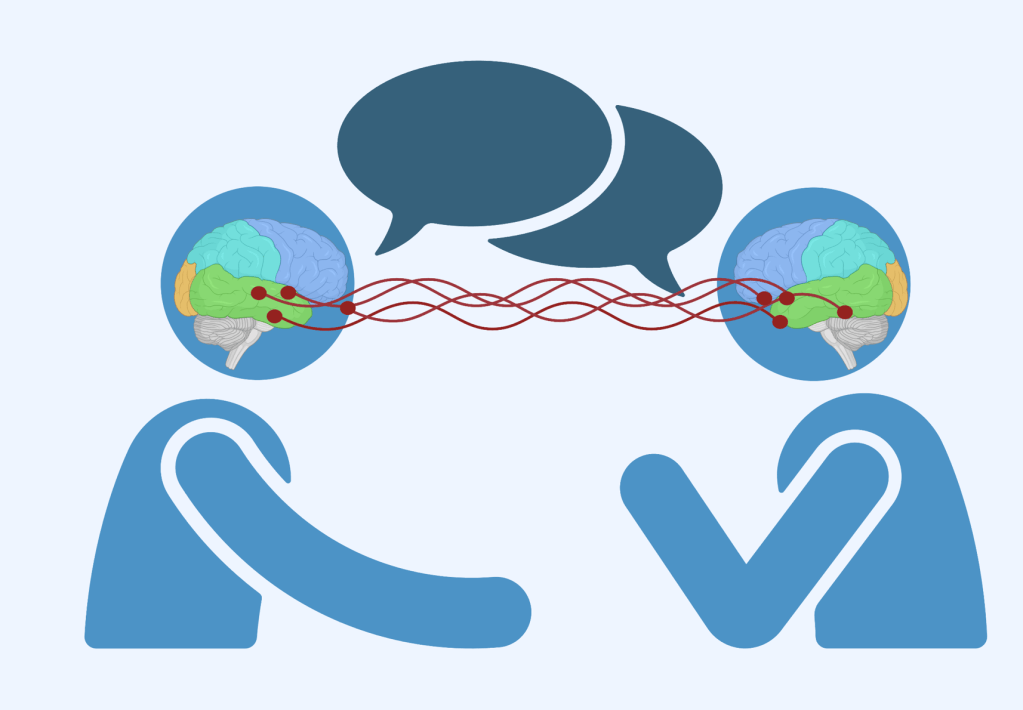
Have you ever had the uncanny feeling that your best friend just knows what you’re thinking? Or effortlessly sensed what your teammates will do next while playing sports? If you’ve played music in a group, have you felt an unexplainable connection with the other musicians around you? While it might sound like something out of science fiction, the activity in your brain mirrors and connects with the activity in the brains of others during social interactions. This concept is called interbrain synchrony and in recent years, neuroscientists have studied it to figure out how and why our brains synchronize in these moments of connection.
What Does It Mean For Brains To Synchronize?
Every day we make decisions that help ensure our comfort and safety. We’ve learned how to make decisions about predictable situations, like putting on warm clothes when it’s cold out, over time. In contrast, social interactions are more complicated and unpredictable. Our behavior is tied to that of other people, and we have to react to what they do in real time. Interbrain synchrony helps us manage these intricate interactions with other people.
You may have heard of mirror neurons, which are “activated when an individual performs an act or experiences a sensation, as well as when a person sees another individual perform the same act or experience a similar sensation”. Interbrain synchrony is a similar concept, except that instead of measuring the activity of single neurons, there are thousands of neurons whose activity mirrors that of thousands of neurons in another person. Neuroscientists have found that when subjects (people in a study) coordinate their behavior, such as in a game or while playing a piece of music together, the activity of their brains becomes similar! There are many brain regions that appear to play a role in interbrain synchrony. For example, when people have face-to-face contact during social interaction or are telling a story to a friend (see our previous post on the neuroscience of successful communication), activity in areas of the brain involved in attention and movement is similar. Importantly, studies have shown that synchrony is not just a product of similar sensory experiences, like being in the same room and hearing the same noise. Even when subjects do not share the same sensory experiences or perform the exact same action, interbrain synchrony still occurs1.
Scientists can learn about what subjects are doing, or what relationship they have to one another using the brain activity collected in these studies. For example, brain activity can indicate whether the behavior subjects are performing is synchronized, like pressing a button at the same time2, or coordinated, like a musical duet where each person has their own part that is related to the other person’s3. Synchrony in brain activity can also indicate what goals the subjects might have in mind or what emotions they might be feeling. Romantic relationships, family relationships, and differences in social status can also be detected in interbrain synchrony patterns. When romantic couples4 or parents and their kids5 play a cooperative game, their brains are more synchronized than two strangers playing the same game. While brain activity can reveal a lot about shared experiences and emotions, it’s essential to acknowledge concerns and avoid misconceptions about how brain synchrony recordings could be used to read minds. Because brain activity is incredibly intricate and dynamic, recordings might capture patterns, but cannot fully capture the narrative of someone’s thoughts and feelings.
How Do Neuroscientists Study Interbrain Synchrony?
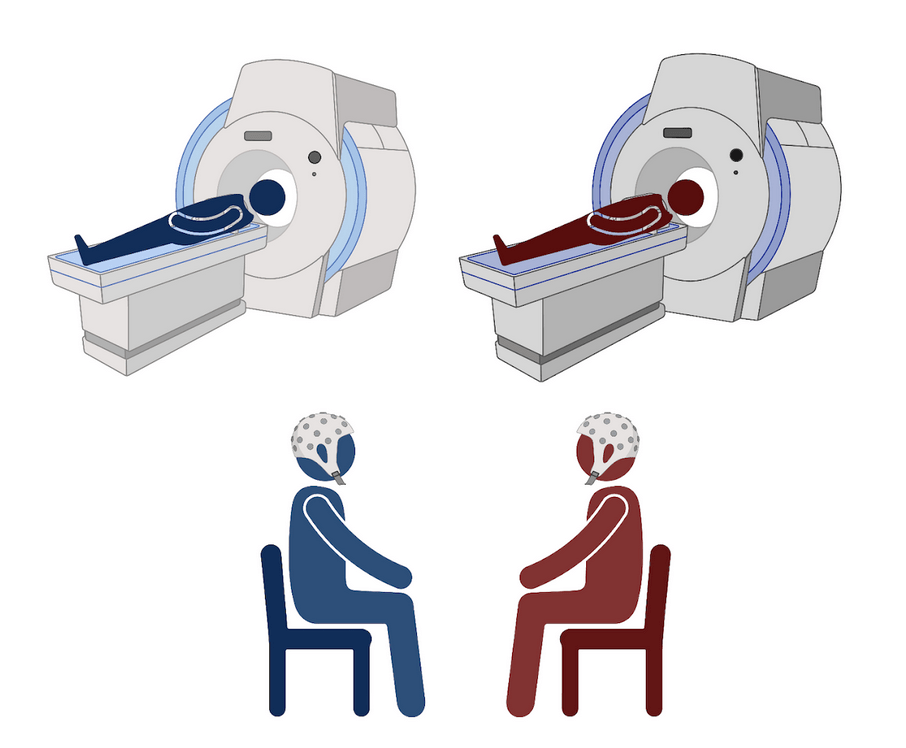
Studying interbrain synchrony during social interactions requires the ability to record brain activity from two brains at the same time, which has only recently been made possible thanks to techniques refined in the last two decades. Examples of these techniques are functional magnetic resonance imaging (fMRI), functional near-IR spectroscopy (fNIRS), and electroencephalography (EEG). These techniques measure changes in blood flow or electrical activity in the brain, and indicate when a particular part of the brain is active. The first studies of interbrain synchrony were done with two people in fMRI machines, but being confined to a large scanning machine limits the types of social interactions people can have. The equipment used in fNIRS and EEG recordings is less constraining, so people can move and interact freely while these recordings are being obtained1.
Interbrain synchrony has also been observed in monkeys, rodents, and even bats! This suggests that synchronized brain activity may have evolved across social species. Electrical recordings of brain cells in monkeys show synchronized activity when one monkey watches another getting a reward6. In mice, activity of neurons in the prefrontal cortex (an area that controls complex mental processes) shows synchrony. This synchrony happens when the mice perform social behaviors like sniffing, chasing, grooming one another, and establishing a dominance hierarchy7.
The studies mentioned above demonstrate that a shared social environment leads to interbrain synchrony, but there is still relatively little known about the specific neural mechanisms that cause it. It isn’t known whether there are connections between brain regions, called neural circuits, or specific types of cells that support synchrony. This is partially because techniques used in humans, like fMRI and EEG, can’t measure the activity of single cells. Future studies in animals will help us learn more about how interbrain synchrony occurs.
Why Should We Care About Interbrain Synchrony?
Interbain synchrony is correlated with cooperativity and shared emotion, so it is possible that differences in social interaction might be linked to disruptions in synchrony with others. Recent studies have started to look at how interbrain synchrony might be altered in neuropsychiatric and neurodevelopmental conditions, such as autism8 and borderline personality disorder9. Continuing study of interbrain synchrony in these populations could give us invaluable information about how synchrony differs between various conditions and how symptoms present differently between individuals with the same diagnosis. However, the use of interbrain synchrony as a clinical measure requires careful consideration. Psychiatric diagnoses shouldn’t be based solely on disruptions in synchrony, but instead could use measures of interbrain synchrony as one tool in a comprehensive assessment. Stringent ethical guidelines should be put into place so individuals aren’t given inaccurate or harmful diagnoses.
Ultimately, studying interbrain synchrony helps us move beyond treating people as “isolated actors”1, instead considering them as part of a larger societal network. Deepening our understanding of interbrain synchrony will help us understand how social factors impact our wellbeing in unexpected ways. A deeper understanding of social neuroscience will give us insight into collective behavior that shapes society.
References
- Kingsbury, L., & Hong, W. (2020). A Multi-Brain Framework for Social Interaction. Trends in neurosciences, 43(9), 651–666. https://doi.org/10.1016/j.tins.2020.06.008
- Konvalinka, I., Bauer, M., Stahlhut, C., Hansen, L. K., Roepstorff, A., & Frith, C. D. (2014). Frontal alpha oscillations distinguish leaders from followers: multivariate decoding of mutually interacting brains. NeuroImage, 94, 79–88. https://doi.org/10.1016/j.neuroimage.2014.03.003
- Sänger, J., Müller, V., & Lindenberger, U. (2013). Directionality in hyperbrain networks discriminates between leaders and followers in guitar duets. Frontiers in human neuroscience, 7, 234. https://doi.org/10.3389/fnhum.2013.00234
- Pan, Y., Cheng, X., Zhang, Z., Li, X., & Hu, Y. (2017). Cooperation in lovers: An fNIRS-based hyperscanning study. Human brain mapping, 38(2), 831–841. https://doi.org/10.1002/hbm.23421
- Reindl, V., Gerloff, C., Scharke, W., & Konrad, K. (2018). Brain-to-brain synchrony in parent-child dyads and the relationship with emotion regulation revealed by fNIRS-based hyperscanning. NeuroImage, 178, 493–502. https://doi.org/10.1016/j.neuroimage.2018.05.060
- Tseng, P. H., Rajangam, S., Lehew, G., Lebedev, M. A., & Nicolelis, M. A. L. (2018). Interbrain cortical synchronization encodes multiple aspects of social interactions in monkey pairs. Scientific reports, 8(1), 4699. https://doi.org/10.1038/s41598-018-22679-x
- Kingsbury, L., Huang, S., Wang, J., Gu, K., Golshani, P., Wu, Y. E., & Hong, W. (2019). Correlated Neural Activity and Encoding of Behavior across Brains of Socially Interacting Animals. Cell, 178(2), 429–446.e16. https://doi.org/10.1016/j.cell.2019.05.022
- Zhang, W., & Yartsev, M. M. (2019). Correlated Neural Activity across the Brains of Socially Interacting Bats. Cell, 178(2), 413–428.e22. https://doi.org/10.1016/j.cell.2019.05.023
- Wang, Q., Han, Z., Hu, X., Feng, S., Wang, H., Liu, T., & Yi, L. (2020). Autism Symptoms Modulate Interpersonal Neural Synchronization in Children with Autism Spectrum Disorder in Cooperative Interactions. Brain topography, 33(1), 112–122. https://doi.org/10.1007/s10548-019-00731-x
- Bilek, E., Stößel, G., Schäfer, A., Clement, L., Ruf, M., Robnik, L., Neukel, C., Tost, H., Kirsch, P., & Meyer-Lindenberg, A. (2017). State-Dependent Cross-Brain Information Flow in Borderline Personality Disorder. JAMA psychiatry, 74(9), 949–957. https://doi.org/10.1001/jamapsychiatry.2017.1682
Cover Photo and Figure 1 made by Abby Lieberman on Biorender.com.

