
November 11th, 2025
Written by: Nita Rome
It can be confusing when the United States President and the Secretary of Health and Human services both claim that vaccines cause autism1,2, yet the agencies under their purview, namely the Center for Disease Control and the Food and Drug Administration, state that vaccines and autism are not connected. While the conversation around vaccines and autism has been around for over 20 years, it has become an increasingly large area of discussion in recent years. The COVID-19 pandemic brought with it a whole new wave of questions and hesitancy around vaccines3, and recent statements from federal officials that contradict those of medical experts have led to greater uncertainty. Furthermore, rates of autism diagnosis have increased dramatically over the years, leaving many searching for a potential cause of this trend4.
While there are many questions surrounding the relationship between vaccines and autism, this article will touch on three large ones: 1) Where did the concern around vaccines and autism come from?, 2) What does the science say about the connection between vaccines and autism?, and 3) What factors may be contributing to the increase in autism diagnoses?
The Measles, Mumps, and Rubella (MMR) Vaccine
The idea that vaccines could lead to autism can be traced back to a UK study from 1998 published in the Lancet, a well-respected medical journal, and led by Andrew Wakefield. The study was based on twelve children (eleven boys and one girl) who had developmental delays and intestinal problems5. Eight of the twelve children had received the measles, mumps, and rubella vaccine, often referred to as the MMR vaccine. According to the study, most of the children who received the vaccine began showing signs of developmental delay and gastrointestinal problems within a single month, some even as early as 24 hours, post vaccination. In the article’s conclusion, the authors state that there may be a link between the gastrointestinal issues and developmental delays, and declare that “In most cases, onset of symptoms was after measles, mumps, and rubella immunization. Further investigations are needed to examine this syndrome and its possible relation to this vaccine.” The authors themselves declare the evidence in this study “did not prove an association” between the MMR vaccine and autism; yet even their suggestion of a link was enough to spark a decades long debate.
However, it was later revealed that the study was not to be trusted, and in 2010, the Lancet fully retracted the study, declaring that many elements of it were “incorrect”6. In the time between the article’s publishing and retraction, investigations were opened into how the study was carried out and the people who ran it, primarily its leader, Wakefield. In 2004, it was revealed that Wakefield had falsified data to support the paper’s claims, and on top of this, the children in the study were unethically subjected to unnecessarily invasive tests7. In addition, most of the children included in the study were handpicked from families engaged in lawsuits against the vaccine manufacturers. Wakefield himself received the equivalent of approximately $800,000 from the legal aid group representing the families in the suits8. Therefore, there was high potential that both the parents of these children and Wakefield had strong ulterior motives to “prove” a connection between the vaccine and autism. That same year, ten of the twelve authors retracted their support of the study’s interpretation, indicating they no longer stood behind the study’s conclusion of a likely connection between autism and the MMR vaccine9. In 2010, the same year that the paper was fully retracted, Wakefield was found guilty of professional misconduct by the UK’s general medical council and barred from practicing medicine10.
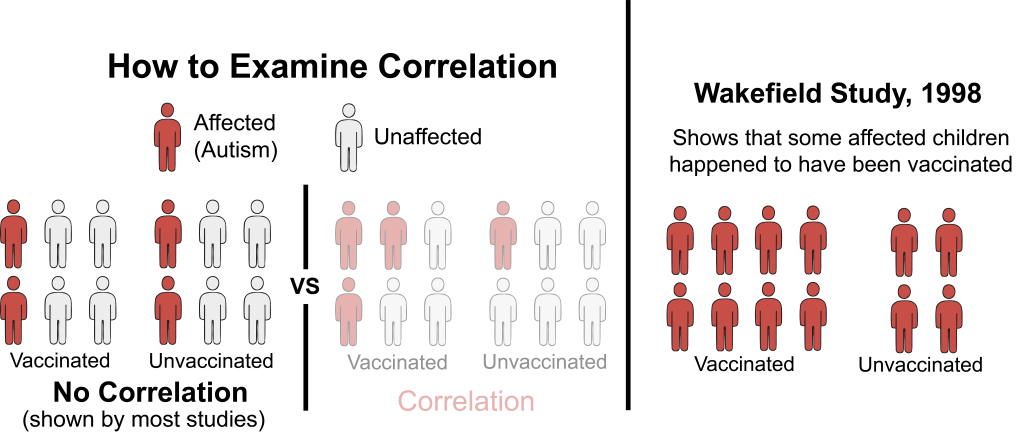
Even before all of Wakefield’s misdeeds came to light, there were still many glaring problems with study. First, twelve is an incredibly low number of participants for this kind of research. Studies that followed this one looked at hundreds, if not thousands, of children11–13. Second, they did not include proper controls. To prove the trend suggested by the authors, that vaccines correlated with autism, they would have needed to show that vaccinated children developed autism more frequently than unvaccinated children, as represented in the center panel of Figure 1 below. Instead, since their group only looked at children with developmental delays, what the authors showed is that of those twelve children, eight happened to have received the MMR vaccine (Figure 1, right). Finally, the study claims that children showed signs of developmental delay within weeks, if not days, of receiving the vaccine. Given the short amount of time between vaccination and symptoms arising, the more likely reason for these observations is that the MMR vaccine is typically given around the same time that developmental delays become noticeable14.
Over the last 26 years, study after study has disproven Wakefield’s claim of a link between autism and the MMR vaccine. One such study, which was also published in the Lancet only one year after Wakefield’s article, examined the medical records of nearly 500 children from the UK with autism11. The researchers compared rates of autism diagnosis of children born before and after the vaccine was introduced in 1988. If the MMR vaccine did in fact increase the risk of autism, they would expect to see a clear and dramatic increase in autism from before 1988 to after. However, they found no association between vaccinations and autism. Additionally, two separate studies from Denmark, one published in 2002 and the other published in 2019, looked at a combined total of over one million children (over 500,000 from the first, and 650,000 from the second). Both studies concluded that children who did and did not receive the MMR vaccine had equal risk of developing autism, further showing that there was NOT a link between the MMR vaccine and autism12,13. Yet to this day, many people continue to believe there is a connection between autism and the MMR vaccine, despite the overwhelming amount of evidence to the contrary.
Also accused of increasing autism rates: Thimerosal
So, how did we get from “the MMR vaccine causes autism” to “vaccines generally cause autism”? Dr. Daniel Salmon, a vaccinologist and the director of the Johns Hopkins Institute for Vaccine Safety, theorizes that “Once it started to become clear that the MMR vaccine was not associated with autism, the hypothesis shifted from the MMR vaccine [as a cause of autism] to thimerosal, which at the time was used as a preservative in some childhood vaccines”15. In other words, the idea that vaccines and autism were linked had already taken root. By the time enough evidence had been gathered to show that the MMR vaccine does not cause autism, this idea was already so engrained that people began looking for alternative explanations to support their preestablished beliefs.
Preservatives, such as thimerosal, are important components of vaccines that prevent contamination by unwanted organisms, such as fungi and bacteria16. However, thimerosal specifically gained a lot of interest because it is a mercury-based compound. Small amounts of mercury can be found in food, with fish being the most common source of mercury in our diets. While consuming these low levels of mercury are typically safe, too much mercury can pose a risk to developing fetuses and newborns, which is why pregnant and breastfeeding women are often advised to limit the amount of fish they eat17.
Thimerosal is not in every vaccine, and was notably never part of the MMR vaccine18. In vaccines that do contain thimerosal, it makes up about 0.01% of a vaccine (that is less than one one-thousandth), containing about 25 micrograms (0.000025 grams) of mercury16. However, babies receive many vaccines in their first year, and one study calculated that the total amount of mercury across all of those vaccines exceeded recommended limits for mercury consumption. While the same study did not find any long-term negative effects from these repeated low-dose exposures to thimerosal, people were still understandably worried19. Parents, of course, did not want to expose their children to what they believed were toxic levels of mercury.
However, the mercury found in fish and the mercury in thimerosal are not actually the same compound. Methylmercury is what is in fish, and the human body processes this type of mercury slowly, meaning that it hangs around longer and can therefore build up easily. However, ethylmercury, the version in thimerosal, is cleared out of the body much faster, and therefore is less likely to accumulate to dangerous levels20. So while a certain amount of the kind of mercury in fish may be toxic, the same amount of mercury in thimerosal can be safe. Since the recommended limits for mercury exposure were based on the one in fish, those same limits do not apply to thimerosal.
Nevertheless, despite the lack of evidence linking thimerosal to developmental problems, the American Academy of Pediatrics and the US Public Health Service responded to the public outcry in 1999, releasing a joint statement recommending thimerosal no longer be used in vaccines16. By 2001, thimerosal was removed from almost all childhood vaccines18. While some formulations of the flu vaccine continue to contain thimerosal, this has decreased over time, with now as little as 4% of flu vaccines containing thimerosal.
A 2014 study combined data across ten earlier studies that examined the possible relationship between vaccines and autism21. These studies were conducted in Japan, the UK, Denmark, Poland, and the USA, and included a combined total of approximately one million children in their research. They examined if autism could be linked to thimerosal, mercury exposure, the MMR vaccine, or the total number of vaccinations a child receives. They found no evidence linking any of these factors to an increased risk of developing autism.
What Causes Autism?
So, if vaccines aren’t contributing to rising rates of autism, what is? The short answer is: we don’t entirely know.
What we do know is that the primary causes of autism are a combination of genetics and environment. Environmental factors that have been shown to increase the risk of autism include: the age of both parents at the time of conception, gestational diabetes, exposure to air pollution, heavy metals such as led, and insecticides during pregnancy, use of certain seizure medications during pregnancy, high fever and infection (particularly in the first two trimesters), complications during birth, and preterm birth4,22–24.
Even so, all of this does not explain the seemingly dramatic rise in autism over the last several decades. In 2005, it was estimated that 1 in 167 people in the US were diagnosed with autism. While the CDC estimates the rate has increased to 1 in 3125, some researchers critique the methods of collection for those data, saying that they overestimate autism rates, and themselves estimate the rate to be much lower26. Nonetheless, most experts agree that autism rates have indeed increased. As for the reason for this, it might be in part due to some unknown change in environmental factors that we have yet to identify.
However, a more common explanation is that the rate of autism hasn’t itself changed, but the rate of diagnosis has. Over time, the definition of what autism is has changed. In the most recent version of the Diagnostic and Statistical Manual of Mental Disorders (the “rule book” for diagnosing mental illness and disorders), many disorders that were once listed separately, such as Asperger Syndrome, Rett Syndrome, and autism, have now been combined under a new umbrella diagnosis: Autism Spectrum Disorder27 . That means that many children who may have received a different diagnosis in the past are now diagnosed with autism. On top of this, screening and awareness have increased while the stigma surrounding autism has decreased dramatically over the last two decades28,29. Therefore, it is likely that many of the “new” cases of autism contributing to the rise in autism rates are not actually new, but rather, we have just gotten better at recognizing the symptoms and characteristics of autism. While it is unlikely that these factors can completely account for the increased rate in autism diagnosis30, several experts in the field cite them as large potential contributors28,29.
Many questions remain about both the causes of autism and why autism rates are increasing, which is why many scientists are investigating this question and lots of money is being invested in this research. Between 2019 and 2020, over $800 million dollars was invested into autism research in the United States alone31, with almost $600 million coming from government funding (For reference, while both ADHD and autism are developmental disabilities, ADHD received around $136 million from the same government sources between 2019 and 2020)32. As for the question of “do vaccines increase the risk of autism?”, decades of research and numerous studies have made both scientists and doctors confident that the answer is “no”.
Nevertheless, if you have concerns about the safety of vaccines, talk to your doctor!
And if you are curious to learn more about autism research and are in the Philadelphia area, consider attending the Neuroscience Public Lecture Series on December 11th, 2025! Come listen to faculty from the University of Pennsylvania given short TED-style talks about their work in autism, followed by a Q&A session at the end.
References
1. Mason, J., Aboulenein, A., Steenhuysen, J., Mason, J. & Aboulenein, A. Trump links autism to Tylenol and vaccines, claims not backed by science. Reuters (2025).
2. Jesse Watters Primetime : FOXNEWSW : July 10, 2023 4:00pm-5:00pm PDT. (2023). http://archive.org/details/FOXNEWSW_20230710_230000_Jesse_Watters_Primetime
3. Ortiz-Prado, E. et al. Pandemic paradox: How the COVID-19 crisis transformed vaccine hesitancy into a two-edged sword. Hum Vaccine Immunotherapy 21, 2543167.
4. Chaste, P. & Leboyer, M. Autism risk factors: genes, environment, and gene-environment interactions. Dialogues Clin Neuroscience 14, 281–292 (2012).
5. Wakefield, A. J. et al. RETRACTED: Ileal-lymphoid-nodular hyperplasia, non-specific colitis, and pervasive developmental disorder in children. The Lancet 351, 637–641 (1998).
6. Lancet, T. E. of T. Retraction—Ileal-lymphoid-nodular hyperplasia, non-specific colitis, and pervasive developmental disorder in children. The Lancet 375, 445 (2010).
7. Eggertson, L. Lancet retracts 12-year-old article linking autism to MMR vaccines. CMAJ 182, E199–E200 (2010).
8. Dyer, O. Wakefield tells GMC he was motivated by concern for autistic children. BMJ 336, 738 (2008).
9. Godlee, F., Smith, J. & Marcovitch, H. Wakefield’s article linking MMR vaccine and autism was fraudulent. BMJ 342, c7452 (2011).
10. Boseley, S. & editor, health. Andrew Wakefield struck off register by General Medical Council. The Guardian (2010).
11. Taylor, B. et al. Autism and measles, mumps, and rubella vaccine: no epidemiological evidence for a causal association. Lancet 353, 2026–2029 (1999).
12. Madsen, K. M. et al. A population-based study of measles, mumps, and rubella vaccination and autism. N Engl J Med 347, 1477–1482 (2002).
13. Hviid, A., Hansen, J. V., Frisch, M. & Melbye, M. Measles, Mumps, Rubella Vaccination and Autism. Ann Intern Med 170, 513–520 (2019).
14. Philadelphia, T. C. H. of. Vaccines and Autism | Children’s Hospital of Philadelphia. https://www.chop.edu/vaccine-education-center/vaccine-safety/vaccines-and-other-conditions/autism.
15. The Evidence on Vaccines and Autism | Johns Hopkins | Bloomberg School of Public Health. https://publichealth.jhu.edu/2025/the-evidence-on-vaccines-and-autism (2025).
16. Hurley, A. M., Tadrous, M. & Miller, E. S. Thimerosal-Containing Vaccines and Autism: A Review of Recent Epidemiologic Studies. J Pediatric Pharmacology and Therapeutics 15, 173–181 (2010).
17. Program, H. F. Mercury in Food. FDA https://www.fda.gov/food/environmental-contaminants-food/mercury-food (2025).
18. CDC. Thimerosal and Vaccines. Vaccine Safety https://www.cdc.gov/vaccine-safety/about/thimerosal.html (2025).
19. Ball, L. K., Ball, R. & Pratt, R. D. An Assessment of Thimerosal Use in Childhood Vaccines. Pediatrics 107, 1147–1154 (2001).
20. Offit, P. A. Thimerosal and Vaccines — A Cautionary Tale. New England Journal of Medicine 357, 1278–1279 (2007).
21. Taylor, L. E., Swerdfeger, A. L. & Eslick, G. D. Vaccines are not associated with autism: An evidence-based meta-analysis of case-control and cohort studies. Vaccine 32, 3623–3629 (2014).
22. Autism. World Health Organization. https://www.who.int/news-room/questions-and-answers/item/autism-spectrum-disorders-(asd).
23. What Is Autism? Cleveland Clinic https://my.clevelandclinic.org/health/articles/autism.
24. Hornig, M. et al. Prenatal fever and autism risk. Mol Psychiatry 23, 759–766 (2018).
25. CDC. Autism Prevalence Varies Across US Communities. Autism Spectrum Disorder (ASD) https://www.cdc.gov/autism/articles/prevalence-varies-across-us-communities.html (2025).
26. Santomauro, D. F. et al. The global epidemiology and health burden of the autism spectrum: findings from the Global Burden of Disease Study 2021. The Lancet Psychiatry 12, 111–121 (2025).
27. Diagnostic Criteria for Autism Spectrum Disorder in the DSM-5. CHOP Research Institute https://www.research.chop.edu/car-autism-roadmap/diagnostic-criteria-for-autism-spectrum-disorder-in-the-dsm-5.
28. Is There an Autism Epidemic? | Johns Hopkins | Bloomberg School of Public Health. https://publichealth.jhu.edu/2025/is-there-an-autism-epidemic (2025).
29. Pearson, H. Autism is on the rise: what’s really behind the increase? Nature 644, 860–863 (2025).
30. Maenner, M. J. et al. Potential impact of DSM-5 criteria on autism spectrum disorder prevalence estimates. JAMA Psychiatry 71, 292–300 (2014).
31. Autism Spectrum Disorder Research Portfolio Analysis Report 2019-2020 – Research Areas | IACC. https://iacc.hhs.gov/publications/portfolio-analysis/2020/funding.shtml.
32. RePORT. National Institutes of Health. https://report.nih.gov/funding/categorical-spending#/.
Gemini 2.5 was used to search for relevant sources. DeepAI.org was used to generate the cartoon brain in the cover image.
Figure 1 was created in Adobe Illustrator by Nita Rome using outlines generated by ChatGPT.
Cover image made using image by Mohamed Mahmoud Hassan from publicdomainpictures.net and image generated on DeepAI.org.

