August 4th, 2026
Written by Carris Borland
KIF1A motor protein
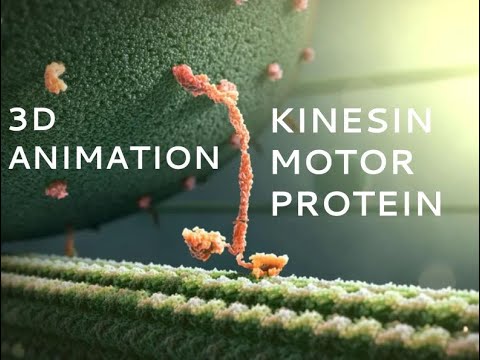
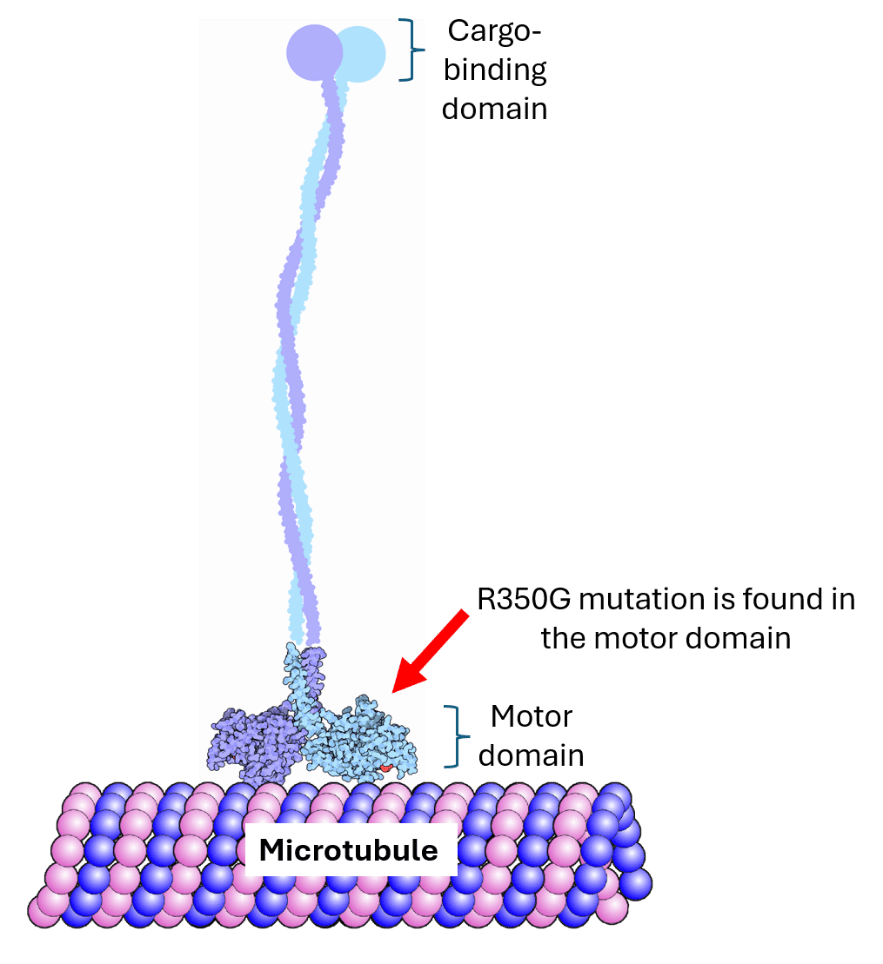
For neurons to be able to talk to each other and function, materials must be transported throughout the cell. Neurons use a family of proteins called kinesin motors (see video 1) to take cargo from one end of the neuron to the other. One kind of kinesin also simply called ‘motors’, specialized for this timely, long-distance transport is called KIF1A. KIF1A is a kinesin motor protein that “walks” along the axon’s roadway, which is made of a material called microtubules, to deliver materials. KIF1A acts as a delivery truck, moving cargo down the length of neurons by using ATP as fuel to take alternating steps (see video 1). KIF1A is a particularly unique motor compared to other motor proteins; it’s fast and travels further distances before detaching from the microtubule. The KIF1A structure has “parts” called domains that help it to work. KIF1A uses its cargo-binding domain to identify and bind to the cargo that needs to be transported. KIF1A uses the motor domain to interact and take steps along the microtubule. (see video 1, see figure 1).
Unfortunately, mutations can happen to KIF1A, causing it to behave differently. Mutations are “typos” in the instruction manual that make up the KIF1A protein. There is one mutation in the motor domain, called R350G, that makes KIF1A walk faster than normal (see figure 1).
How does this mutation make KIF1A faster?
The R350G mutation affects KIF1A’s stepping rhythm along the microtubule. KIF1A uses the motor domain to step along the microtubule, like how we alternate between two feet when we walk1 (see Figure 1). When we put one foot forward to take a step we wait for it to be firmly planted before lifting the back foot off the ground. Motor proteins typically do the same, but the R350G mutation in the motor domain destroys this waiting period, making KIF1A take faster steps1.
You might think this is a good thing because faster motors mean faster delivery, right? Not exactly. The mutation makes KIF1A unstable. Research shows that while the motor moves faster, KIF1A is unable to walk as far as it usually does because it falls off the microtubule too often1. Think of it this way: we walk with our feet in a coordinated fashion, with the front foot pausing until our back foot catches up. If this rhythmic step becomes out-of-sync, we will more likely fall to the ground. The same can be said with KIF1A stepping. The R350G disrupts this rhythmic stepping, making KIF1A more prone to falling off the microtubule.
What are the consequences of a faster motor on the cell?
Remember that KIF1A acts as a cargo truck, taking materials and making timely deliveries throughout the cell. If you have a truck that is always speeding and doesn’t respect traffic lights, it is bound to get into accidents, thus delaying the delivery. This is exactly what the R350G mutation does to cargo trafficking in a cell. Research shows that the R350G mutation causes KIF1A to deliver incorrect amounts of cargo and delivers to the wrong location3. More specifically, like a speeding truck, the R350G mutation does not respect “cues” on the microtubule that tells the motor to “stop” and release the cargo, causing the motor to miss the delivery address2.
How does this translate to disease?
Because R350G causes KIF1A to move faster but inefficiently deliver the cargo, the cargo needed for the neurons to survive and communicate gets lost. Overtime this causes the neuron to become sick and die. People with this mutation develop a disease called Hereditary Spastic Paraplegia 30 (SPG30), which causes progressive weakness in the legs5. We have long neurons that make connections all the way down to our legs. If these neurons cannot properly communicate with the muscles in our legs, our leg muscles will become weak and unresponsive. People with the R350G mutation suffer from muscle weakness because KIF1A is unable to properly and efficiently deliver the cargo. This just goes to show how beautifully precise and tightly regulated axonal trafficking is in neurons, and that any slight deviation can cause profound effects on the cell and eventually the person. Scientists are now trying to find ways to get rid of the bad KIF1A and introduce the normal KIF1A into patients4. As this goes on, we are hoping that this provides benefit to the people suffering from “typos” in KIF1A.
References
- Shatarupa, A., Rao, L., Asenjo, A. B., Gennerich, A., & Sosa, H. (2026). Pathogenic KIF1A R350 mutations disrupt a conserved and conformation-dependent kinesin-tubulin salt bridge. Nature communications, 17(1), 5175. https://doi.org/10.1038/s41467-026-71026-6
- Aiken, J., Borland, C., Marotta, N., Prosser, B. L., & Holzbaur, E. L. F. (2026). Pathogenic KIF1A variants differentially disrupt axonal trafficking and impede synaptic development. bioRxiv : the preprint server for biology, 2026.01.14.699478. https://doi.org/10.64898/2026.01.14.699478
- Chiba, K., Takahashi, H., Chen, M., Obinata, H., Arai, S., Hashimoto, K., Oda, T., McKenney, R. J., & Niwa, S. (2019). Disease-associated mutations hyperactivate KIF1A motility and anterograde axonal transport of synaptic vesicle precursors. Proceedings of the National Academy of Sciences of the United States of America, 116(37), 18429–18434. https://doi.org/10.1073/pnas.1905690116
- Zuccaro, M. V., Young, R. E., Hu, J., Lanzano, P., Semenova, E., Lin, X., Skowronski, A., Shen, Y., Kim, T. H., Miller, D. E., Germain, N., Sarmiere, P., LeDuc, C. A., & Chung, W. K. (2026). Antisense oligonucleotides to KIF1A polymorphisms expand targets and rescue patient-derived neurons in vitro. Nature communications, 17(1), 1109. https://doi.org/10.1038/s41467-025-67752-y
- Klebe, S., Lossos, A., Azzedine, H., Mundwiller, E., Sheffer, R., Gaussen, M., Marelli, C., Nawara, M., Carpentier, W., Meyer, V., Rastetter, A., Martin, E., Bouteiller, D., Orlando, L., Gyapay, G., El-Hachimi, K. H., Zimmerman, B., Gamliel, M., Misk, A., Lerer, I., … Stevanin, G. (2012). KIF1A missense mutations in SPG30, an autosomal recessive spastic paraplegia: distinct phenotypes according to the nature of the mutations. European journal of human genetics : EJHG, 20(6), 645–649. https://doi.org/10.1038/ejhg.2011.261
No LLMs or AI assistance were used in the creation of this post.
Cover photo by Richard Croft in Wikimedia Commons
Linked video uploaded by Professor Chimp on Youtube.
Figure 2 image by David Goodsell from Wikimedia Commons
 PennNeuroKnow


Leave a comment