December 23rd, 2025
Written by: Victoria Subritzky Katz
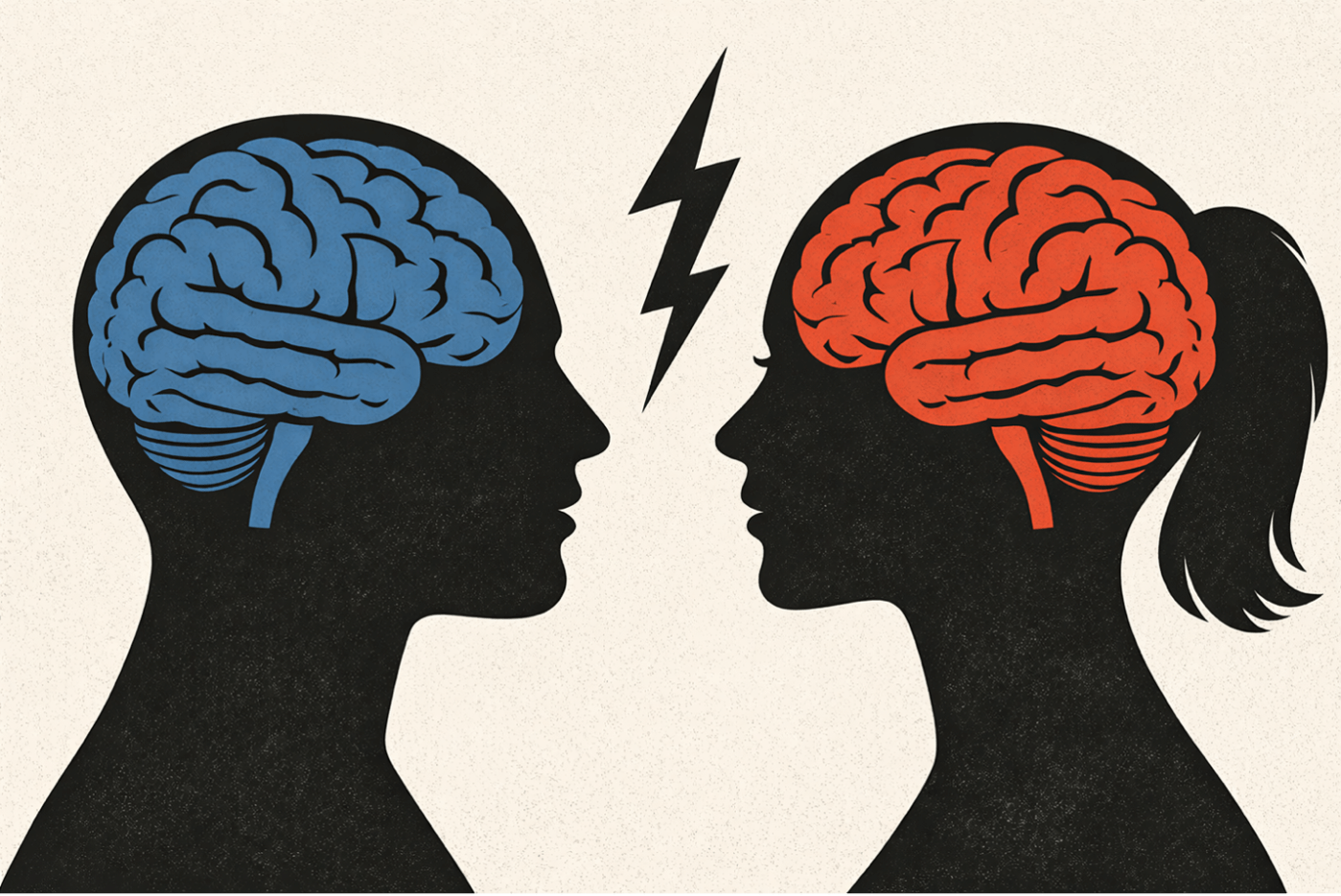
“Men and women are different in this way…men can compartmentalize things” stated Speaker of the House Mike Johnson in a recent TV interview. His wife, Kelly Johnson, added “Men’s brains are like waffles” and later followed up with the idea that women’s brains are like spaghetti (watch the clip here). While neither a waffle nor spaghetti are a very apt description of anyone’s brain -man or woman- the belief that there is some fundamental difference between the mind of a man and a woman has been pervasive in society long before speaker Johnson and his wife entered the scene. Too often, these assumed differences are used to sustain the idea that men are intellectually superior to women. But is any of it true? Let’s see what the science says about cognitive ability between men and women and what sex differences* there might be in the underlying brain structure and biological mechanisms.
Who’s smarter?
Intelligence is difficult to define and quantify, as the popular expression goes, if you judge a fish by its ability to climb a tree, it will live its whole life believing that it is stupid. That hasn’t stopped psychologists, neuroscientists, school admission boards, and your most irksome sibling from developing ways to try to measure who’s smarter than who. Across a variety of tests and evaluation conditions (such as verbal, numerical, spatial and abstract reasoning) there is a consensus: there is no reliable or significant difference in ‘general intelligence’ between men and women1-4. This has been shown when intelligence is evaluated in children3,4, in adults1,3,4, and across different metrics1 to quantify intelligence. One study conducted in Romania evaluated 15,000 participants across a battery of six different intelligence tests and did not find evidence supporting either sex having the edge in general intelligence1.
Breaking it down further, there is some evidence that there are differences between men and women for sub-categories of intelligence, however these results are less consistent. Studies have found that men tend to be better at visual processing—tasks that require the spatial manipulation of an object2-4. On the other hand, women outperform men when it comes to evaluations of processing speed4 and measures related to self-control (like response inhibition tasks)2,3. These results have been found in multiple studies, but not all. Some work has found that using different tests to evaluate the same subcategory of intelligence do not replicate the result even within the same test subjects1.
An area that research has identified sex differences is how we tend to rate our own intelligence. Men tend to estimate their own intelligence higher than women, unrelated to either’s actual measured intelligence5. There may be a sex difference in perception of intelligence, but not in performance.
Whose brain is better?
Even if behavioral evidence shows no difference in general intelligence between men and women, are their brains different? Scientists can use fMRI to measure the size and shape of different brain regions, allowing us to compare brain structure between men and women by looking at the brains of thousands of participants.
Using this technique, scientists have found that men’s brains are, on average, 11% larger in volume than women’s6. But keep in mind that on average men’s bodies are larger than women’s too. The difference in average brain size between men and women is actually less than the average difference for other internal organs: on average men’s heart are 17% larger, lungs 23 %, liver 14 %, pancreas 18 %, and kidneys 19 %6. However, it’s worth noting that the difference in body size does not seem to entirely account for the difference in brain size between men and women, though this is still debated by researchers6-8.
What’s potentially more interesting are differences in the relative size of different parts of the brain. For example, a particular brain region may take up more of the brain’s total volume in men than women, making that region larger proportionally. A recent study analyzed 40,028 brain scans of men and women, measuring the volume of 620 different brain regions and statistically correcting for differences in total brain size7. They found 36% of the areas were larger in men and 29% were larger in women7. However, it is important to note that the amount by which these sub regions were different between men and women is very small. On average, the size of brain regions between men and women overlapped by 86.9%, meaning that most individuals of either sex fall well within the same range9. The variation in the size of brain regions within men and within women is much larger than the difference between their group averages.
But what might these small differences in brain structure and total brain volume actually mean for how the brain works? The short answer is we don’t know for sure. Outside of obvious cases like brain injury or disease, the size of a brain region does not reliably tell us anything about ability or behavior9. Size isn’t everything! If brain size equated to intelligence, then you might expect sperm whales with their 20lb brains to be the intellectual heavy weights, not humans with our measly 3lb brains. While scientists can link certain brain areas to different functions, we are still learning how those regions do their jobs and don’t have anything concrete to say about how size plays into that function. So far, these small differences in the size of brain regions between men and women have not proven to be very informative about differences in function.
Are our brains the same?
There isn’t a clear answer for what sex differences in brain size might mean, but where scientists have found meaningful differences between male and female brains is in the biological mechanisms underlying function. These differences are called latent sex differences because the outcome is the same even though the mechanisms are different9. You can think of latent sex differences as differences in form but not function—both methods get you from A to B equally well, just using different steps.
Groundbreaking work from Dr. Catherine Woolley’s lab looking at biological mechanisms in rats has shown that there are latent sex differences in a region of the brain important for learning and memory called the hippocampus. How the connections between certain types of neurons are strengthened, which is an essential part of learning and memory, is accomplished through different mechanisms in male and female rats. Researchers already knew that estrogens, a group of hormones commonly linked to female reproduction but present and active in both male and female brains, strengthen these connections. However, what Dr. Woolley found is that while the outcome is the same (connections get strengthened), how estrogen does this in males and females is quite different. Because of these different hows,releasing a particular enzyme (FAAH) in the hippocampus weakened the connections between neurons in female rats but had no effect on the male rats9,10. This is just one example of latent sex difference in form and not function that scientists are beginning to uncover across the brain.
Even though the outcome of the process might be the same, latent sex differences are important when it comes to medicine and designing drugs that target specific steps in a process. If a treatment is designed based on male neural mechanisms to target a certain step on the path from A to B, but that step is different or doesn’t exist in the female brain, then the treatment won’t work correctly when administered to women, or vice versa. This underscores why it is imperative to include all genders in drug development and not exclude women from clinical trials— which was the standard FDA policy until the 1990’s11.
Claims about inherent male or female superiority in intelligence, such as Speaker Johnson’s assertion that men are better at compartmentalizing, do not hold up under scientific scrutiny. Research does reveal meaningful differences in biological mechanisms between men’s and women’s brains, but these differences reflect variarion, not hierarchy. Instead, they highlight the diversity of neural strategies the brain uses to accomplish the same functions. Recognizing these sex differences is important, not to rank one sex over another, but to ensure science and healthcare serve everyone.
*Note: This article uses “sex differences” to refer to differences based on the biological concept of sex, understood as a pattern of biological features (such as chromosomes, hormones, and anatomy) that often, but not always, covary. It does not address gender, which reflects socially constructed identities, roles, and experiences that are shaped by cultural and social contexts12.
References
- Iliescu, Dragos, Alexandra Ilie, Dan Ispas, Anca Dobrean, and Aurel Ion Clinciu. 2016. “Sex Differences in Intelligence: A Multi-Measure Approach Using Nationally Representative Samples from Romania.” Intelligence 58: 54–61.
- Gaillard A, Fehring DJ, Rossell SL. A systematic review and meta-analysis of behavioural sex differences in executive control. Eur J Neurosci. 2021; 53: 519–542.
- Giofrè D, Toffalini E, Esposito L, Cornoldi C. Sex/gender differences in general cognitive abilities: an investigation using the Leiter-3. Cogn Process. 2024 Nov.
- Reynolds, Matthew R., Daniel B. Hajovsky, and Jacqueline M. Caemmerer. 2022. “The Sexes Do Not Differ in General Intelligence, but They Do in Some Specifics.” Intelligence 92: 101651.
- Furnham, Adrian. 2001. “Self-Estimates of Intelligence: Culture and Gender Differences in Self and Other Estimates of Both General (g) and Multiple Intelligences.” Personality and Individual Differences 31 (8): 1381–1405.
- Eliot L, Ahmed A, Khan H, Patel J. Dump the “dimorphism”: Comprehensive synthesis of human brain studies reveals few male-female differences beyond size. Neurosci Biobehav Rev. 2021 Jun;125:667-697. doi: 10.1016/j.neubiorev.2021.02.026. Epub 2021 Feb 20. PMID: 33621637.
- Williams CM, Peyre H, Toro R, Ramus F. Sex differences in the brain are not reduced to differences in body size. Neurosci Biobehav Rev. 2021 Nov;130:509-511. doi: 10.1016/j.neubiorev.2021.09.015. Epub 2021 Sep 11. PMID: 34520800.
- Ritchie SJ, Cox SR, Shen X, Lombardo MV, Reus LM, Alloza C, Harris MA, Alderson HL, Hunter S, Neilson E, Liewald DCM, Auyeung B, Whalley HC, Lawrie SM, Gale CR, Bastin ME, McIntosh AM, Deary IJ. Sex Differences in the Adult Human Brain: Evidence from 5216 UK Biobank Participants. Cereb Cortex. 2018 Aug 1;28(8):2959-2975. doi: 10.1093/cercor/bhy109. PMID: 29771288; PMCID: PMC6041980.
- Woolley CS. His and Hers: Sex Differences in the Brain. Cerebrum. 2021 Jan 1;2021:cer-02-21. PMID: 34650671; PMCID: PMC8493822.
- Huang GZ, Woolley CS. Estradiol acutely suppresses inhibition in the hippocampus through a sex-specific endocannabinoid and mGluR-dependent mechanism. Neuron. 2012 Jun 7;74(5):801-8. doi: 10.1016/j.neuron.2012.03.035. PMID: 22681685; PMCID: PMC3372866.
- Balch, Bridget. “Why We Know So Little About Women’s Health.” AAMCNews, March 26, 2024. Accessed December 22, 2025.
- Canadian Institutes of Health Research. 2023. “What is Gender? What is Sex?” Canadian Institutes of Health Research. Accessed October 21, 2025.
ChatGPT version GPT-5.2 was used to help with rewording a few sentences and the blurb.
Cover photo generated by Victoria Subritzky Katz using ChatGPT version GPT-5.2.
 PennNeuroKnow
Leave a comment