July 22nd, 2025
Written by: Lindsay Ejoh
Have you ever stomped on grass or cut a flower stem and wondered to yourself: “Can the plants feel this? Am I hurting them?” The answer might seem like an obvious no, but some plant researchers beg to differ. The ways some plant species react to damage open the door to fascinating questions about what pain really is, whether plants experience it, or if they are even conscious enough to experience anything.
What is pain, really?
To keep our bodies safe, we, like most animals, have specialized sensors in our bodies that alert us when we are experiencing physical harm. These pain sensors are attached to nerves that quickly carry pain signals to the brain, alerting us to the pain so we can respond and prevent further damage to the body1.
We already know that pain hurts— sometimes causing a LOT of discomfort and suffering. Scientists believe this aspect of pain is actually for our own good— it motivates us to avoid things in our environment that could harm our bodies2. This ultimately helps keep us safe and better able to pass our genes on to the next generation.
Plants, on the other hand, do not have pain sensors, nerves, or a brain. At first glance, it seems there is no machinery in place for them to experience pain (or anything, really). But shockingly, some plants react to physical damage in pretty sophisticated ways.
Venus flytraps move in response to touch
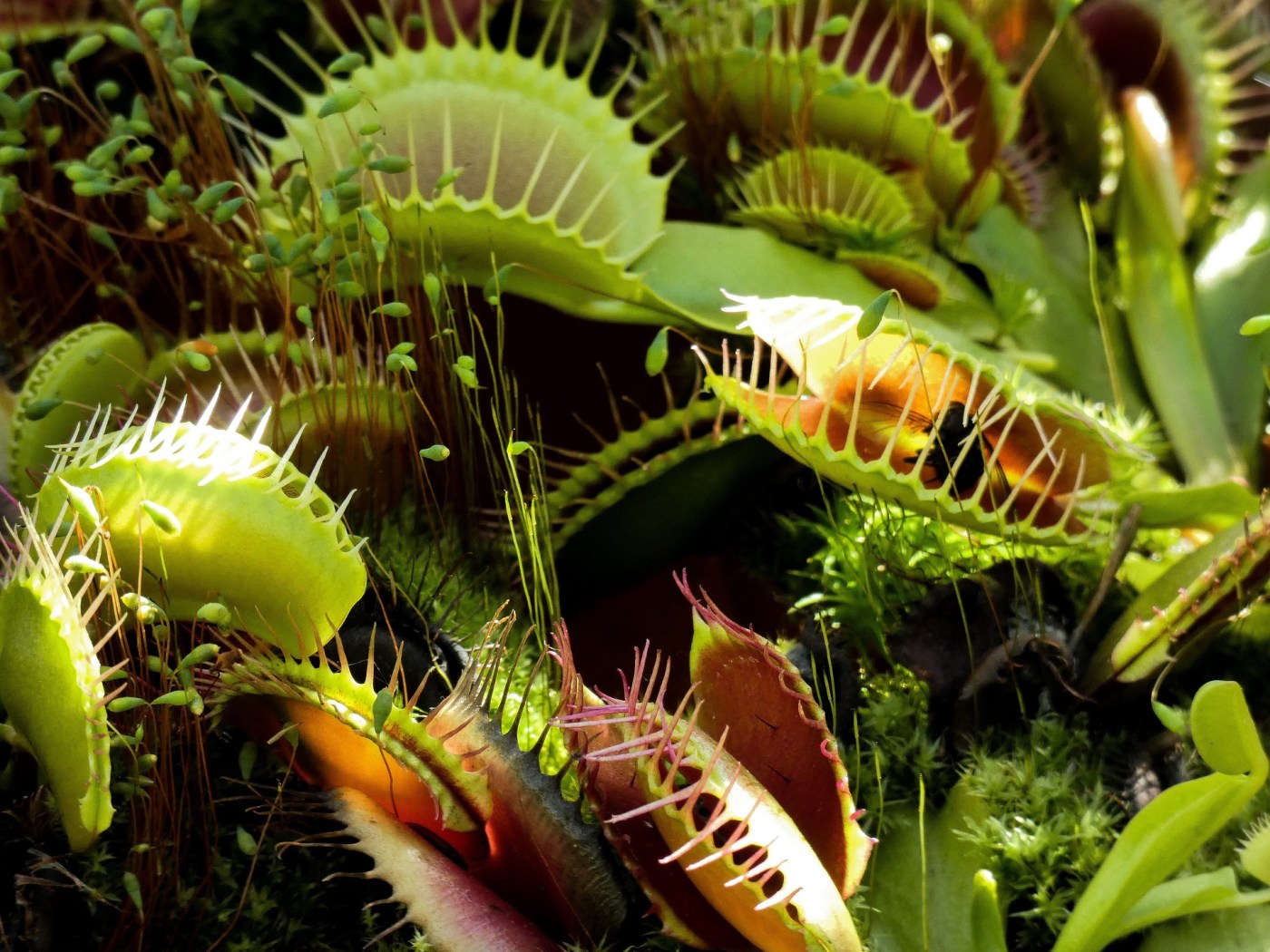
The Venus flytrap is famous for being one of the few carnivorous plants on planet earth3. When hungry, it uses two strategies to attract food: its leaves turn a bright red color and it releases airborne chemicals that attract starving prey (mostly flies and spiders). Once a bug comes looking for food, they step onto touch sensors on the surface of the Venus flytrap’s inner leaves4. The touch sensors detect the weight of the prey on the leaf and send signals to the flytrap’s outer leaves to trigger them to snap shut, trapping the bug. The outer leaves also have small bristles running along them to ensure that the prey has no chance to escape. There are other carnivorous plants in the wild, but the Venus flytrap is one of the few that physically detects prey and moves to trap them. Another example of a plant that responds to touch is the Mimosa pudica, which also folds up when touched— though not for the purpose of capturing its next meal. It does this to discourage herbivores from eating it by making its leaves look thinner and less appealing5. Check out this video to watch the Mimosa pudica in action!
Same machinery, different species
Interestingly, our nervous systems detect pain using the same fundamental force that drives movement in the Venus flytrap and Mimosa pudica: electricity4.
For example, when you touch a hot stove, pain sensors in your skin send electrical signals to communicate that pain to other nerves in your body and brain1. These nerves also use electricity to force your muscles to pull your hand back from that dangerously hot surface. Even gentle, non-painful touches work this way— electrical signals not unlike those used in Venus flytraps help communicate your sense of touch to your brain.
Now, while plants do not have nerves, they do use electrical signals in a similar way to us. In the Venus flytrap and Mimosa pudica, their touch sensors cause a flow of electrically-charged chemicals through the leaf that allow their leaves to move. Our own touch and pain sensors also use the same electrically charged chemicals to power our nerves.
Fascinatingly, movement in these plants can be blocked using the same drugs that block touch and pain signals in humans6! Lidocaine, the numbing medicine your dentist may use during a procedure, works by blocking the flow of electrically-charged chemicals, which stops nerves from sending pain signals to the brain. Even though plants do not have nerves, they rely on the movement of these same chemicals to send signals through the plant— so lidocaine can stop their movements too.
So it’s pretty clear that plants can detect touch— but can they feel pain??
The (weak) case for plant pain
Some scientists argue yes, plants do feel pain, at least in a loose sense. A research group from the University of Bonn found that certain plants, like the sagebrush7, release chemical gases when damaged, possibly as a warning to nearby plants8. Other researchers have recorded ultrasonic sounds outside the hearing range of humans coming from tomato plants that are stressed, dehydrated, or injured9. But again, does that count as pain? These findings suggest that plants respond to damage, but that’s not quite the same thing as feeling pain.
The (strong) case against plant pain
The (shortened) definition of pain from the International Association for the Study of Pain is:
“An unpleasant sensory and emotional experience associated with actual or potential tissue damage.”
Key word: emotional. Experiencing pain is more than just sensing damage- it’s suffering from it. Pain is a two-sided process where you sense damage and then experience emotions from it. This emotional experience requires a brain, something plants simply don’t have. Experiencing pain also requires the ability to consciously perceive something, so arguably species that aren’t conscious, like plants, can’t feel pain. They might be able to respond to damage (as can very simple organisms like bacteria!), but they can’t consciously feel it.
So while plants are capable of detecting and responding to physical touch and damage in really impressive ways, the current consensus among pain researchers is: no, plants do not feel pain.
They move. They release gases. They might even scream- but plants do not suffer. However, they do interact with and respond to their environment in a variety of complex ways to keep themselves alive. So, it’s up to you how much you want to protect them given what they can, and can’t, do and feel! As for me, I won’t worry too much next time I eat a forkful of salad.
References
- U.S. Department of Health and Human Services. (n.d.). Pain. National Institute of Neurological Disorders and Stroke. https://www.ninds.nih.gov/health-information/disorders/pain
- Nesse, R. M., & Schulkin, J. (2019). An evolutionary medicine perspective on pain and its disorders. Philosophical transactions of the Royal Society of London. Series B, Biological sciences, 374(1785), 20190288. https://doi.org/10.1098/rstb.2019.0288
- Hedrich, R., & Neher, E. (2018). Venus Flytrap: How an Excitable, Carnivorous Plant Works. Trends in plant science, 23(3), 220–234. https://doi.org/10.1016/j.tplants.2017.12.004
- Procko, C., Wong, W. M., Patel, J., Mousavi, S. A. R., Dabi, T., Duque, M., Baird, L., Chalasani, S. H., & Chory, J. (2023). Mutational analysis of mechanosensitive ion channels in the carnivorous Venus flytrap plant. Current biology : CB, 33(15), 3257–3264.e4. https://doi.org/10.1016/j.cub.2023.06.048
- Ahmad, H., Sehgal, S., Mishra, A., & Gupta, R. (2012). Mimosa pudica L. (Laajvanti): An overview. Pharmacognosy reviews, 6(12), 115–124. https://doi.org/10.4103/0973-7847.99945
- De Luccia T. P. (2012). Mimosa pudica, Dionaea muscipula and anesthetics. Plant signaling & behavior, 7(9), 1163–1167. https://doi.org/10.4161/psb.21000
- Gauna, F. J. (n.d.). U.S. Forest Service. Forest Service Shield. https://www.fs.usda.gov/wildflowers/plant-of-the-week/artemisia_tridentata.shtml
- Dove, L. L., & Bowie, D. (2023, September 7). Do plants feel pain? A Primer on Plant Neurobiology. HowStuffWorks Science. https://science.howstuffworks.com/life/botany/plants-feel-pain.htm
- Khait, I., Lewin-Epstein, O., Sharon, R., Saban, K., Goldstein, R., Anikster, Y., Zeron, Y., Agassy, C., Nizan, S., Sharabi, G., Perelman, R., Boonman, A., Sade, N., Yovel, Y., & Hadany, L. (2023). Sounds emitted by plants under stress are airborne and informative. Cell, 186(7), 1328–1336.e10. https://doi.org/10.1016/j.cell.2023.03.009
Cover image by Lawrie Phipps from Pixabay
 PennNeuroKnow
What’s interesting is how the brains and nervous systems that do feel pain rely on some of the same functionality found in plants and possibly all living organisms – excitable membranes and irritability.
LikeLike