

September 29th, 2026
Written by Meagan Olson
The night of Hecate
I sat on the floor in the lamplight, arranging the altar with amethyst, moonstone, smoky quartz, obsidian, a cup of dried lavender, a jar of honey, and a few heads of garlic. I focused my intentions and softly recited the invocation to Hecate, the Greek goddess of the moon, magic, and crossroads (Figure 1). During the night of Hecate, she is reputed to roam the Earth and bless those who left her offerings. I was hoping my crystals and herbs would delight her, and that she would offer me guidance and protection navigating the crossroads I was facing.
At the time, I was in the midst of applying to graduate school. I knew that in less than a year, if I was lucky enough to be accepted somewhere, I would likely be moving to a new place to start school- leaving my home state and my family. Surrounded by such big unknowns, I was anxious. I was hoping that by creating an altar and focusing my thoughts on getting into a graduate program and smoothly transitioning into my next phase of life, that Hecate would work her magic in my favor.
She must have heard my call, because a few months later I received an invitation to interview with the UPenn Neuroscience program! In the weeks that followed, I occasionally returned to the altar, each time focusing on the same hope of being accepted. The night before I was expecting to hear back about a decision, I placed my UPenn Neuroscience tote bag in front of the altar. The next morning, I finally got the call that I had wished so badly for, I was accepted!
So my manifestation worked! Or did it? Was my acceptance thanks to the goddess Hecate? Sheer luck? Or some other divine intervention? There’s no way any of that could be real, right? Crystals and garlic don’t have magical powers! Or perhaps setting my intention to get into grad school helped shape my perception and behavior to better pursue the future I was imagining.

Neuroscience: the magic behind manifestation
Manifestation is the practice of focusing your thoughts and intentions on something you hope to achieve or experience. It can take many forms, and you’ve probably done some version of it before without even realizing it. Maybe you’ve visualized yourself succeeding at an important event, written out your New Year’s resolutions, repeated an affirmation, prayed for something you desperately wanted, or closed your eyes before blowing out your birthday candles and made a wish. But how can simply thinking about your aspirations actually bring them to fruition? Turns out, it may actually be our own brains doing the magic.
Despite its popularity, manifestation itself has received surprisingly little scientific investigation. One of the few studies to examine manifestation found that more than a third of participants believed that manifestation could influence success to some degree, but there is currently no scientific evidence that simply thinking about something causes the universe to deliver it1.
However, many of the individual processes involved in manifestation, such as attention, mental imagery, neuroplasticity, and goal-directed behavior, have been studied extensively. When we manifest, we focus our attention on something we want, imagine what that future might look like, and repeatedly return to those thoughts and expectations. In turn, these processes can influence what motivates us and how we behave in pursuit of our goals. By breaking manifestation down into these components, we can begin to understand how focusing on a desired future might shape our brains and ultimately affect how we interact with the world around us.
Seeing what we seek
Many manifestation practices begin by slowing down, taking a few deep breaths, and focusing your attention inward. These elements of mindfulness can promote relaxation and reduce stress2, and this calm state makes it easier to direct your thoughts towards your intentions3. And that is where manifestation becomes particularly powerful: you can choose what deserves your attention.
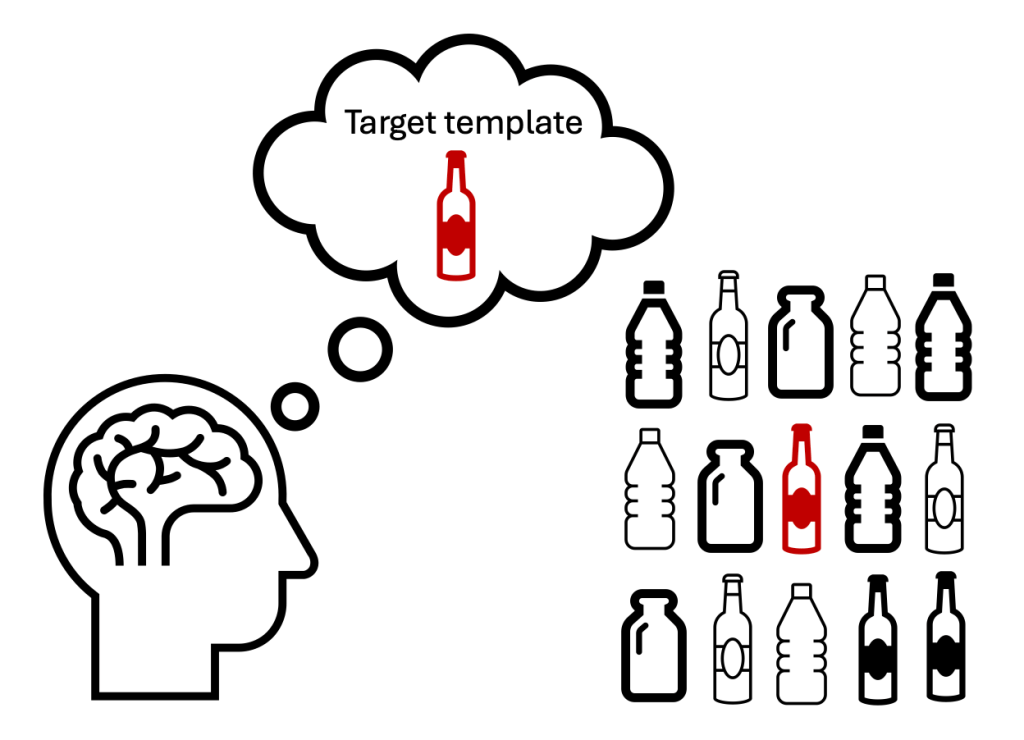
At any given moment, your brain is receiving far more information than you could possibly pay attention to. What captures our attention depends not only on what is happening around us, but also on what we’re currently looking for and what matters to us. To help navigate this overwhelming sensory environment, our brains can use internal representations of what we’re looking for to prioritize important information. These internal representations, sometimes called attentional or target templates, can help guide our attention toward information in our environment that is relevant to us4,5. Neural systems including the salience network help to hone in on information that is relevant to our current needs, emotions, or goals, and recruits other brain networks needed to respond to it6. In this way, what we hold in mind can influence what we notice in the world around us.
Perhaps you’re in the condiment section of the grocery store, and you’re looking for Heinz ketchup. Among the bottles of mayonnaise, mustard, barbecue sauce, and relish, you hone in on the red ketchup bottles. Except there are still so many red bottles to choose from, and the screaming child in aisle four is making it hard to concentrate. You’ve already been standing there for a minute, growing increasingly annoyed by the elusive Heinz ketchup. You think in your mind: “Heinz, I’m looking for the Heinz ketchup”, and you might even try to imagine the bottle with the brand “Heinz” on it as you visually scan the rows of red bottles. Until finally, aha! You’ve found the one you were looking for and drop it in the cart. Although it may seem like it, the Heinz bottle didn’t suddenly appear. As finding the Heinz bottle became more relevant to you, your salience network worked to focus your brain’s attention and hone in on locating it (Figure 2).
Repeatedly focusing on a goal through manifestation could therefore make goal-relevant information more likely to capture our attention. By deliberately bringing an aspiration to mind, we reinforce its personal relevance and create mental representations which can bias our salience network toward information related to that goal. This doesn’t mean that manifestation causes opportunities to appear; instead, changing what is important to us can change what we notice in an environment that is already full of information. Noticing something is often the first step toward acting on it.
Dreaming of the future can change the brain
Directing your attention is only part of the process. Manifestation usually involves imagining something that has not happened yet. Luckily, this is something that humans are particularly good at. A collection of interconnected brain regions known as the default mode network becomes active during many forms of internal thought, including remembering our past, thinking about ourselves, daydreaming, and imagining possible future events7. To construct these imagined futures, the brain can recombine pieces of previous experiences into simulations of events that have never occurred8. In this sense, the brain is constantly making predictions based on past experiences, allowing us to imagine what might happen next and how we might respond.
By visualizing your aspirations, particular neuronal pathways, which are webs of neurons connected together, are activated in your brain. For example, perhaps you are a soccer player and have an important game coming up. You imagine yourself running across the field, taking the shot, watching the ball enter the goal, and hearing the crowd cheer. What you may not expect, is that visualizing making a goal activates similar neural pathways as actually making a goal. Neuroimaging studies show that imagining movements recruits parts of the motor-related networks involved in actually performing them9. In other words, visualization gives your brain the opportunity to rehearse, which can help to improve your performance when it comes time to execute these actions in the real world10.
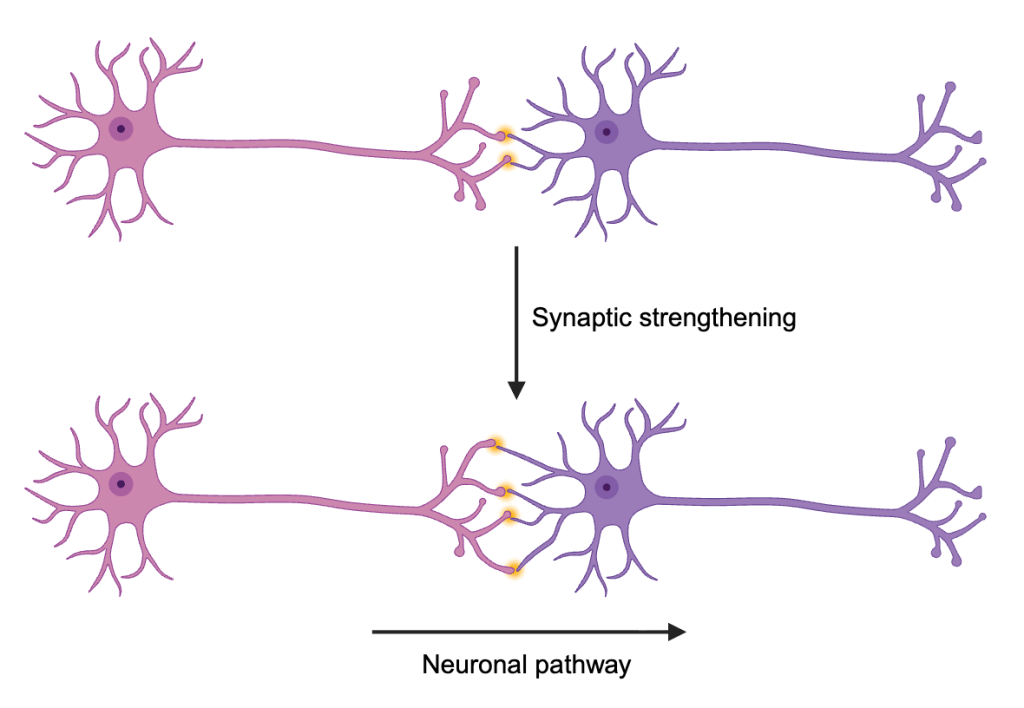
If the same neuronal pathways are activated over and over again, these pathways can be strengthened. This ability of the brain to reorganize itself in response to experience is called neuroplasticity. When connected neurons are repeatedly active together, the synapses between them can become stronger. This is often summarized as “cells that fire together, wire together” (Figure 3)11.
There is extensive evidence that repeated experience and practice can strengthen or refine the neuronal pathways involved in those behaviors11. Because mental rehearsal can recruit some of the same neural systems involved in actually performing an action, repeatedly imagining an action may also contribute to changes in these networks9,10. The strengthening of these pathways allows our brain to activate these networks more efficiently in the future11.
Turning intention into action
So you’ve manifested, you open your eyes, and now what? Well now you continue to go about your life. But now you may be more prepared to recognize and act on opportunities related to your goal. Imagining a future does not make it happen, but the mental representations we create can influence our behavior. When we imagine obtaining something we value, we can engage neural systems involved in reward and decision making, helping make that future something we are motivated to pursue12.
Mental simulation may also help translate those intentions into action. Research across a variety of behaviors suggests that mentally simulating future actions can make us more likely to subsequently perform them13. In this way, imagining a desired future may actually help us carry out the actions needed to pursue it.
But imagining success is not the same as achieving it. Research on goal pursuit suggests that simply fantasizing about a desired future may not be enough14; connecting our goals to concrete plans and actions is more effective for actually achieving them15. For example, if you want to manifest being a great artist, you could set an intention to practice painting every evening. By imagining yourself coming home, eating dinner, and then setting up your art supplies and painting, this could make it more likely that you will actually practice painting in the future. Ultimately, our internal thoughts can only influence our goals if they change how we behave. We have to recognize opportunities, make decisions, and act on our intentions.
But even effectively changing your behavior does not guarantee success. There will always be circumstances outside of our control, and no amount of positive thinking can eliminate every obstacle we face. Manifestation may help us imagine our future, but whether that future becomes reality still depends on what happens next.
If you can dream it, you can achieve it
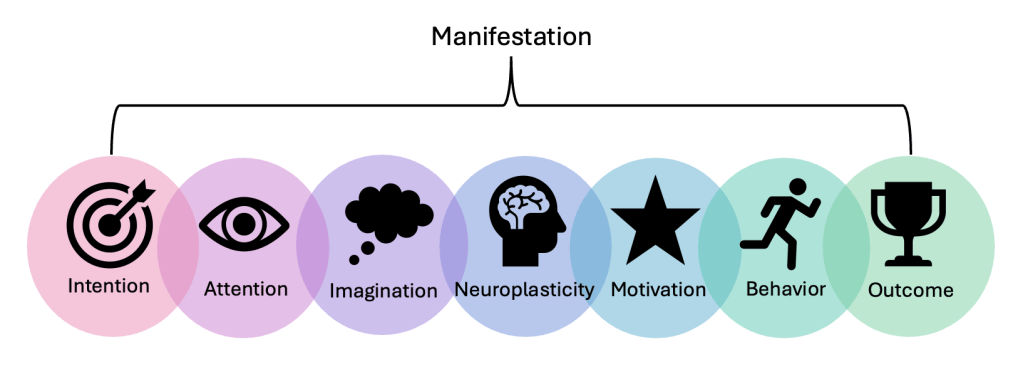
Together, these mechanisms provide a possible neuroscientific explanation for how some practices associated with manifestation could influence our behavior (Figure 3). Intention can direct attention. Attention can influence what we perceive. Visualization can simulate possible futures and rehearse actions. Repetition and experience can change neural circuits through neuroplasticity. All of these elements affect our behavior and can subsequently alter the outcomes we experience. In this way, the process of manifestation can be used as a tool for guiding the thoughts and behaviors that can bring our goals to fruition.
Does it matter where the magic comes from?
All of this may sound eerily similar to the placebo effect, which describes when our preconceived knowledge and expectations can affect our subjective experiences, behaviors, and physiological responses. The placebo effect demonstrates that what the brain expects can sometimes influence how the nervous system processes what happens next16.
If holding a crystal or reciting an affirmation helps someone focus attention, visualize a goal, or regulate stress, the object itself does not need to possess supernatural properties for the ritual surrounding it to produce real psychological effects.
So did Hecate get me into Penn? Perhaps it wasn’t entirely her guidance that got me accepted into the grad program of my dreams. Perhaps taking a break from writing my application essays to sit in the darkness helped quiet my mind, reciting an invocation to her helped me focus in on what I wanted my future to look like, and imagining how exciting an acceptance would be helped motivate me to work harder towards that goal. But of course, beyond my own actions there were a multitude of other factors that aligned to result in my acceptance.
While manifestation may not magically make your dreams come true through mystical powers beyond your control, it can be a tool for shaping your own mind and focusing on the things you do control. Understanding the neuroscientific underpinnings of manifestation doesn’t make the process any less special. Our brains are capable of amazing things, including changing how we perceive, respond to, and ultimately impact the world around us.
(Also, Hecate if you’re still listening, I’d love to get a job after grad school as well…)
References
- Dixon, L. J., Hornsey, M. J., & Hartley, N. (2025). “The Secret” to Success? The Psychology of Belief in Manifestation. Personality and Social Psychology Bulletin, 51(1), 49–65. https://doi.org/10.1177/01461672231181162
- Zaccaro, A., Piarulli, A., Laurino, M., Garbella, E., Menicucci, D., Neri, B., & Gemignani, A. (2018). How Breath-Control Can Change Your Life: A Systematic Review on Psycho-Physiological Correlates of Slow Breathing. Frontiers in Human Neuroscience, 12, 353. https://doi.org/10.3389/fnhum.2018.00353
- Tang, Y.-Y., Hölzel, B. K., & Posner, M. I. (2015). The Neuroscience of Mindfulness Meditation. Nature Reviews Neuroscience, 16(4), 213–225. https://doi.org/10.1038/nrn3916
- Carlisle, N. B., Arita, J. T., Pardo, D., & Woodman, G. F. (2011). Attentional Templates in Visual Working Memory. Journal of Neuroscience, 31(25), 9315–9322. https://doi.org/10.1523/JNEUROSCI.1097-11.2011
- Moriya, J. (2018). Visual Mental Imagery Influences Attentional Guidance in a Visual-Search Task. Attention, Perception, & Psychophysics, 80(5), 1127–1142. https://doi.org/10.3758/s13414-018-1520-0
- Menon, V., & Uddin, L. Q. (2010). Saliency, Switching, Attention and Control: A Network Model of Insula Function. Brain Structure and Function, 214(5–6), 655–667. https://doi.org/10.1007/s00429-010-0262-0
- Andrews-Hanna, J. R., Smallwood, J., & Spreng, R. N. (2014). The Default Network and Self-Generated Thought: Component Processes, Dynamic Control, and Clinical Relevance. Annals of the New York Academy of Sciences, 1316(1), 29–52. https://doi.org/10.1111/nyas.12360
- Schacter, D. L., Addis, D. R., & Buckner, R. L. (2008). Episodic Simulation of Future Events: Concepts, Data, and Applications. Annals of the New York Academy of Sciences, 1124, 39–60. https://doi.org/10.1196/annals.1440.001
- Hardwick, R. M., Caspers, S., Eickhoff, S. B., & Swinnen, S. P. (2018). Neural Correlates of Action: Comparing Meta-Analyses of Imagery, Observation, and Execution. Neuroscience & Biobehavioral Reviews, 94, 31–44. https://doi.org/10.1016/j.neubiorev.2018.08.003
- Driskell, J. E., Copper, C., & Moran, A. (1994). Does Mental Practice Enhance Performance? Journal of Applied Psychology, 79(4), 481–492. https://doi.org/10.1037/0021-9010.79.4.481
- Holtmaat, A., & Svoboda, K. (2009). Experience-Dependent Structural Synaptic Plasticity in the Mammalian Brain. Nature Reviews Neuroscience, 10(9), 647–658. https://doi.org/10.1038/nrn2699
- Peters, J., & Büchel, C. (2010). Episodic Future Thinking Reduces Reward Delay Discounting Through an Enhancement of Prefrontal-Mediotemporal Interactions. Neuron, 66(1), 138–148. https://doi.org/10.1016/j.neuron.2010.03.026
- Cole, S. N., Smith, D. M., Ragan, K., Suurmond, R., & Armitage, C. J. (2021). Synthesizing the Effects of Mental Simulation on Behavior Change: Systematic Review and Multilevel Meta-Analysis. Psychonomic Bulletin & Review, 28(5), 1514–1537. https://doi.org/10.3758/s13423-021-01880-6
- Kappes, H. B., & Oettingen, G. (2011). Positive Fantasies About Idealized Futures Sap Energy. Journal of Experimental Social Psychology, 47(4), 719–729. https://doi.org/10.1016/j.jesp.2011.02.003
- Wang, G., Wang, Y., & Gai, X. (2021). A Meta-Analysis of the Effects of Mental Contrasting With Implementation Intentions on Goal Attainment. Frontiers in Psychology, 12, 565202. https://doi.org/10.3389/fpsyg.2021.565202
- Atlas, L. Y. (2023). How Instructions, Learning, and Expectations Shape Pain and Neurobiological Responses. Annual Review of Neuroscience, 46, 167–189. https://doi.org/10.1146/annurev-neuro-101822-122427
ChatGPT version 3.5 was used to help with rewording some sentences.
Cover photo by Marie-Lan Taÿ Pamart on Wikimedia Commons.
Figure 1 by Dosseman on Wikimedia Commons.
Figure 2 made by Meagan Olson in Powerpoint.
Figure 3 made by Meagan Olson in BioRender.
Figure 4 made by Meagan Olson in Powerpoint.


