
September 8th, 2026
Written by Sophia Rueda
We tend to only talk about postpartum mental health when it becomes a headline—a sensationalized case, a crisis that becomes a news story instead of a diagnosis caught and treated in time. What gets far less attention is everything that happens before that point: the biological changes, the risk factors, the science that could help provide support and treatment earlier rather than later. Unfortunately, this is one of the places where science has quietly failed mothers and their families for a long time. This piece is a deeper dive into the “why” (the changes in the postpartum brain), in the hopes that understanding the biology earlier can keep fewer stories from ever becoming a headline at all.
How pregnancy changes the brain
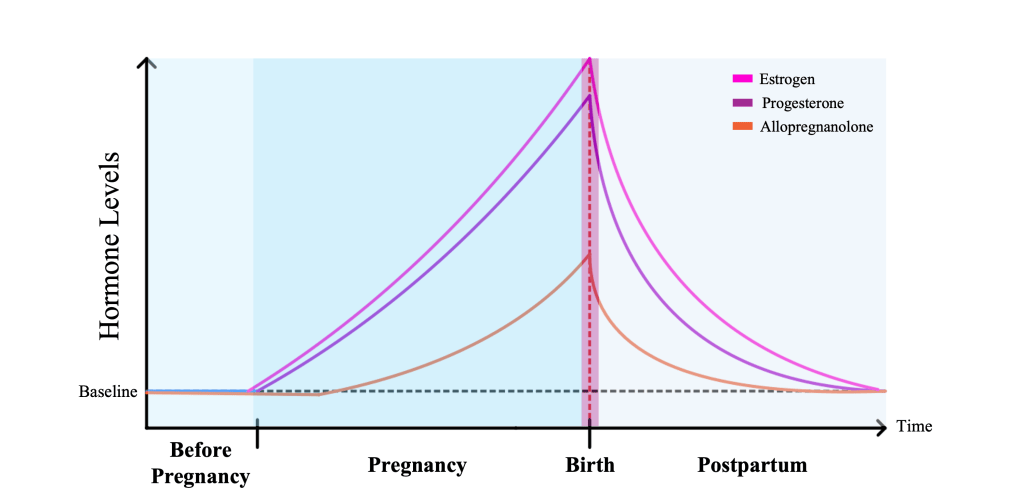
Pregnancy causes hormone levels, such as estrogen and progesterone (Figure 1), to drastically surge and shift across each trimester. These hormonal changes prepare the body for birth and can directly impact the brain. Scientists believe that these changes drive the structural brain changes that are seen during pregnancy and that they serve an adaptive purpose. In other words, the brain reorganizes itself to get ready for the demands of caring for a newborn. Its a bit like what happens during puberty, the brain prunes away unused connections in order to fine-tune itself for adulthood. It is possible that pregnancy may reflect that process and that hormones help refine the connections that are involved in reading and responding to a baby’s needs.
Research studies support this idea by showing that mothers experience a decrease in gray matter (the neuron rich areas of the brain) in regions tied to social and emotional processing. While a drop in gray matter may sound like something has gone wrong, the researchers saw an interesting correlation: the more gray matter a mother lost, the stronger her reported attachment to the baby.1 This points to these changes being adaptive and helping the brain specialize for the role of motherhood. While researchers saw that some of these brain changes had slightly reversed themselves around a month postpartum, many clear changes remained visible up to two years after giving birth.2 To read more about the changes in your brain during pregnancy, check out one of our previous articles.
However, adaptation isn’t the whole story. The pregnancy and the postpartum period are windows of significant brain reorganization, and the same changes that may help prepare one parent for motherhood, may make other parents vulnerable to depression.
A common but underdiagnosed condition
Postpartum depression (PPD), also known as perinatal depression, is the most common complication of pregnancy and goes well beyond the “baby blues”, which are feelings of sadness or anxiety that fade within a few weeks of giving birth.3 PPD symptoms are much more severe and long-lasting— they can begin during pregnancy or up to a year after giving birth and can include persistent sadness, guilt, anxiety, difficulty caring for the baby, and in some cases thoughts of self-harm, which require attention from a medical professional. Factors that can increase risk of PPD include low social support, socioeconomic stress, preterm birth, and a traumatic birth experience—which is not rare. Even though childbirth is expected to be one of the most joyful events in a mother’s life, up to 45% of mothers describe it as traumatic.4
PPD affects roughly one in seven mothers,5 and the real number is likely higher than that as nearly 60% of mothers with depressive symptoms do not receive a clinical diagnosis.6 Researchers believe stigma and guilt are largely responsible for these statistics, with many mothers reporting feeling ashamed to admit they are struggling when they are “supposed” to be feeling joy.7 The fear of being judged as a bad parent for having any of these feelings in the first place, keeps many from seeking help. Therefore, it is important to be clear: PPD is real, rooted in biological changes, and shaped by factors that go beyond willpower or how much a mother wants her baby.
Traces of a traumatic birth in the brain?
Childbirth is one of the most physically and emotionally intense experiences a person can go through, and a growing body of research suggests that the experience itself can leave structural changes in the brain. A 2025 study used magnetic resonance imaging (MRI), a technique used to see the structure and composition of people’s brains, to scan the brains of 88 first-time mothers, first during late pregnancy and again a few weeks postpartum. The mothers also completed questionnaires about their experiences during childbirth and about potential depression symptoms. The study showed that a more traumatic birthing experience was associated with an increase in the volume of the hippocampus, an area responsible for memory formation, especially emotionally intense memories. Researchers also found that worsening depression symptoms were correlated with a volume increase in the amygdala, an area responsible for threat detection and emotional processing (which has been previously implicated in depression more broadly).8
Together, these findings show that both depression symptoms and known risk factors, such as a traumatic birth, are tied to measurable, physical changes in the brain, which could help explain changes to mood and behavior in PPD. The degree to which these regions change may vary from person-to-person, helping explain why postpartum struggles don’t look the same for everyone.
Not as simple as a hormone issue
Due to the drastic hormonal changes that occur during pregnancy, hormone levels were always thought to be the prime suspect behind PPD. However, recent research shows that it’s not simply how much hormones change but rather how sensitive a person’s brain is to that change. One study gave non-pregnant women synthetic hormones to mimic pregnancy’s sharp hormonal rise, then withdrew them to mimic the crash that follows birth (Figure 1). Since none of the participants of the study were pregnant, researchers could specifically ask whether hormonal swings were enough to produce depressive symptoms. They found that only women who previously had PPD developed depression symptoms in response to the hormonal crash, even though everyone was given identical doses.9 Researchers suggested that the hormonal changes themselves aren’t leading to depression symptoms (or they would see depression symptoms in everyone). Instead, some people may have a higher risk for PPD after each pregnancy because their brains are sensitive to hormonal swings and interpret them as a crisis, while others don’t. Figuring out why may be the real key to predicting PPD risk.
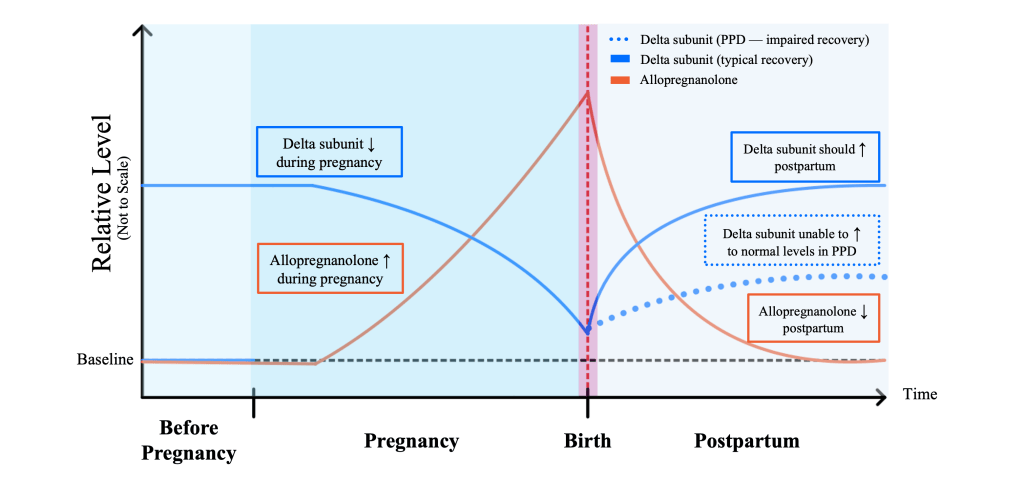
The brain’s GABA system, the primary “calm down” signaling pathway, seems to play an important role in a person’s sensitivity to hormonal fluctuations. GABA-A receptors, which are responsible for activating the GABA system, are built from several smaller parts. One of these subunits, delta, happens to be particularly sensitive to allopregnanolone, a byproduct of progesterone that surges during pregnancy. To avoid getting way too calm due to allopregnanolone’s activation of the GABA system, cells are able to dial down the amount of delta subunits during pregnancy, effectively reducing their sensitivity to the hormone. After birth, allopregnanolone levels sharply drop and cells are supposed to reverse this process: the amount of delta subunits is now meant to be dialed back up to keep the brain’s calming system steady now that there is far less of the hormone to activate it. Mice that were artificially prevented from dialing delta back up developed depression-like behaviors and struggled to care for their pups.10 This provides strong evidence that PPD isn’t simply a story of “too little hormone”. Instead, it could be the story of a brain that struggles to adjust when those hormones disappear.
Treating the underlying biology
Currently, there are two FDA-approved treatments specifically for PPD. Both medications are synthetic versions of allopregnanolone, which help replace the hormone signal that crashes after birth and activate the GABA system, acting to calm the mothers nervous system.11 Where they differ is their delivery. With the first ever PPD medication, Zulresso (brexanolone), patients report significant decreases in depression and anxiety symptoms across 12 months of follow-up appointments.12 However, because it is administered through an IV infusion in a hospital setting over the course of 60 hours, this process presents a logistical challenge for many new mothers.The second FDA-approved treatment, Zurzuvae (zuranolone), was more recently approved in 2023. Since it is a once-daily pill taken at home for 14 days, it offers more accessibility, and some patients have experienced improvements as early as three days after starting treatment.
Treatment has come a long way from telling mothers to simply “wait it out”. However, a drug built around only one biological mechanism may not have the same benefits for everyone since PPD may occur due to a combination of several biological factors that may vary from person-to-person, such as hormone sensitivity and physical brain changes to regions like the amygdala and hippocampus. This is why it is crucial that future research focuses on better prediction of PPD, to help prevent it. For example, identifying patients with hormone-sensitive brains, having more regular follow-ups with mothers who had traumatic birthing experiences, or those missing a support system, could shift care away from crisis response towards genuine prevention for both the mothers and their children. This shift is one of the most important ways that science can stop quietly failing mothers, and start showing up for them instead.
*Note: This article uses “mother” and “women” to refer to individuals who experience pregnancy and childbirth, since most existing research is done in cohorts of self-identified women and mothers. Not everyone who becomes pregnant or gives birth identifies as a woman or as a mother, and this terminology is not meant to exclude or erase those experiences.
References
- Hoekzema E, Barba-Müller E, Pozzobon C, Picado M, Lucco F, García-García D, Soliva JC, Tobeña A, Desco M, Crone EA, Ballesteros A, Carmona S, Vilarroya O. Pregnancy leads to long-lasting changes in human brain structure. Nat Neurosci. 2017 Feb;20(2):287-296. doi: 10.1038/nn.4458. Epub 2016 Dec 19. PMID: 27991897.
- Pritschet L, Taylor CM, Cossio D, Faskowitz J, Santander T, Handwerker DA, Grotzinger H, Layher E, Chrastil ER, Jacobs EG. Neuroanatomical changes observed over the course of a human pregnancy. Nat Neurosci. 2024 Nov;27(11):2253-2260. doi: 10.1038/s41593-024-01741-0. Epub 2024 Sep 16. PMID: 39284962; PMCID: PMC11537970.
- Wenzel ES, Frye R, Roberson-Nay R, Payne JL. The neurobiology of postpartum depression. Trends Neurosci. 2025 Jul;48(7):469-482. doi: 10.1016/j.tins.2025.05.005. Epub 2025 Jun 11. PMID: 40506324.
- Beck CT, Watson S, Gable RK. Traumatic Childbirth and Its Aftermath: Is There Anything Positive? J Perinat Educ. 2018 Jun;27(3):175-184. doi: 10.1891/1058-1243.27.3.175. PMID: 30364308; PMCID: PMC6193358.
- Wisner KL, Sit DKY, McShea MC, et al. Onset Timing, Thoughts of Self-harm, and Diagnoses in Postpartum Women With Screen-Positive Depression Findings. JAMA Psychiatry. 2013;70(5):490–498. doi:10.1001/jamapsychiatry.2013.87
- Ko JY, Rockhill KM, Tong VT, Morrow B, Farr SL. Trends in Postpartum Depressive Symptoms — 27 States, 2004, 2008, and 2012. MMWR Morb Mortal Wkly Rep 2017;66:153–158. DOI: http://dx.doi.org/10.15585/mmwr.mm6606a1
- Beck CT, Watson S, Gable RK. Traumatic Childbirth and Its Aftermath: Is There Anything Positive? J Perinat Educ. 2018 Jun;27(3):175-184. doi: 10.1891/1058-1243.27.3.175. PMID: 30364308; PMCID: PMC6193358.
- Billotte Verhoff C, Hosek AM, Cherry J. “A Fire in my Belly:” Conceptualizing U.S. Women’s Experiences of “Mom Rage”. Sex Roles. 2023;88(11-12):495-513. doi: 10.1007/s11199-023-01376-8. Epub 2023 May 5. PMID: 37283731; PMCID: PMC10159823.
- Cristina Ballesteros et al. ,Linking birth experience and perinatal depression symptoms to neuroanatomical changes in hippocampus and amygdala.Sci. Adv.11,eadt5619(2025).DOI:10.1126/sciadv.adt5619
- Eisenlohr-Moul T, Swales DA, Rubinow DR, Schiff L, Schiller CE. Temporal dynamics of neurobehavioral hormone sensitivity in a scaled-down experimental model of early pregnancy and parturition. Neuropsychopharmacology. 2024 Jan;49(2):414-421. doi: 10.1038/s41386-023-01687-0. Epub 2023 Jul 31. PMID: 37524753; PMCID: PMC10724266.
- Barrett M, Hettema J, Youngman C, Wilkinson ST, Dalthorp R. Real-World Outcomes of Brexanolone to Treat Postpartum Depression. Womens Health Rep (New Rochelle). 2025 Oct 6;6(1):1081-1091. doi: 10.1177/26884844251383702. PMID: 41142477; PMCID: PMC12549179.
- Maguire J, Mody I. GABA(A)R plasticity during pregnancy: relevance to postpartum depression. Neuron. 2008 Jul 31;59(2):207-13. doi: 10.1016/j.neuron.2008.06.019. PMID: 18667149; PMCID: PMC2875248.
- Perkes, C. (2023, August 15). New postpartum depression pill acts more quickly than other treatments. | UCLA Health. https://www.uclahealth.org/news/article/new-pill-treat-postpartum-depression-could-be-game-changer
Claude, powered by Sonnet 5, was used to help with rewording some sentences, highlighting technical language, checking grammar, and to brainstorm title ideas.
Cover photo by RDNE Stock Project from Pexels.
Figure 1 and Figure 2 made by Sophia Rueda in goodnotes and powerpoint.

