
March 24th, 2026
Written by Stephen Wisser
The famous astronomer and science communicator Carl Sagan describes the heart of science as “an openness to new ideas…and the most ruthless skeptical scrutiny of all ideas new and old”1. Most people would probably agree that we should be critical of new ideas which haven’t yet stood the test of time. Indeed, after a new scientific discovery is made it can take years of additional experimentation and debate with other scientists before the community agrees to change their perspective and consider that discovery a fact. But furthermore, and perhaps more interesting is that Sagan also suggests we should continue to question old ideas, ideas that people think are hard and true facts about the world. Even after a majority of scientists may agree on some finding, the debate is never truly won and put to rest, as new evidence could swing the conversation in another direction at anytime. A few months ago, this very scenario happened. An old debate resurfaced when a series of experiments were published that challenged what many neuroscientists believed to be a basic fact about how the brain’s neurons are connected and talk to each other. Before these recent experiments, neuroscientists believed most neurons were indirectly connected, and instead talk to each other through small gaps by releasing chemicals. Now, scientists discovered a new way that neurons can communicate with each other, through direct tube-like connections that physically connect neurons. In this post, we’ll explore these new connections, and how this finding might rewrite the textbooks or at least add a few pages on a fundamental area of neuroscience that many thought was a settled matter.
Neuron communication: The first debate in neuroscience
To understand the significance of these new connections, let’s take a moment to talk about a basic cell of the brain: the neuron. The human brain is made up of about 80 billion neurons2 whose primary function is to talk to one another so that we can experience and interact with the world. In the late 1800s when the field of neuroscience was being born, scientists weren’t quite sure how neurons were connected. An Italian doctor, Camillo Golgi, used a dye that allowed him to see neurons in certain brain tissue. Based on what he saw, he believed that neurons were physically connected to each other, forming a fully-connected web across the brain. However, another scientist, Santiago Ramón y Cajal, used the same dye to produce a different set of pictures and concluded something seemingly counterintuitive: that neurons are not physically connected, but instead are separated by a very small gap to form what was later called a synapse. So, who was correct? Most textbooks and intro neuroscience classes today teach that Cajal was correct and that his proposal led to the groundbreaking realization that the vast majority of neurons communicate through gaps called synapses3 rather than physical connections. Nonetheless, Golgi was still recognized for his work as he received the Nobel Prize in Medicine in 1906 alongside his arch rival Cajal. Perhaps now 120 years later, Golgi will get his revenge and receive some more recognition as the debate shifts back to reconsider the importance of direct neuron connections.
The synapse and its players
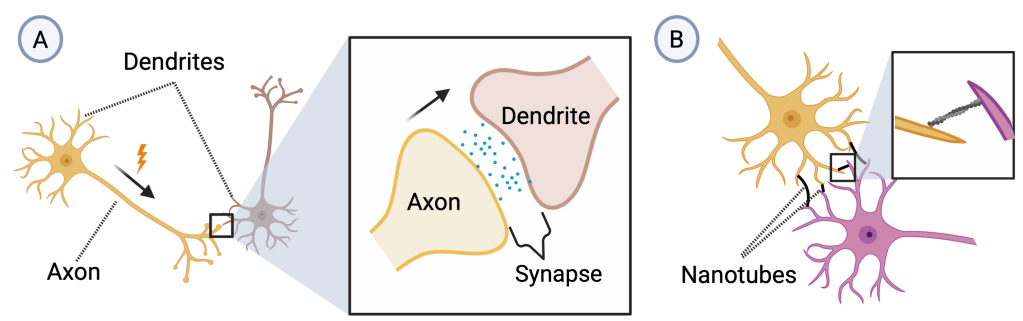
The synapse (Figure 1A) first discovered by Cajal is a popular research subject because this small gap is where neurons “talk” to each other, allowing them to do all the complicated things we need brains for. So how exactly does that work? The general idea is that some message must be transferred from one neuron to another, similar to how you might mail a letter to a friend. To mail that letter, you’ll likely walk outside to your mailbox and drop it off there, where a mailman will pick it up later and continue the journey of the letter, your message. Neurons act in a similar way, where they first walk their message to the mailbox by sending an electrical signal down a structure called the axon. This first step of sending the signal is sometimes referred to as the neuron “firing”. Once this signal gets to the end of the axon, chemicals called neurotransmitters (since these chemicals “transmit” a signal) are released. These neurotransmitters travel across the short gap of the synapse to a part of another neuron that receives the message called the dendrite. This process of neurotransmitter release would be like dropping the letter in the mailbox, which would serve as the synapse here since the mailbox is the “gap” in your letter delivery process that allows it to eventually reach the next neuron, the mailman. Once enough neurotransmitters reach the dendrite, they tell that neuron to send its own signal down its axon, and the process continues. At this point, the mailman has picked up your letter, and he “fires” taking the letter to the next destination like you did earlier that day when you walked your letter to the mailbox. This conversation from axon, across the synapse to dendrite, typically takes only a few milliseconds4,5 and is the main way that neurons talk to each other. If only the US Postal Service worked that fast!
Dendritic nanotubes: A new connection
Although synapses are the most common form of communication between neurons, scientists recently discovered a new type of connection that bypasses synapses completely. Since the debate of how neurons are connected was a founding conversation of neuroscience, this new connection type is a shocking discovery that has the ability to change the field for all neuroscientists since it strikes at a core tenet of the discipline itself. Recently, a team of researchers used advanced microscopes to observe small, thin structures, or “tubes” that physically connect one dendrite to another, called dendritic nanotubes6. Unlike synapses, dendritic nanotubes directly connect neurons, acting as a sort of bridge (Figure 1B). Over 100 years after neuroscientists thought Cajal and Golgi’s debate was settled here was evidence to support Golgi’s belief that neurons are physically connected!
Although dendritic nanotubes are physical structures, they aren’t very stable and can come and go rather quickly. In one experiment, the researchers took a picture of these nanotubes every minute over the span of 66 hours. During this time, they saw individual nanotubes be created and broken down, with about 80% of all the observed nanotubes “living” fewer than 4 hours6. So, while an axon can be thought of as a more permanent structure that allows a message to be passed down, these nanotubes are more temporary. Even though nanotubes are short-lived, they are constantly being built and torn down which means there is an overall consistent network of them that could allow communication between neurons. So while axons and nanotubes are different in terms of stability and how they work, they likely make a good team where axons facilitate longer term communications through the synapse and any individual nanotube facilitates shorter term communication through direct connections.
If nanotubes don’t involve synapses and don’t have the machinery of neurotransmitters, how exactly might they theoretically allow for neurons to communicate with each other? Here, we need to introduce one more player: calcium. That’s right, the substance in milk that everyone tells you to drink to get strong bones! At a normal synapse, calcium is needed to cause the release of neurotransmitters and thus serves a very important role in passing along a message to the next neuron. It’s like the key that opens the blue mailbox which allows the mailman to actually get your letter. If you drop your letter in the box, but the mailman has no way to open it, your message can’t get cross the gap to get to the next person. Typically, neurons get their calcium from the outside through “gates” that open only when a neuron fires. But scientists found that calcium can directly move between neurons through nanotubes, which might be how nanotubes facilitate communication. In one fascinating experiment, the scientists found that when injecting calcium in one neuron, it spread to nearby neurons. Interestingly, this spread didn’t happen when the nanotubes were “cut”6 suggesting that the calcium indeed moved between neurons through these nanotubes. Since the researchers didn’t measure neurotransmitter release or other properties of the neurons, we don’t yet know if calcium movement between neurons through nanotubes actually influences the firing of neurons or does anything else. But since this is the first time direct transfer of calcium between neurons has been seen, it will need to be further studied and it could change our basic understanding in how some neurons fire to pass along a message.
In addition to signaling molecules like calcium, the scientists found that dendritic nanotubes can transport other things, like the beginning forms of a disease. For example, although it is a complicated disease, Alzheimer’s is thought in part to be caused by a substance, called b-amyloid that enters the brain and causes problems that ultimately lead to the symptoms of Alzheimer’s. In the final series of experiments, the research team injected b-amyloid into a single neuron in a mouse brain, and found that it spread to nearby neurons only when the nanotubes were intact, just like calcium6. This opens up the possibility that the direct transfer of b-amyloid through nanotubes could help spread Alzheimer’s6. So, not only are nanotubes communication shortcuts that transport calcium, but they could be a new lead for scientists looking to prevent Alzheimer’s or other diseases.
Conclusion
The discovery of dendritic nanotubes introduces an entirely new way of thinking about how neurons communicate and affect each other. Nanotubes may even be the missing link to understanding questions like how Alzheimer’s spreads throughout the brain. On a philosophical level, it reminds us that science is never truly settled as Carl Sagan suggests. Even a founding principle, such as how neurons are connected, can be challenged the minute new data arrives. It’s unlikely that with more research into nanotubes over the coming years, we’ll completely disregard the importance of the synapse. But maybe it is time to stop thinking about this connectivity issue as a debate with only one winner. Perhaps Golgi was right too, and we need to reconsider how the physical connectiveness of neurons guides brain function in both health and disease. Having only been published a few months, it is still too early to assess the significance of these nanotubes; like all things, only time will tell.
References
1. Sagan, C. (2011). The Demon-Haunted World: Science As a Candle in the Dark (Random House Publishing Group).
2. Goriely, A. (2025). Eighty-six billion and counting: do we know the number of neurons in the human brain? Brain 148, 689–691. https://doi.org/10.1093/brain/awae390.
3. Raz, A., and Perouansky, M. (2019). Central Nervous System Physiology. In Pharmacology and Physiology for Anesthesia (Elsevier), pp. 145–173. https://doi.org/10.1016/B978-0-323-48110-6.00008-9.
4. Drukarch, B., and Wilhelmus, M.M.M. (2023). Thinking about the action potential: the nerve signal as a window to the physical principles guiding neuronal excitability. Front. Cell. Neurosci. 17, 1232020. https://doi.org/10.3389/fncel.2023.1232020.
5. Südhof, T.C. (2013). Neurotransmitter release: the last millisecond in the life of a synaptic vesicle. Neuron 80, 675–690. https://doi.org/10.1016/j.neuron.2013.10.022.
6. Chang, M., Krüssel, S., Parajuli, L.K., Kim, J., Lee, D., Merodio, A., Kwon, J., Okabe, S., and Kwon, H.-B. (2025). Intercellular communication in the brain through a dendritic nanotubular network. Science 390, eadr7403. https://doi.org/10.1126/science.adr7403.
Cover photo generated by Victoria Subritzky Katz using ChatGPT version GPT-5.3.
Figure 1 made with BioRender.com
 PennNeuroKnow
Leave a comment