March 3rd, 2026
Written by Carly Seligman
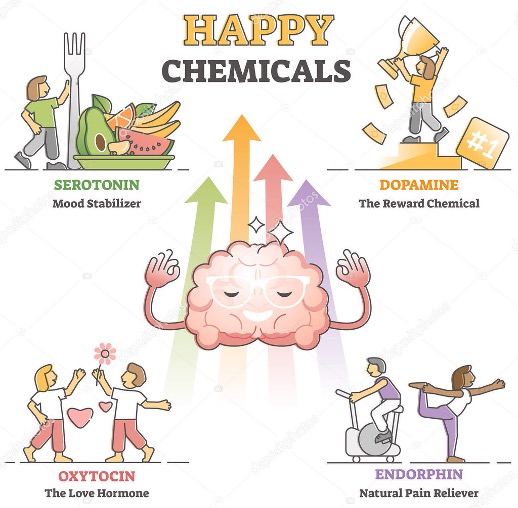
The term “happy hormones” is used to describe four chemical messengers that are thought to promote happiness. These “happy hormones” are dopamine, oxytocin, serotonin, and endorphins. Although these hormones are involved in happiness and pleasure, they are important for much more than just making you happy. Here, we’ll dive into all the other important functions your “happy hormones” support.
Dopamine
The hormone dopamine is often referred to as the “reward chemical”. Dopamine certainly plays a role in pleasure and reward, a topic that is expertly covered in this PNK article. However, scientists think dopamine is important for many other functions, such as movement, motivation, mood, attention, addiction, learning, memory, and sleep1.
Because of its role at the center of multiple important functions, not having enough dopamine can be dangerous. The death of neurons that release dopamine is linked to movement disorders such as Parkinson’s Disease2. Patients with this neurodegenerative disease experience muscle tremors, stiffness, and difficulty performing movements, among other symptoms3. On the other hand, while having lots of dopamine may sound like a good thing, excess dopamine can lead to delusions and hallucinations that people with schizophrenia experience4. Because of this, scientists have worked hard to create medicines that combat both too much and too little dopamine. For instance, drugs that prevent cells being able to sense extra dopamine are often used to treat schizophrenia5. In contrast, many healthcare providers now treat Parkinson’s using L-DOPA, the substance dopamine is made from. Supplying patients with L-DOPA helps Parkinson’s patients make more dopamine, increasing dopamine levels in the brain and relieving symptoms2. These medicines have made it clear how important having just the right amount of dopamine is, and the conditions they treat demonstrate dopamine’s diverse roles in the body.
Oxytocin
Oxytocin is a small hormone that has become known as the “love hormone” because of its involvement in the development of social bonds, for instance between romantic partners, friends, and mothers and their children6. This hormone is released during positive social interactions, such as hugging, and is thought to be important in attachment, trust, and sexual arousal7.
Although oxytocin is most notably known for its role in pair-bonding, it has been shown to play a role in other important functions in the body. Oxytocin is thought to have biological functions in neuroimmunity (the brain’s immune system), stress regulation, and mental health8. Recent research discovered that oxytocin can prevent the consequences of sleep-deprivation, such as inflammation and cognitive problems9. Oxytocin is also important in triggering contractions during childbirth as well as initiating maternal lactation after birth6. This role for oxytocin motivated the development of drugs that mimic its functions, such as Pitocin, which healthcare providers can use to stimulate labor during childbirth. Therefore, oxytocin has many important roles outside of just love.
Serotonin
Serotonin is an incredibly important molecule with many functions throughout the body. One of its most well-known roles is in regulating mood by both promoting positive emotions, such as happiness, love, and pleasure, and managing anger, fear, and stress. But serotonin is involved in more than emotions; it is also a key regulator of learning and memory, sleep, pain, appetite, digestion, and nausea10. It is known to be important for normal gut function, and many disorders of the gut are linked to serotonin11. Scientists even recently found evidence suggesting that serotonin dysfunction may be connected to memory deficits seen in Alzheimer’s Disease12.
Not having enough serotonin is thought to be one of the key causes of psychological disorders such as anxiety and depression, making it the focus of many of the drugs designed to treat these conditions. Some of the most well-known medicines using serotonin include selective serotonin (and norepinephrine) reuptake inhibitors (SSRIs and SNRIs) and monoaminoxidase inhibitors (MAOIs). As the name implies, SSRIs and SNRIs prevent the reuptake of serotonin into the cell, meaning that more serotonin can be passed between neurons. MAOIs act similarly by preventing the breakdown of serotonin, thus keeping it around the brain and enabling it to do its job for longer13. These medications have had a hugely positive effect on the lives of those suffering from such mental health disorders.
Endorphins
Although endorphins are included in the group of “happy hormones”, their main job is not to promote happiness, but instead to prevent pain, fear, and stress. When your body feels physical or emotional stress, it releases endorphins, which bind to cells sending out these signals and stop more from being released14. This essentially blocks these negative signals, allowing your body to keep functioning even in scary situations. While endorphins work this way throughout most of the body, they do something special in the brain: here, they boost the release of dopamine, which, as mentioned earlier in this piece, is important for pleasure15. In this way, endorphins are important for both promoting the circulation of “happy” signals and limiting the release of “unhappy” signals.
There are many ways of boosting endorphins in your brain and body. The most common method is through exercise, such as going on a run, taking a swim, or having a dance party. Other pleasurable activities, such as eating, having a massage, listening to music, and sex, have also been shown to increase endorphins14. These approaches can thus both boost happiness as well as curb more negative emotions.
Conclusions
The “happy hormones” are involved in much more than just happiness. Dopamine, oxytocin, serotonin, and endorphins work together to manage a host of functions, such as mood, pain, movement, stress, love, digestion, and more. Simplifying their biological role to “happiness” alone does these neurotransmitters a disservice. Just like these hormones, most important components of the brain play many different roles at once. It is therefore important that we don’t limit our understanding of these players to simply what they are most famous for. Instead, we should appreciate the complexity of the brain and all it does to keep us alive and healthy.
References
- Dopamine: What It Is, Function & Symptoms. Cleveland Clinic https://my.clevelandclinic.org/health/articles/22581-dopamine.
- Franco, R., Reyes-Resina, I. & Navarro, G. Dopamine in Health and Disease: Much More Than a Neurotransmitter. Biomedicines 9, 109 (2021).
- Parkinson’s Disease | National Institute of Neurological Disorders and Stroke. https://www.ninds.nih.gov/health-information/disorders/parkinsons-disease.
- Juárez Olguín, H., Calderón Guzmán, D., Hernández García, E. & Barragán Mejía, G. The Role of Dopamine and Its Dysfunction as a Consequence of Oxidative Stress. Oxid Med Cell Longev 2016, 9730467 (2016).
- Kantrowitz, J. T., Correll, C. U., Jain, R. & Cutler, A. J. New Developments in the Treatment of Schizophrenia: An Expert Roundtable. International Journal of Neuropsychopharmacology 26, 322–330 (2023).
- Oxytocin: What It Is, Function & Effects. Cleveland Clinic https://my.clevelandclinic.org/health/articles/22618-oxytocin.
- Olff, M. et al. The role of oxytocin in social bonding, stress regulation and mental health: An update on the moderating effects of context and interindividual differences. Psychoneuroendocrinology 38, 1883–1894 (2013).
- Carter, C. S. Oxytocin and love: Myths, metaphors and mysteries. Compr Psychoneuroendocrinol 9, 100107 (2021).
- Elkattawy, H. A. et al. Oxytocin restores cognitive function and attenuates neuroinflammation in chronic sleep-deprived aged rats. Front. Aging Neurosci. 18, 1742343 (2026).
- Serotonin: What Is It, Function & Levels. Cleveland Clinic https://my.clevelandclinic.org/health/articles/22572-serotonin.
- Mawe, G. M. & Hoffman, J. M. Serotonin signalling in the gut—functions, dysfunctions and therapeutic targets. Nat Rev Gastroenterol Hepatol 10, 473–486 (2013).
- Le Bras, A. New evidence linking serotonin and memory. Lab Anim 53, 195–195 (2024).
- Bamalan, O. A., Moore, M. J. & Al Khalili, Y. Physiology, Serotonin. in StatPearls (StatPearls Publishing, Treasure Island (FL), 2025).
- Endorphins: What They Are and How to Boost Them. Cleveland Clinic https://my.clevelandclinic.org/health/body/23040-endorphins.
- Sprouse-Blum, A. S., Smith, G., Sugai, D. & Parsa, F. D. Understanding Endorphins and Their Importance in Pain Management. Hawaii Med J 69, 70–71 (2010).
Cover photo from Mikel Agirregabiria from Flickr
 PennNeuroKnow
Leave a comment