January 27th, 2026
Written by: Catrina Hacker
Every once in a while I learn something new about the natural world that completely changes my perspective. Most recently, this occurred while I was reading a wonderful book (that I highly recommend) called Entangled Life: How Fungi Make Our Worlds, Change Our Minds & Shape Our Futures by Merlin Sheldrake. The book opened my eyes to the beautiful and complex web of fungi that shape all aspects of life on earth that I hadn’t appreciated before. As a neuroscientist, I was especially fascinated by the chapter detailing how fungi can shape animal minds. The most famous of these fungi, Ophiocordyceps, acts like a parasite, infecting ants turning them into “zombies” that clamp onto leaves and spread fungal spores, and is said to have inspired the fungal zombies of the video game and TV show The Last of Us. But as I hopped on the internet to learn more about these fascinating fungus-insect relationships, I was amazed to find that Ophiocordycepsisn’t the only fungus that can manipulate insect behavior to promote its own needs. Here I’ll share a few examples that caught my interest. Welcome to the fascinating world of parasitic fungi.
Entomophaga grylli: Making grasshoppers climb to their deaths
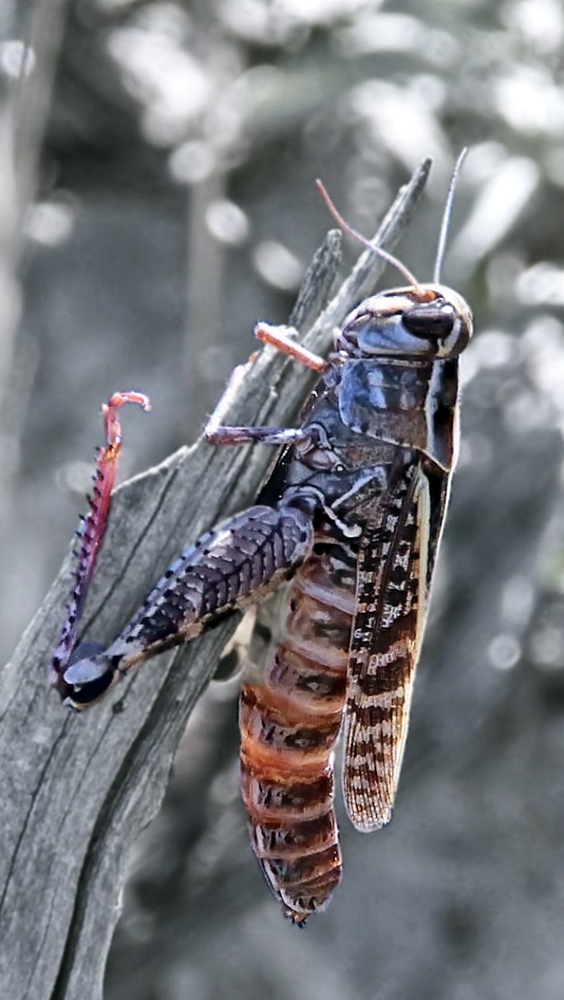
The behavioral changes that fungi induce in their insect hosts aren’t just for fun; they directly help the fungus to grow and spread. One of the most widespread causes of disease in grasshoppers, infection with the fungus Entomophaga grylli, is no exception. Infection begins when fungal spores enter the grasshopper, making their way to the circulatory system where they continue to reproduce, eventually eating the grasshopper from the inside out1. But importantly, before the grasshopper dies, the fungus hijacks the insect so that it will climb to the top of a plant where it grips the tip of a stem until it dies2 (Figure 1).
This climbing before death is referred to as a summiting behavior. Summiting behavior ensures that the fungus will be more widely dispersed3. This is because spores built up within the grasshopper are more likely to spread away from the original site to infect new hosts if they are spread from a height where they can be caught in the wind than if the grasshopper dies on the ground.
Like many cases of infection by parasitic fungi, exactly how E. grylli infection leads to summiting behavior is still an open question, but there are some hints at the answer. One study that examined the bodies of infected grasshoppers at various stages of infection found two interesting things: that the fungus did not penetrate the skeletal muscle until near or after the grasshopper’s death, and that the fungus infected neural tissue early4. This early invasion of the nervous system could be what drives the grasshopper to climb before its death, but more experiments are needed to say for sure. For example, an alternative possibility is that E. grylli’s penetration of the skeletal muscle drives the summiting behavior directly. However, with the late timing of skeletal muscle penetration and mounting evidence that E. grylli isn’t the only fungus to cause summit behavior and infect neural tissue early (see below) it’s possible, if not likely, that infection of the neural tissue itself is important for driving summiting behavior5. Whether involved in the grasshopper’s forced climb or not, another possible role for the penetration of skeletal muscle could be to keep the grasshopper’s corpse hanging on after death, facilitating the spread of spores and infection of new grasshopper hosts.
Entomophthora muscae: Taking flies for a deadly ride
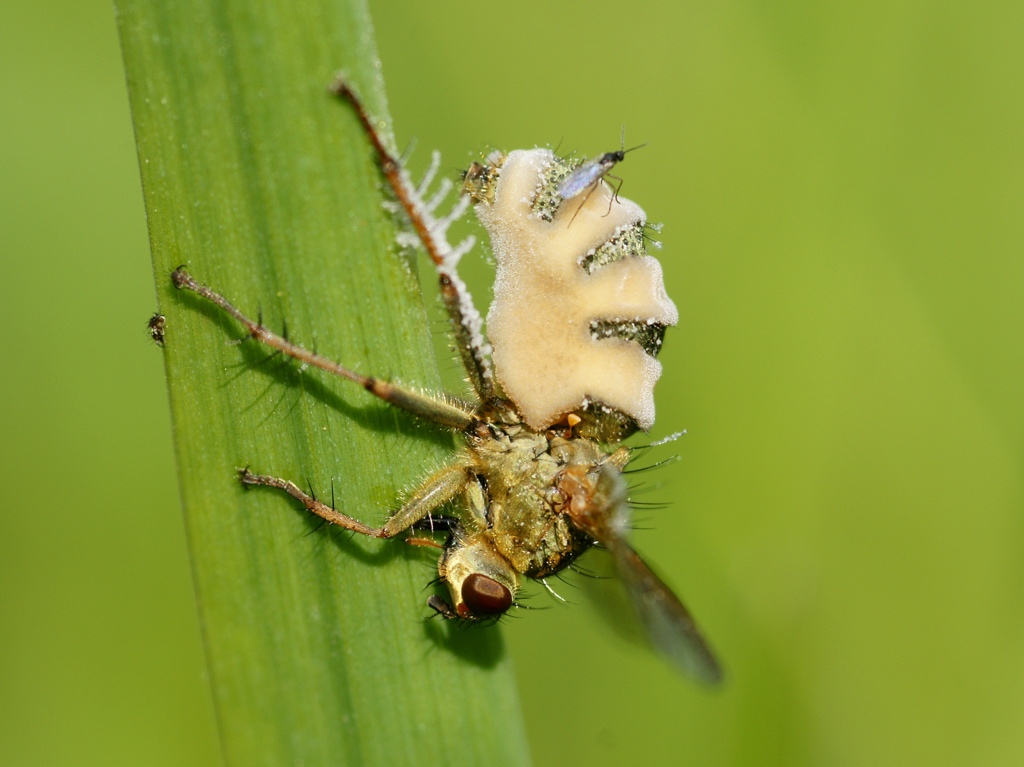
Going one step beyond E. grylli, the summit behavior associated with Entomophthora muscae infection not only causes infected flies to climb up before their deaths, but also induces a body posture that helps to disperse spores (Figure 2). E. muscae also digests infected flies from the inside out over the course of a few days6,7. However, just before sunset on the day of its death (yes, it’s that specific), the fly finds a surface where it can crawl upwards and then straightens its hind legs, opens its wings, and fungus grows to attach the fly to its position8. This special positioning helps to ensure that there’s nothing in the way of spreading fungal spores as widely as possible.
Much like E. grylli, E. muscae infects the tissue of the nervous system early in the infection cycle6,7. One group of researchers found that when infected fruit flies start displaying summiting behavior the neurons that are needed to produce the behavior remain intact even though many other parts of the brain are invaded by the fungus and damaged9. This suggests that fungal infection is impressively specific, only leaving alive the neurons it needs to position the fly before its death. So, if the neurons that produce summiting behavior are untouched by the fungus, how does the fungus trigger the behavior? The same group of researchers also found that the content of the liquid that circulates in insect bodies, called hemolymph, was different in infected flies than healthy flies. Normally, substances circulating throughout the body have limited access to the brain because of a protective wall between the blood and brain, called the blood-brain barrier. However, the researchers found that flies infected with E. muscae had degraded blood-brain barriers, potentially allowing the substances circulating in the hemolymph even more access to the brain to trigger the neurons that produce summiting behavior. In support of this proposal, when they took hemolymph from infected flies and injected it into healthy flies, the healthy flies showed summiting behavior, suggesting that the chemicals in the hemolymph are what trigger the behavior. While there’s still a lot more to learn, these results paint a remarkable picture of direct and impressive control of the host body and behavior by E. muscae.
Massospora cicadina: Creating a deadly mate
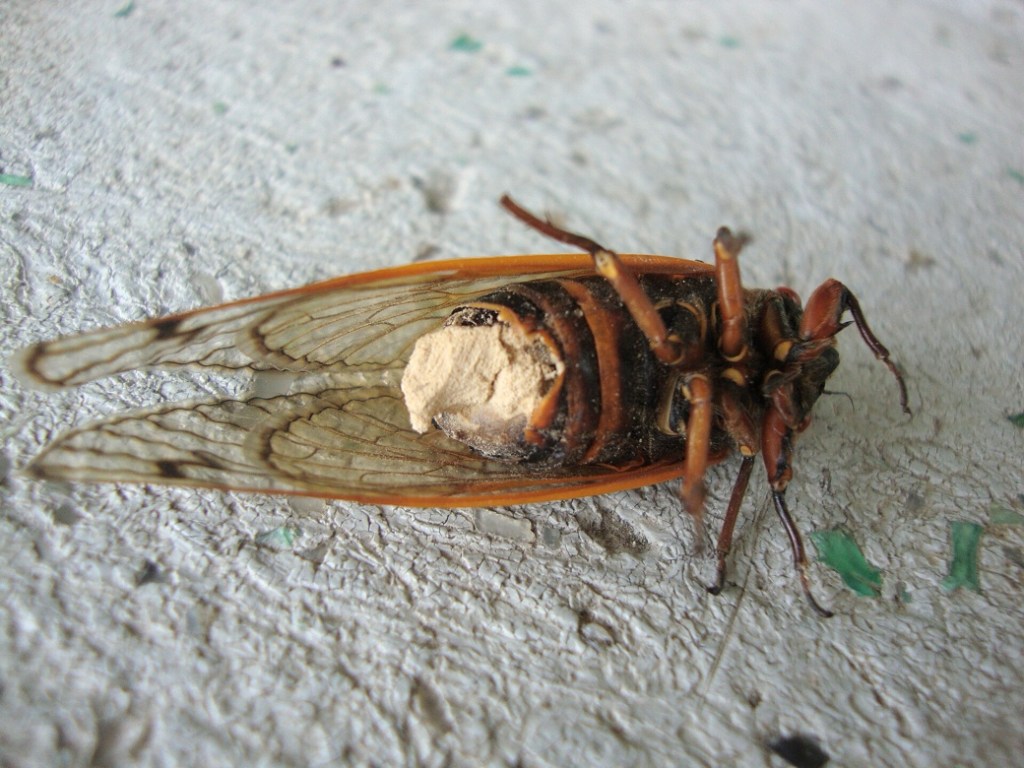
Parasitic fungi have been shown to impact more than just behavior in the moments before death to promote their dispersal. For example, Massospora cicadina causes changes in cicadas’ sexual behavior to promote the spread of spores from one insect to the next. M. cicadina infects cicadas and builds up in their abdomens (Figure 3), eventually killing them10. Infection with one type of M. cicadina causes infected male cicadas to flick their wings in a highly-specific way that is typically only seen in female cicadas looking to mate10. This causes confused males to attempt to mate with infected males which infects them with the fungus too. This helps to spread the fungus because whereas female cicadas will naturally attract mates, this change in behavior makes it possible for male cicadas, who wouldn’t otherwise attempt to attract mates, to spread the disease as well.
Exactly how the fungus is able to hijack the brain of its infected host to produce such specific mating behavior is still unknown, leaving plenty of exciting open questions about how fungal infection can lead to increasingly complex and specific behavioral control.
For neuroscientists, parasitic fungi offer a fascinating glimpse into how other organisms are already so much better at controlling brains than we are. Many neuroscience studies aim to understand the brain by manipulating brain activity to produce specific behaviors, but few have been as successful as fungal infection. One goal of neuroscience research is to eventually be able to control brains that have gone awry, such as in cases of Alzheimer’s or schizophrenia. While there’s still plenty we need to learn before we’ll be able to enact this kind of control, maybe we can learn something from fungi to help us steer human brains into healthier states. Ultimately, whether learning about fungal infection gives us insight into treating human disease or not, the fascinating world of fungal parasites is just plain cool.
References
1. Peña, S. R. S. IN VITRO PRODUCTION OF HYPHAE OF THE GRASHOPPER PATHOGEN ENTOMOPHAGA GRYLLI (ZYGOMYCOTA: ENTOMOPHTHORALES): POTENTIAL FOR PRODUCTION OF CONIDIA. Fla. Entomol. 88, 332–334 (2005).
2. Grasshoppers and Summit Disease | NDSU Agriculture. https://www.ndsu.edu/agriculture/ag-hub/grasshoppers-and-summit-disease (2022).
3. Masoudi, A., Joseph, R. A. & Keyhani, N. O. Viral- and fungal-mediated behavioral manipulation of hosts: summit disease. Appl. Microbiol. Biotechnol. 108, 492 (2024).
4. Funk, C. J., Ramoska, W. A. & Bechtel, D. B. Histopathology of Entomophaga grylli Pathotype 2 Infections in Melanoplus differentialis. J. Invertebr. Pathol. 61, 196–202 (1993).
5. De Bekker, C., Beckerson, W. C. & Elya, C. Mechanisms behind the Madness: How Do Zombie-Making Fungal Entomopathogens Affect Host Behavior To Increase Transmission? mBio 12, e01872-21 (2021).
6. Elya, C. Entomophthora muscae. Trends Parasitol. 40, 427–428 (2024).
7. Elya, C. et al. Robust manipulation of the behavior of Drosophila melanogaster by a fungal pathogen in the laboratory. eLife 7, e34414 (2018).
8. Krasnoff, S. B., Watson, D. W., Gibson, D. M. & Kwan, E. C. Behavioral Effects of the Entomopathogenic Fungus, Entomophthora muscae on its Host A4usca domestica: Postural Changes in Dying Hosts and Gated Pattern of Mortality.
9. Elya, C. et al. Neural mechanisms of parasite-induced summiting behavior in ‘zombie’ Drosophila. eLife 12, e85410 (2023).
10. Cooley, J. R., Marshall, D. C. & Hill, K. B. R. A specialized fungal parasite (Massospora cicadina) hijacks the sexual signals of periodical cicadas (Hemiptera: Cicadidae: Magicicada). Sci. Rep. 8, 1432 (2018).
Cover photo by Reinhold Möller on Wikimedia Commons.
Figure 1 by Mbchristoph on Wikimedia Commons shared under the Creative Commons Attribution-Share Alike 4.0 International license.
Figure 2 by Hans Hillewaert on Wikimedia Commons shared under the Creative Commons Attribution-Share Alike 4.0 International license.
Figure 3 by TelosCricket on Wikimedia Commons shared under the Creative Commons Attribution-Share Alike 4.0 International license.
 PennNeuroKnow


.jpg)

Leave a comment