
August 19th, 2025
Written by: Joseph Stucynski
Millions of Americans, including yours truly, live with autoimmune conditions like rheumatoid arthritis, ulcerative colitis, Crohn’s disease, and the list goes on. We take medications to help tame our out-of-control immune systems, but they’re imperfect and often have many side effects.
What if instead, there were instead a way to control your immune system to more precisely treat these diseases without medications? Well that’s where Vagus Nerve Stimulation, or VNS, comes into play.1 As part of an emerging, broader field of treatments called Bioelectric Medicine where electricity is used to treat disease, VNS is a treatment that delivers electric currents to a critical nerve in your body called the vagus nerve. Stimulating this nerve can help control runaway inflammation in your body,2 potentially offering an alternative to medications. But due to this nerve’s critical role in a wide variety of bodily functions, VNS can help improve other conditions including epilepsy, severe depression, obesity, sleep disorders, and even recovery from stroke!1
What is the Vagus Nerve?
The word ‘vagus’ is based on the latin word ‘vagari’, meaning ‘to wander’.3 This name seems appropriate because the vagus nerve is one of the longest nerves in the entire human body as it ‘wanders’ all throughout your organ systems (see Figure 1). It is the main component of the parasympathetic nervous system, which is a branch of the nervous system most well known as the rest-and-digest pathway. This pathway helps control food intake and digestion, slowing of your heart rate or breathing rate, and inflammation, among many other functions that keep you alive.
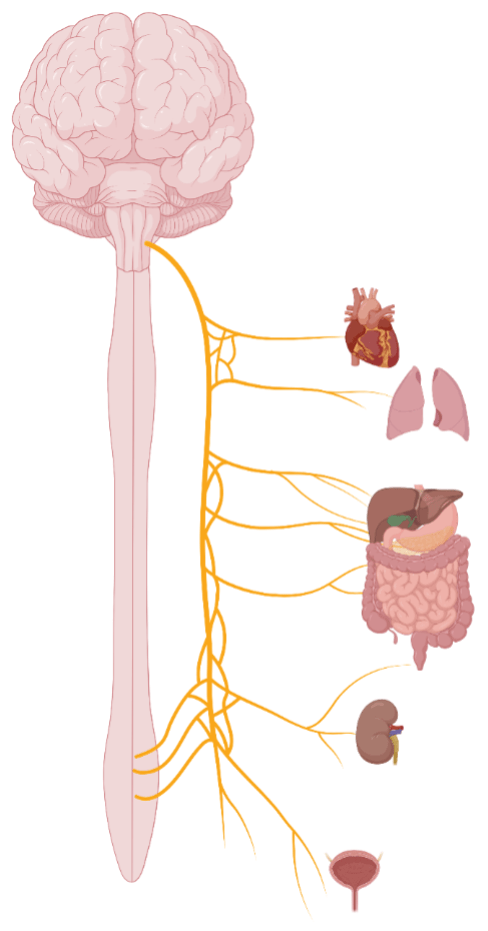
You can think of the vagus nerve as the main neural highway that handles almost all communication of sensations from your organs to your brain. Your brain also sends commands back down through the vagus nerve and can control many aspects of organ functioning. This brain-body communication pathway has been a very hot topic among neuroscientists in recent years, as researchers seek to understand how the brain governs and maintains balance among organ systems in the body.
One exciting function of the vagus nerve is its ability to sense signals released by your immune system that can cause inflammation and send that information to the brain.2,4 Perhaps more importantly, it can then send signals back to the immune system to reduce inflammation when it’s no longer needed.4 Since most autoimmune conditions involve excess inflammation caused by an out-of-control immune system, the hope is that by activating the vagus nerve artificially, it may be possible to bring inflammation levels that cause disease back down to normal levels.2 Due to this promising evidence, in August 2025 the Food and Drug Administration (FDA) approved a vagus nerve stimulation device for this exact control of inflammation for auto-inflammatory diseases that was fast tracked as a Breakthrough Therapy.5 But how does VNS work?
How does Vagus Nerve Stimulation work?
In order to electrically stimulate the vagus nerve, doctors need to surgically implant a small device into the neck. The device is the size of a large pill and contains a battery that can last up to 10 years.6 It’s then attached to an electrical wire that is carefully coiled around the vagus nerve that can deliver electrical stimulation periodically based on customizable settings.1,6 There is a vagus nerve on either side of your body, but most times, this device is only implanted around the left vagus nerve, as opposed to the right which is known to control heart rate and could cause serious issues if stimulated. The device is then calibrated for each patient and monitored closely to ensure the maximum effect with the minimum amount of side effects.
Because the vagus nerve receives so much information from your organs, you might be wondering how delivering an electrical pulse to the whole nerve can affect inflammation without messing with all the other processes that the vagus is involved in. Great question! As a general principle of neuroscience, different types of neurons behave very differently. For instance, some neurons are bigger while others are smaller, with connections that are shorter or longer. These physical properties can affect the way electricity can change their activity. Scientists take advantage of this when targeting the vagus nerve, which is made of many different types of neurons. Since the neurons that control inflammation are a specific type, the electrical pulses can be adjusted to hopefully target only them and not neurons that process other sensory information.
In the case of auto-immune conditions like rheumatoid arthritis, the VNS device has been shown through clinical trials to reliably reduce inflammatory molecules released by the immune system and reduce chronic pain!2 This is hugely promising since it provides a potential alternative to medications which are not effective some patients. These existing medications, which target the excess inflammatory molecules and tell your body to get rid of them, really don’t address the underlying physiology of the overactive immune system – they merely treat the symptoms without getting to the root of the problem. However, VNS is able to trigger the biologically hard-wired neural circuits in the vagus nerve and brain that enable your nervous system to intentionally control your immune system!2,4 In this case VNS is a very promising treatment option for patients who do not respond to medications well.
What else is VNS used for?
While auto-immune and inflammatory diseases are just the latest target for VNS, there’s a long history of VNS being used to address other disorders. For instance, in early experiments with electrically stimulating the vagus nerve, scientists noticed that it affected brain activity1 and wondered whether it could counteract epilepsy in which brain activity becomes overactive and prevent healthy brain functioning. This then led to the first instance of FDA approval of a VNS device for treating epilepsy in the early 1990’s which opened the floodgates to more research and testing. VNS devices have also been approved for treatment resistant depression, stroke recovery, and traumatic brain injury.6 Looking to the future, researchers hope to test whether VNS can improve outcomes in many other diseases in which disordered brain activity or inflammatory markers play a role, including sleep disorders, sepsis, severe obesity, diabetes, and a whole host of others.
References
- Schachter, S.C., and Saper, C.B. (1998) Vagus Nerve Stimulation. Epilepsia 39, 677–686.
- Koopman, F.A., Chavan, S.S., Miljko, S., Grazio S., Sokolovic S., Schuurman, P.R., Mehta, A.D., Levine Y.A., Faltys, M., Zitnik, R., Tracey, K.J., & Tak, P.P. (2016) Vagus nerve stimulation inhibits cytokine production and attenuates disease severity in rheumatoid arthritis. PNAS, 113 (29) 8284-8289.
- Prescott, S.L., and Liberles, S.D. (2022). Internal senses of the vagus nerve. Neuron 110, 579–599. PMC8857038.
- Jin, H., Li, M., Jeong, E., Castro-Martinez, F., and Zuker, C.S. (2024). A body–brain circuit that regulates body inflammatory responses. Nature 630, 695–703.
- New implant offers hope for easing rheumatoid arthritis. Rabin, R.C. The New York Times (2025) https://www.nytimes.com/2025/07/31/health/arthritis-implant-vagus-setpoint.html
- Vagus Nerve Stimulation: What experts need you to know (2024) Feinstein Institutes for Medical Research at Northwell Health. https://feinstein.northwell.edu/news/insights/vagus-nerve-stimulation
Figure 1 made by Joseph Stucynski on BioRender.com
Cover image by Evgeny Ozerov via Unsplash.com
 PennNeuroKnow