July 29th, 2025
Written by: Carris Borland
Whether you’re hitting the gym, doing yard work, walking to the store, or just breathing— you use your muscles to move and perform the work. Whether you notice it or not, your brain “tells” your muscles to move, and they do. How does this work? And what happens when your brain can’t tell your muscles what to do?
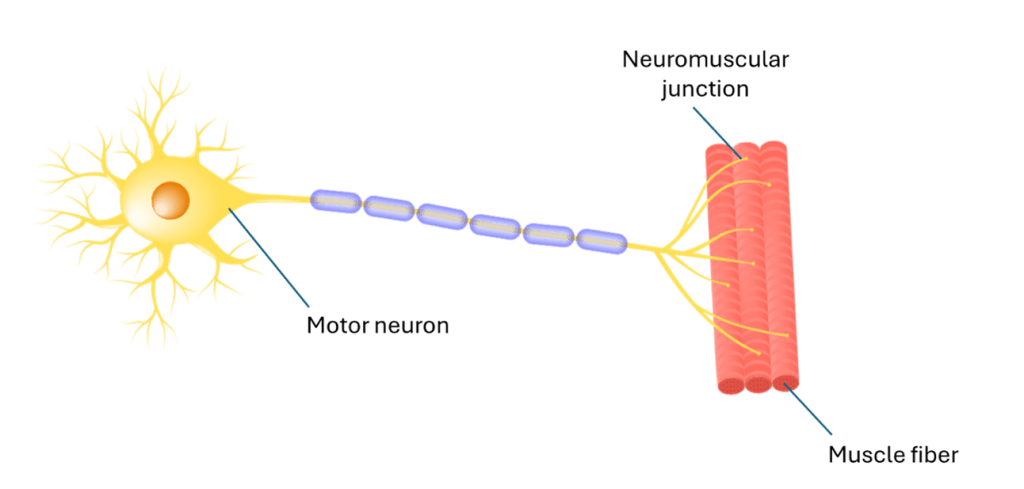
Let’s say you dropped your phone and want to pick it up from off the ground. The process starts in your brain. Once you’ve decided to pick up your phone, your brain passes that message all the way to your legs by sending an electrical message from motor neurons in your brain directly down to your muscles. When the motor neuron reaches the muscle, the message is passed from the motor neuron to the muscle through a special connection called the neuromuscular junction. The messages is conveyed by releasing a chemical called acetylcholine from the motor neuron that binds to receptors on the muscle (Figure 1). The muscle itself is composed of cells that make up the muscle tissue, called muscle fibers. Once acetylcholine makes contact with the muscle, the muscle fibers will contract, and your legs will bend.
What happens when the muscle-mind connection fails?
A breakdown of communication between anything —like between you and your boss or intimate partner— has negative consequences to the relationship. The same can be said if the communication between your brain and muscles breaks down. This disrupts the relationship between your brain and muscles, leading to negative effects that can be life-altering.
For example, consider Amyotrophic Lateral Sclerosis (ALS), which affects 2-3 people per 100,000 worldwide1. The symptoms of ALS occur because motor neurons in the brain die. When the motor neurons die, the muscles cannot receive information from the brain to tell them what to do. This leads to the breakdown and wasting away of the muscles. As the disease gets worse, it can have a huge impact on quality of life as it severely impairs daily activities that we often take for granted such as walking, speaking, and even breathing. The person affected experiences muscle cramping and twitching because their brain cannot control the way the muscles behave. Because their muscles become weak, they experience tripping, falling, clumsiness, and find it hard to do regular movements such as buttoning their clothes or lifting objects. Their speech becomes slurred, they have difficulty swallowing, and because we also use our motor neuron- muscle connection to breathe, people with ALS eventually suffer from respiratory failure.
To conclude, a breakdown in the communication between your brain and muscles can have very negative outcomes and can stop you from performing daily activities that are necessary and enjoyable. So, the next time you pick up weights at the gym, vacuum your house, or walk your dog, remember that these movements wouldn’t be possible without your brain and muscles working together!
References
Cover photo from Pixabay
Figure 1 by DataBase Center for Life Science (DBCLS) on Wikimedia Commons
 PennNeuroKnow
