Some believe that male-dominance and leadership is the “natural” order of things. While this view has decreased in popularity in the last few generations (and for good reason), there are some who may still argue “males are bigger and stronger, of course they are always in charge! Just look at animals.” Well, such a statement is wrong in a few ways. First, if you look across animal species, you will see that males are NOT always the biggest and strongest sex. In fact, males are larger than females in less than half of mammals. Second, size, strength, and even dominance does not equate to leadership – the person in a group who can lift the most weight is not necessarily the best decision-maker. And lastly, of course males are not always in charge! In many animal species, females are the ones running the show! These female-dominant or female-led species are found in both small and large creatures, ranging from insects, to apes, to elephants!
Queen Bees
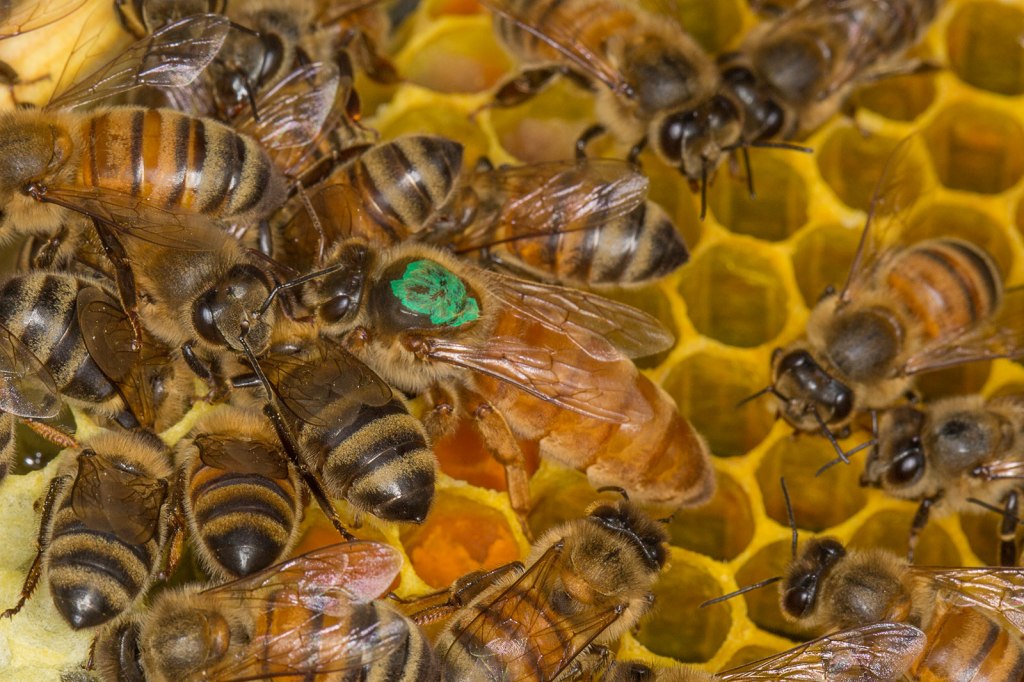
Perhaps one of the most well-known female-dominant species is the bee. You may have heard the phrase “queen bee” before, and indeed, each colony has one central female who is the queen. From the moment she hatches, she receives special care and food from the other bees. Once she matures and becomes the largest bee in the hive, her primary job is to produce lots and lots of eggs. This is vital to the hive, because only she is allowed to mate with male bees, and therefore she is the only one who produces the worker bees, who make up a majority of the hive. And these worker bees, the ones who go out and forage for food for the hive, are all female. The only job the males, called drones, have is to fertilize the queen’s eggs, a process that kills the males right after 1. Once the cold season rolls around and mating is over for the year, the surviving drones, who are no longer useful to the hive, get pushed out by the worker bees 2. So to quote Queen B herself, “Who run the (bee) world? Girls!”. (If you want to read more about bees and how they dance to communicate, check out this PNK article from last summer!).
Elephants
On the other end of the spectrum, at least in terms of size, are elephants. Elephant herds are predominantly female, as the males leave upon reaching adulthood (which is about 11 years old for African elephants and 14 years old for Asian elephants). Afterwards, males will typically travel and live alone, occasionally interacting with other herds in passing, and sometimes joining small herds of other males 3. The more stable and predominantly female herds are often called “families” or “family units”, and can be made up of anywhere from 3-30 elephants. In the family units, females old and young work together to raise the babies. The largest and oldest female of each herd is the leader of the family, known as the matriarch 4.
Elephants are famous for their memory, and since certain species of elephant can live up to 70 years old, you can imagine how much valuable information the matriarch gains over her lifetime 5. She uses her knowledge about the location of important resources, like food and water, and her experience with predators to guide the herd and keep it safe. Matriarchs keep track of other elephant groups as well, and are able to identify other families based on their specific calls. When two elephant families come in contact, it is the matriarchs who set the tone for the interaction, establishing whether their meeting will be peaceful or not 6. Altogether, the matriarch is the one calling the shots and is an incredibly important member of her elephant herd (so don’t forget to respect your elders)!
Primates
Now you may be thinking “ok bees and elephants are cool and all, but why should this matter to me?”. Well, we see some similar behavioral patterns in apes as well! Evolutionary biology indicates that humans and apes share a common ancestor. Therefore, we often study the behavior of monkeys and apes, also called primates, to draw conclusions about human behavior (check out this video to see how research of monkey behavior can teach us about morality and fairness).
These types of studies can be informative, but if the results are not interpreted carefully, they can be misleading. For example, studies of baboons and chimpanzees show that these species tend to be male-dominant, and at times exhibit great levels of male-driven violence 7. This has historically led some scientists to conclude that male dominance and violence in humans is natural and inevitable, especially given the fact that chimpanzees are one of the closest evolutionary relatives to humans 8. But this is only a portion of the story.
A scientist named Dr. Frans De Waal made great strides in understanding these social dynamics amongst primates. Dr. De Waal, who sadly passed away last year, was a Primatologist who spent a good portion of his career showing that chimps are not just violent, but also show empathy (check out this short animated video narrated by Dr. De Waal discussing this topic). So, if we use the behavior of chimps to argue that violence is innate in the human species, we must include empathy and kindness in that argument as well.
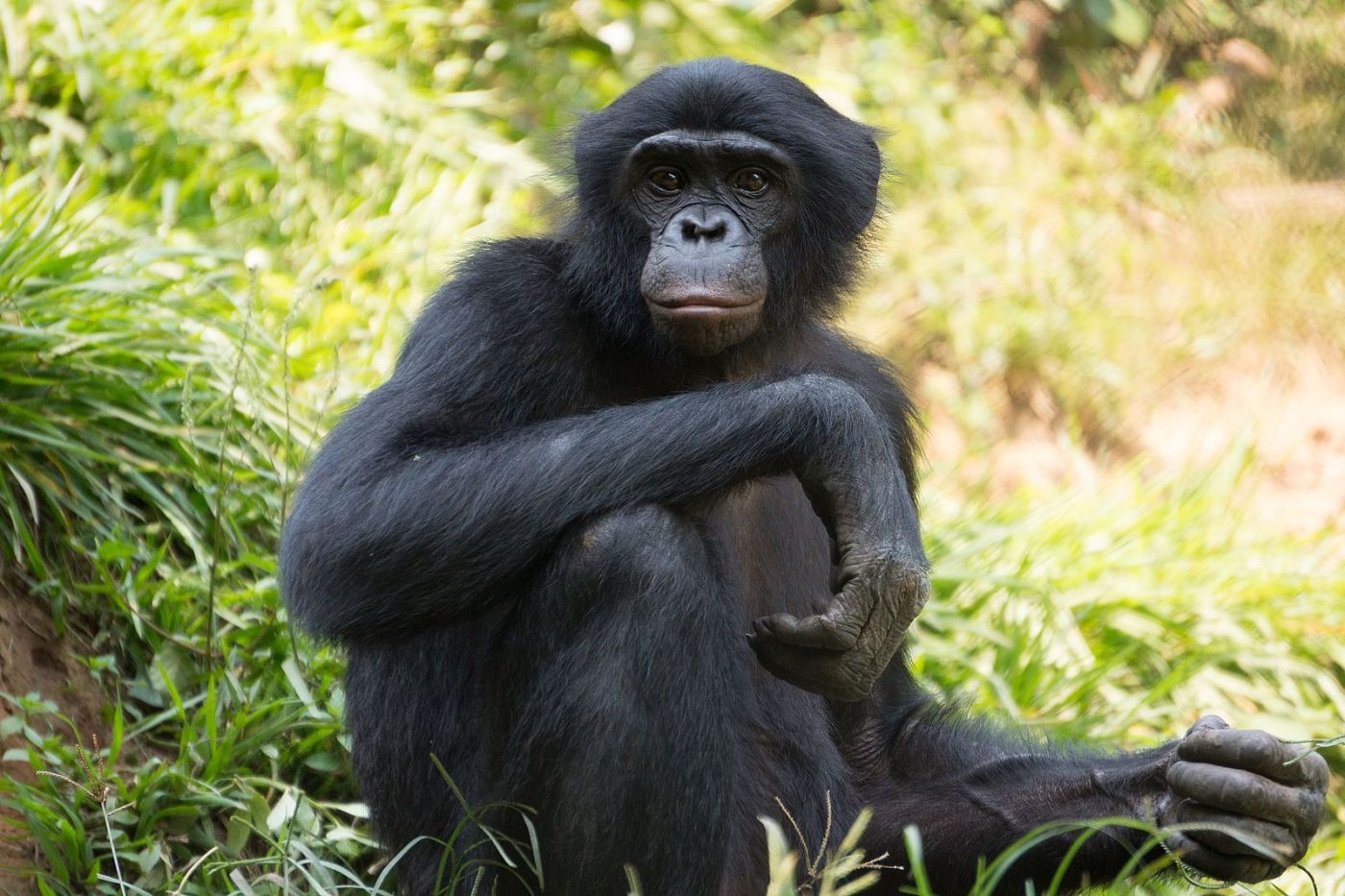
Also, chimps are really only half the story; there is another ape that is just as closely related to humans. Enter: the Bonobo
Bonobos, like chimps, are apes with which humans share approximately 99% of our DNA9. Unlike chimps, females rule in bonobo society. Bonobos have a complex social hierarchy. Individuals in the community have a social rank, and those of higher rank are respected and dominant of those of lower rank. These top ranks are almost always held by the females in the community 10.
Now to be clear, all male bonobos are not automatically at the bottom. The ranks of the males are often tied to that of their mother 11; so sons of high ranking females are dominant over sons of lower ranking females. It’s almost like comparing the rank of the son of a queen, aka a prince, and the son of a duchess; the prince would outrank the other son because he is royalty. This ranking system carries over to daughters as well, but only while they are in the community they were born into. While males will typically stay in their mothers’ communities for their entire life, females, once they reach adulthood, leave this group. They migrate to other bonobo communities where they must start over and establish themselves in the social hierarchy. As part of this process, they try to develop positive relationships with the higher ranking females. If this sounds familiar, it’s sort of like the plot of Mean Girls; new girl joins a high school, befriends the popular girls, and thereby gains popularity/ social power herself. (There are a few more Mean Girls parallels… keep an eye out for * if you are interested)
So why is this ranking system so important? Well, females of higher rank tend to get “dibs” on food, priority when choosing a mate*, and hold a lot of sway when forming alliances with other bonobos**. These alliances, or coalitions, are perhaps one of the primary elements contributing to female dominance amongst bonobos. While male bonobos tend to be bigger than females, females are more social and form tight bonds amongst one another. So when a female has a conflict with a male, she will often have several other females backing her up10, particularly when a male is threatening a juvenile, aka child, in the community11. Even though an individual male might be more likely to overpower an individual female, the females remain in power because they stick together, and there is power in numbers (to hear a story about the time a group of female bonobos bonded together after a male bonobo was threatening them, go to timestamp 2:00 in this video).
This is only a select few examples of female leaders in the animal kingdom (or should I say, animal queendom). Orcas, spotted hyenas, some lemurs, lions… these are all species where females lead their communities. Codominance, where neither sex is typically in charge over the other, has also been observed in some animal species11. All of this to say, that when it comes to the “natural order of things”… there really isn’t a single natural order.
Mean Girls Parallels
* Like when the main character, Cady, says she is interested in Aaron Samuels and the other Plastics (Karen and Gretchen) tell her to stay away because Regina dated him. Even though they weren’t even together anymore, Regina still got priority
** When Regina lost her friends, she lost her power as the popular girl
References
- The Hierarchy of the Hive. The Washington Post (2002).
- Information on the roles of queen bees, drones and worker bees | MDBKA. https://www.mdbka.com/bee-information/ (2018).
- Elephant – Reproduction, Life Cycle | Britannica. https://www.britannica.com/animal/elephant-mammal/Reproduction-and-life-cycle (2025).
- Sara. EleFact Friday: The Role of a Matriarch. Global Sanctuary for Elephants https://globalelephants.org/elefact-friday-the-role-of-a-matriarch/ (2021).
- Hope, S. F., Willgohs, K. R., Dittakul, S. & Plotnik, J. M. Do elephants really never forget? What we know about elephant memory and a call for further investigation. Learn. Behav. 53, 44–64 (2025).
- Esposito, R. Effect of Matriarchs on Group Interactions, Kinship Fitness, and Differences In Chemosensory Behavior of African Elephants (Loxodonta Africana). Ga. South. Univ. (2008).
- Christopher, B. The Massacre at Monkey Hill. Priceonomics https://priceonomics.com/the-massacre-at-monkey-hill/ (2016).
- Marks, J. Review of Demonic Males: Apes and the Origins of Human Violence. Hum. Biol. 71, 143–146 (1999).
- Comparing Chimp, Bonobo and Human DNA | AMNH. American Museum of Natural History https://www.amnh.org/exhibitions/permanent/human-origins/understanding-our-past/dna-comparing-humans-and-chimps.
- Surbeck, M. et al. Drivers of female power in bonobos. Commun. Biol. 8, 1–11 (2025).
- Surbeck, M. & Hohmann, G. Intersexual dominance relationships and the influence of leverage on the outcome of conflicts in wild bonobos (Pan paniscus). Behav. Ecol. Sociobiol. 67, 1767–1780 (2013).
- Male dominance isn’t the default in primate societies, new study shows. Mongabay Environmental News https://news.mongabay.com/2024/03/male-dominance-isnt-the-default-in-primate-societies-new-study-shows/ (2024).
 PennNeuroKnow
Leave a comment