
May 27th, 2025
Written by: Serena Chen
*Knock knock*
Have you ever heard that sound – the sound of your neighbors coming to your door? Perhaps they are just checking in, wanting you to turn your music down a level, or maybe they are bringing by a bundt cake after hearing you have been having a hard time recently. Regardless of how often you run into them or the reasoning for it, who your neighbors are and how they treat you can make a huge difference in how comfortable you feel in your neighborhood and your overall livelihood. The same is true in your nervous system, which is home to billions of cells called neurons. Neurons are a specialized type of cell that use electrical and chemical signals to deliver information to each other between different areas of the brain and body1. And just like how your neighbors may impact you, the messages that neurons receive from their neighboring cells greatly affect how they behave in the area they live in.
So, what are these areas? While you might have previously heard about the presence of neurons in your brain, did you know that neurons are also located in your spinal cord? In fact, the entire central nervous system (CNS) is made up of both the brain and the spinal cord2. However, the types of neurons living in each of these areas and their jobs within them are unique. This article focuses on the spinal cord, which is home to three major types of neurons:
1. Sensory neurons: Communicate information about your senses (sight, sound, touch, etc.) to the CNS3.
2. Motor neurons: Directs muscle activity (such as talking and walking) by communicating information between the spinal cord, muscles, and brain3.
3. Interneurons: The “middlemen” connecting sensory and motor neurons3.
While spinal interneurons may seem like just an intermediary contact point between sensory and motor neurons, these interneurons have a powerful role in controlling information flow between the muscles and spinal cord4. Without this connection, you would experience severe limitations in your everyday movements and reflexes4 (for example, you would not notice or jump back upon accidentally touching a pot of boiling water, resulting in potentially dangerous burns). Spinal cord injury is one type of case where the connection between interneurons and the sensory and motor neurons around them is disrupted, and reestablishing this connection may help in the recovery process5 (as described more below). Thus, interneurons are not your average chatty next door neighbor spreading gossip from you to the next house down. Rather, they have significant roles in your everyday life.
Structure and function of spinal interneurons
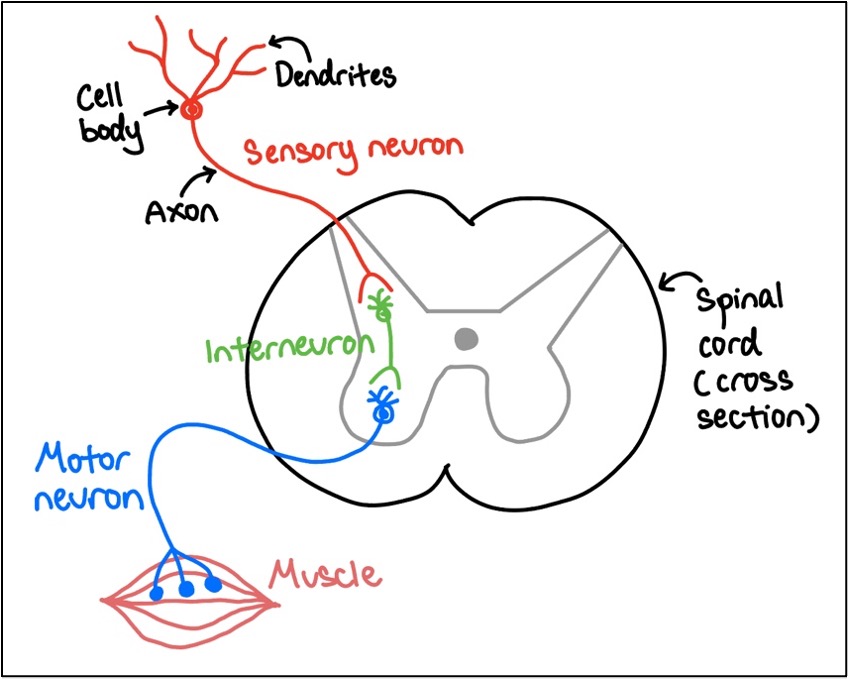
All neurons have three basic parts: a cell body, an axon, and dendrites3 (Figure 1). When a neuron is active, it can communicate with other neurons by sending an electrical signal down its axon. When the electrical signal reaches the tip of the axon, it triggers the release of chemical molecules called neurotransmitters3. These neurotransmitters carry a message from the original neuron, and they deliver this to the dendrites of a neighboring neuron3. This message from the original neuron can serve two purposes: either convincing the receiving neighbor neuron to become active itself (and continuing the gossip train to the next neighbor) or inhibiting it (telling it to be quiet)6.
Spinal interneurons can carry both types of messages, equally important for ensuring normal movement of your body6. For example, when you step on something hot, sensory neurons in your skin send signals to interneurons in your spinal cord saying: “it’s hot!”. The spinal interneurons then quickly decide what to do: “we need to move the foot away!”. At this moment, these interneurons send an activating signal to the motor neurons that make your thigh muscles contract and lift your foot away from danger (Figure 1)7. However, simultaneously, other interneurons receiving the same “it’s hot!” signal from the sensory neurons would say “stop!” to inhibit motor neurons in your opposing muscles (those that would straighten your leg)7. This prevents a tug-of-war action between your opposing muscles which would delay your response to the hot item. Thus, having interneurons that can send activating and inhibiting messages helps your body react fast and smoothly during reflexes as well as everyday movements like walking.
Role of spinal interneurons in recovery after injury
During an injury like spinal cord damage, some pathways between the spinal cord, muscles, and even brain can be cut off. As a result, some interneurons become confused and start sending inhibitory messages to motor neurons in the muscles, even if they were originally meant to send activating signals5. This contributes to the paralysis that may result from a spinal cord injury5. Neuroscientists have found that restoring these interneurons to their original state in mice (a common animal model for studying injury and various neurological disorders) improved their recovery and ability to move after experiencing a spinal cord injury5. So, not only do spinal interneurons help ensure that things run smoothly on an everyday basis, but they could also play an important role in healing their community when it is broken – talk about a good neighbor!
Conclusion
Overall, spinal interneurons are critical members of the central nervous system, maintaining healthy communication with other sensory and motor neurons to ensure that you can always move and go about your daily life properly. Like a good neighbor, they are always keeping those in the neighborhood and the community in line.
References
1. Holt, C. E., Martin, K. C. & Schuman, E. M. Local translation in neurons: visualization and function. Nat. Struct. Mol. Biol. 26, 557–566 (2019).
2. Thau, L., Reddy, V. & Singh, P. Anatomy, Central Nervous System. in StatPearls (StatPearls Publishing, Treasure Island (FL), 2025).
3. Brain Basics: The Life and Death of a Neuron | National Institute of Neurological Disorders and Stroke. https://www.ninds.nih.gov/health-information/public-education/brain-basics/brain-basics-life-and-death-neuron.
4. Zholudeva, L. V. et al. Spinal Interneurons as Gatekeepers to Neuroplasticity after Injury or Disease. J. Neurosci. 41, 845–854 (2021).
5. Bertels, H., Vicente-Ortiz, G., El Kanbi, K. & Takeoka, A. Neurotransmitter phenotype switching by spinal excitatory interneurons regulates locomotor recovery after spinal cord injury. Nat. Neurosci. 25, 617–629 (2022).
6. Interneuron – an overview | ScienceDirect Topics. https://www.sciencedirect.com/topics/medicine-and-dentistry/interneuron.
7. Ronzano, R. et al. Spinal premotor interneurons controlling antagonistic muscles are spatially intermingled. eLife 11, e81976 (2022).
Cover photo by ClickerHappy on Pexels.
Figure 1 drawn by Serena Chen.
 PennNeuroKnow
Leave a comment