
December 3rd, 2024
Written by: Serena Chen
It’s that time of year again! Perhaps you are already anticipating a long-awaited reunion with friends and family, being huddled in your room with a cup of hot chocolate, or maybe even traveling to a place you’ve never been before. But with the joys of holiday cheer also come a list of seemingly endless tasks: decorating, planning, gift shopping, budgeting, cleaning – all on top of completing your final tasks of the year for work, attending meetings, and getting to that basket of laundry waiting for you at home. To handle it all, maybe you try tackling multiple tasks at once. For example, taking a virtual meeting while dealing with something at home. The act of managing multiple tasks at once, known as multitasking1, has become frequent practice in many people’s lives. However, what happens to your brain when you multitask? And what does this mean for the quality of your performance?
The challenges of multitasking
You may have noticed that when you multitask, it sometimes feels as though you are working harder than you would be if you were doing one task at a time. For example, imagine you are watching a TV screen. Letters of the alphabet begin to pop up and you must press a yellow button if the letter is capitalized. Seems easy, right? Now, what if you were given an additional blue button which you must simultaneously press if the letter is also a vowel? For most people, this activity just became more difficult. It might take you more time to consider your options before you decide to press either button. You may also begin to feel ‘scatterbrained’, where you are doing one task but still thinking about the other. This feeling would continue to grow as even more tasks are added on top of the first. Why is multitasking challenging? Turns out, the brain is very particular about how it handles information and your resulting multitasking skills.
Brain networks involved in multitasking
What is happening in your brain while you multitask? To tackle this question, scientists asked people to perform the exact tasks you were prompted to think about earlier: first selecting capitalized letters, then trying this together with selecting vowels2. While the people did these single vs. multiple tasks, scientists studied their brain activity using a brain scanning technology called functional magnetic resonance imaging (fMRI). The neuroscientists found that two main brain regions became active only when multitasking: the prefrontal cortex and the parietal cortex2,3(Figure 1). The prefrontal cortex and parietal cortex are involved in cognitive functions such as attention-keeping and decision-making4. From the fMRI scans, scientists found that these regions became more active when people performed two tasks simultaneously compared to when they only performed one task2,5. Therefore, the prefrontal and parietal cortices are likely important drivers for the human ability to multitask3.
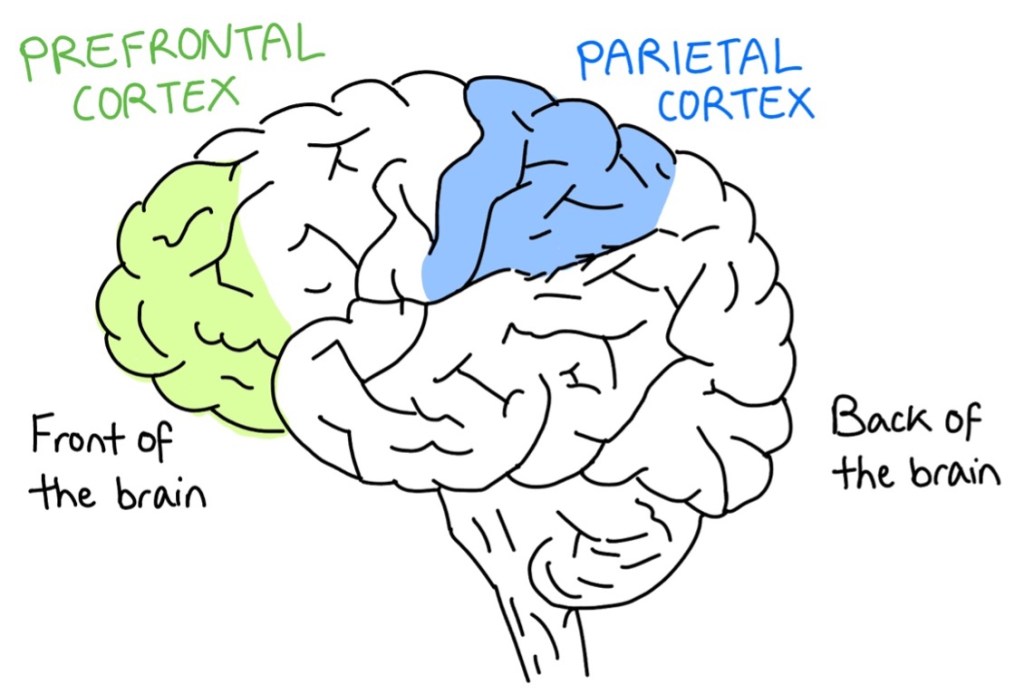
But how do these brain regions support multitasking? The parietal cortex is a central location for storing information about the relationship between an external stimulus, such as an image or sound, and the response that results from that stimulus3. In the described experiment, this would be between seeing the letter (stimulus) and reporting whether it was capitalized and/or a vowel by pressing the yellow and/or blue button, respectively (response)3. However, while the parietal cortex stores this information, it does not necessarily mean you would be able to retrieve it. For example, using the parietal cortex alone, you may press the blue button for vowel during the single task where you were only supposed to be pressing the yellow button for capitalized letters. This is where the prefrontal cortex comes in: It organizes information in a way where you can correctly and more easily retrieve the stimulus-to-response connection that you need3. Together, the prefrontal and parietal cortices allow multitasking to occur.
The costs of multitasking
It seems our brains can manage multitasking, but should we be doing this? While multitasking is defined as you attempting multiple things at once, and it does feel this way, most of the time your brain is just switching rapidly between the tasks you are attempting to do. Each switch comes with an energy cost. Scientists call this idea the bottleneck theory, where the brain is like a bottle filled with marbles. When the bottle is tipped upside down, only one marble can fit through the bottle neck and fall out at a time3,5. Similarly, the human brain has limited processing capacity and can only function optimally when handling one thing at a time3. When people are required to perform multiple tasks at a time, not only are they slower to complete each task, but they are also more prone to making errors1. This is the cost of multitasking that can often reduce productivity and performance quality. It is also the reason why multitasking is extremely risky in certain scenarios. For instance, texting and driving.
Overall, the human brain can store and organize information in a manner that allows you to tackle multiple tasks simultaneously. This can feel like it may come in handy during busy times in life, but it also comes at the cost of energy and sometimes, safety. Although scientists have found some of the brain networks involved in multitasking and developed theories for why it is challenging, more research is needed to understand how multitasking works and the benefits and drawbacks of multitasking on the brain. So, the next time you are out gift shopping this season, try checking off things on your list one at a time, rather than going for it all together. This might just save you a potential return trip where something is missed!
References
1. Garner, K. G. & Dux, P. E. Knowledge generalization and the costs of multitasking. Nat. Rev. Neurosci. 24, 98–112 (2023).
2. Dreher, J.-C. & Grafman, J. Dissociating the roles of the rostral anterior cingulate and the lateral prefrontal cortices in performing two tasks simultaneously or successively. Cereb. Cortex N. Y. N 1991 13, 329–339 (2003).
3. The More, The Merrier? What Happens In Your Brain When You Are Multitasking? Frontiers for Young Minds https://kids.frontiersin.org/articles/10.3389/frym.2021.584481.
4. Katsuki, F. & Constantinidis, C. Unique and shared roles of the posterior parietal and dorsolateral prefrontal cortex in cognitive functions. Front. Integr. Neurosci. 6, 17 (2012).
5. Worringer, B. et al. Common and distinct neural correlates of dual-tasking and task-switching: a meta-analytic review and a neuro-cognitive processing model of human multitasking. Brain Struct. Funct. 224, 1845–1869 (2019).
Cover photo by Matthew Henry on Burst.
Figure 1 drawn by Serena Chen (author).
 PennNeuroKnow
Leave a comment