August 26th, 2024
Written by: Abby Lieberman
Have you ever gone to a dance performance and been blown away by the gravity-defying leaps and seemingly impossible number of pirouettes? These performances are extraordinary because they combine incredible physical feats with artistic expression. The ability to combine physical feats with rhythm and musicality feels uniquely human, but is it? As it turns out, we are not alone in this ability. A remarkable group of birds, called birds-of-paradise, are also masters of dance.
What is a bird-of-paradise?
Birds-of-paradise are species of songbirds that are primarily found in the dense forests of New Guinea and surrounding islands. They are known for their breathtaking colors and unusual feather configurations, called ornamentation or ornaments(1) (just like Christmas!) (Figure 1). Birds-of-paradise have evolved their beautiful appearances because they live in tropical rainforests that are rich with food and do not have many natural predators(2). Many scientists think that as a consequence, these birds evolved their ornamentation.

Showing off their good looks isn’t the only thing birds-of-paradise do to find a mate. Male birds-of-paradise also perform elaborate dances to get the attention of females. Female birds choose to mate with males based on their song and dance moves, suggesting that over time the brains of these birds evolved to let them be masters of a mix of acrobatics and musical theater. Bird-of-paradise dances are quick, accurate, and powerful–much like ballet or a gymnastics routine. Some birds-of-paradise dance high up in the trees, while others prefer to perform on a self-made stage, and others even perform acrobatic duets (video 1). Remarkably, some birds incorporate DIY setpieces into their dances, hoping to impress potential mates with their building skills. Some species will even place objects that contrast with their feathers and ornaments around the dance floor to set the mood (see video 2). These building behaviors also let a female know how smart a male is. If a male bird gives a bad performance or builds a bad set piece, the female bird will signal that she gives his attempt a low rating by flying away from him(3). Ouch.
Why “bird brain” shouldn’t be an insult
Many of us have heard of Darwin’s theory of natural selection, which says that some members of a species are better adapted to their environment than others(4). Animals better adapted to their environment are more likely to survive and reproduce. Another important concept in evolution that you may not have heard of is sexual selection. Darwin came up with the idea of sexual selection to explain traits that might seem disadvantageous at first glance, but help animals find mates, ultimately promoting the survival of the species(5). Sexual selection plays an important role in explaining how birds-of-paradise evolved their fabulous feathers, songs, and dances. Scientists are currently studying how sexual selection has shaped parts of the songbird brain, allowing these birds to turn movements they use every day into show-stopping dances and songs.
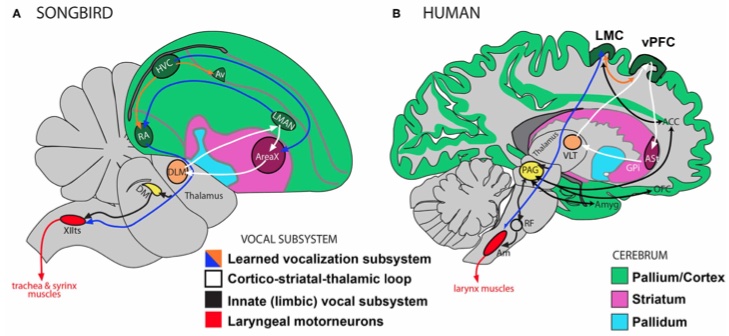
For years, scientists thought that bird brains were simple. Over the past few decades, we have learned that this is incorrect. Thousands of species of songbirds, including birds-of-paradise have sophisticated brains that work similarly to the human brain. Just like us, birds have brain structures that help them learn new things, process sensory information, and control movement. These parts of the bird brain are contained in a region called the pallium, which has similar jobs as the human cortex(6). Structures of the pallium allow birds to make the intricate songs and dances shown in the videos above. Important specialized structures of the pallium include the high vocal center (HVC) that specifically helps birds learn songs and perform songs(7-10) and the robustus nucleus of the arcopallium (RA) that talks to regions in the brainstem that then control muscles of the throat to let the bird sing(7-10). These parts of the brain are shown below in Figure 2. As for the part of the brain controlling dancing in bird-of-paradise, scientists hypothesize that a region called the periaqueductal grey (PAG, also called DM in the songbird as shown in Figure 2) is important(9). The PAG/DM receives information from the pallidum and other regions and is known to control attack and defensive behavior, hunting, parenting, mating and is also involved in singing. Future research will let us understand more how this structure controls movement in birds-of-paradise.
Practice makes perfect
Birds-of-paradise are tremendously hard working, using their specialized brain structures to perfect complex song and dance routines from an early age. Young male birds-of-paradise will often observe older, more experienced males to learn the intricacies of the dance, which they then practice extensively on their own(10). This process of observation and practice suggests that these birds learn from their environment and improve their skills over time. So, the next time you watch a dance performance, remember that this artistic expression is mirrored in the natural world. The moves and grooves of birds-of-paradise show us that some of the most impressive dancers in the animal kingdom are, in fact, neon and feathered!
References
- Evolution of dance and color in the birds of paradise. Animal Ecology in Focus. Accessed August 25, 2024. https://animalecologyinfocus.com/2018/04/11/evolution-of-dance-and-color-in-the-birds-of-paradise/
- Birds of the Gods. PBS. Accessed August 19 2024. https://www.pbs.org/wnet/nature/birds-of-the-gods-bird-of-paradise-facts/6236/#:~:text=Threats%3A%20Birds%20of%20paradise%20have,put%20some%20species%20at%20risk.
- Fusani et al. Physiological control of elaborate male courtship: Female choice for neuromuscular systems. (2014). Neurosci Biobehav Rev. 46, 534-546, (2014).
- Darwin, C. On the Origins of Species by Means of Natural Selection 1, (1859).
- Darwin, C. The descent of man, and Selection in relation to sex 1, (1871).
- Byers, J., Hebets, E., & Potos, J. Female mate choice based upon male motor performance. Animal Behavior 4, 771-778 (2010).
- Jarvis E.D. et al. Global view of the functional molecular organization of the avian cerebrum: mirror images and functional columns. J Comp Neurol. 521(16), 614-3665 (2013).
- de Lima, J.L.R. et al. A putative RA-like region in the brain of the scale-backed antbird, Willisornis poecilinotus (Furnariides, Suboscines, Passeriformes, Thamnophilidae). Genet Mol Biol. 38(3), (2015).
- Schwark, R.W., Fuxjager, M.J., & Schmidt, M.F. Proposing a neural framework for the evolution of elaborate courtship displays. eLife 11, eLife (2022).
- Burke, J. & Schmidt, M.F. Neural Control of Birdsong. eLS 1, 345-355 (2020).
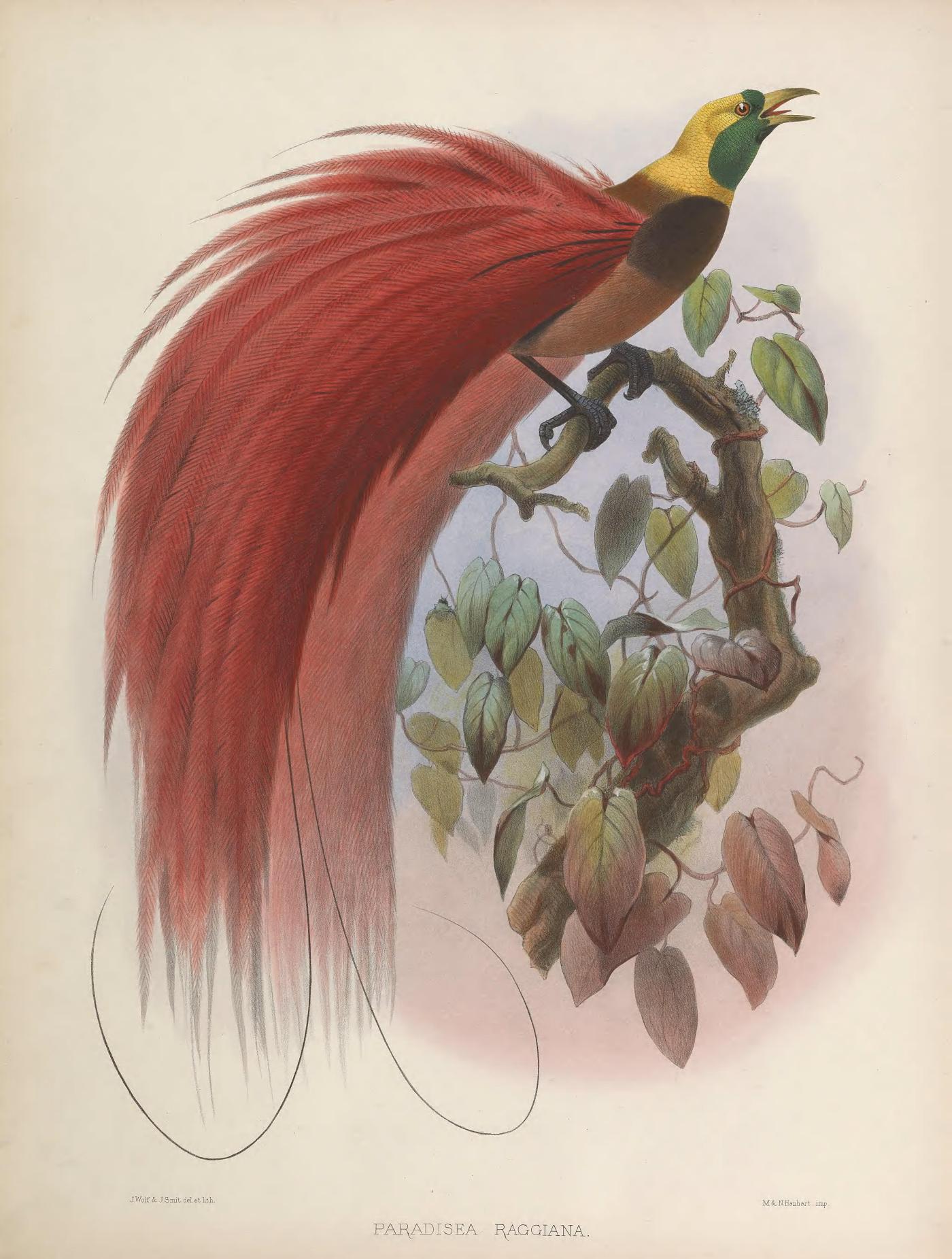
Cover photo by Daniel Giraud Elliot on WikiMedia Commons.
Figure 1 (left to right): image by Almir Cândido de Almeida on WikiMedia Commons, image by Doug Janson on WikiMedia Commons, image by gailhanson on WikiMedia Commons, image by JJ Harrison on WikiMedia Commons
Figure 2 from Christopher Petkov and Erich Jarvis on WikiMedia Commons.
 PennNeuroKnow
_BHL44792727.jpg)
.jpg)

.jpg)
.jpg)
Leave a comment