July 9th, 2024
Written by: Omer Zeliger
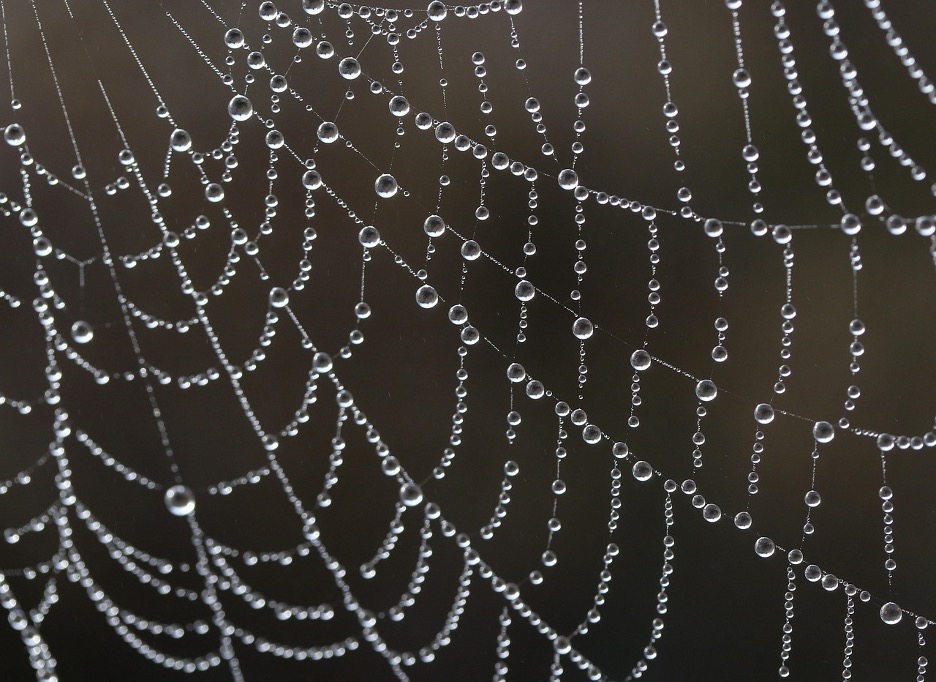
Step outside on a cool morning and you may be treated to the sight of a dewy spiderweb hanging delicately between two blades of grass. Though they can look beautiful, webs are much more than just decorations or homes for spiders. Some aquatic spiders use silk to waterproof their egg sacs1, while others use thin strands to get swept up in the wind and fly to new habitats2. Some species of social spiders live communally in giant webs, which they use to organize and communicate with each other3. Most famous, however, are orb webs: the classic cobwebs made of sticky silk spirals that catch prey mid-flight. With how central webs are to spiders’ lives, it’s no wonder they’ve gotten so good at weaving them – even newborn spiders can build flawless orb webs4! This incredible skill has scientists wondering: how do spiders build such intricate, complex structures as orb webs?
This is the question that drives spider scientist Dr. Andrew Gordus. As he told Science Daily, “After seeing a spectacular web I thought, ‘if you went to a zoo and saw a chimpanzee building this you’d think that’s one amazing and impressive chimpanzee.’”5 In pursuit of answers, researchers in his lab at Johns Hopkins video-recorded one species of web-building spider, Uloborus diversus, through its orb web-weaving process6 (Figure 1). Rather than tackling the entire process at once, the spider breaks it down into four simpler stages. First, it builds a disorganized proto-web as a canvas to help the web keep its shape while it’s still under construction. Next, the spider adds the web’s “spokes”, also known as radii, while slowly removing sections of the proto-web it no longer needs. Once the radii are finished, the spider starts at the center to quickly add an accessory spiral, which is thought to temporarily stabilize the web. Finally, the spider slows down and carefully weaves the capture spiral, working from the outside inwards and removing the auxiliary spiral as it goes. Once the web is done, the spider settles in the middle to wait for its next meal.

Breaking the web-building down into different steps helps to simplify the process, but it’s still an enormous task for a tiny spider to keep track of an entire web many times bigger than it. How do spiders remember all that information?
Scientists believe they don’t have to7. One team of researchers, Dr. Fritz Vollrath and Dr. Thiemo Krink, hypothesize that spiders manage to build their complex webs using only what they can feel in their immediate surroundings. According to their research, spiders don’t need to know what’s going on at the opposite side of the web. Instead, they decide what to do based on a few simple rules that only take into account what the spider senses right next to it. For example: if the spider is building the capture spiral and it has just connected a thread, walk forward to the next radius. Though we don’t know yet how spider brains “store” these rules, each spider seems to be born with the rules already determined, which might explain how even newly hatched spiderlings can weave webs4.
This sounds straightforward enough on paper. In reality, the rules have to be flexible enough to let the spiders adapt to different conditions and unexpected mishaps. For example, spiders customize their webs based on the current environment8. It is hot or cold? Humid or dry? What supports are available? Spiders take in all this information about the world and use it to fine-tune their webs. Every web ends up being unique – specialized to work best in the environment in which it was built. On top of that, spiders can repair damaged webs and even work around injured legs6,7. Despite the web-building rules themselves being relatively simple, when they’re put into practice they let spiders build astonishingly complex and varied webs.
Once completed, a web becomes central to the spider’s life, acting almost as an extension of its body and its senses. By sensing vibrations in their webs, spiders can tell when and where prey’s been trapped9 and “hear” when a predator is approaching10. By pulling specific strands tight and making them more sensitive to vibrations, spiders can change where on the web they’re listening to11. Scientists even think that spiders can use their webs to help them think by acting as a physical record of the spider’s past experiences, the same way a human might write in a diary12.
With webs so central to their success, it’s little surprise that spiders are so well-adapted to web-weaving. We humans have plenty to learn from them. Spider silk, for example, is so lightweight and strong that thousands of hours of research have gone into figuring out what makes it so tough, and how we can use that to create better cloth and building materials13,14. Roboticists, on the other hand, are interested in the web-building process itself. They want to know how such a small animal, working from such a simple set of rules, can create such complex masterpieces. They hope that studying spiders will lead to simple yet adaptable robots that use straightforward rules of thumb to achieve elaborate results7.
Though we’re not quite there yet, scientists are already on the case! By analyzing footage of web weavers at work, Dr. Vollrath and Dr. Krink reverse-engineered one spider species’ web-building rules and used them to create a virtual spider: the cyber spider Theseus7. In its natural digital environment, Theseus weaves webs almost indistinguishable from its real-life inspirations. If Theseus can be brought to life, its creators hope to use its webs to fight pollution, and as temporary scaffolds for construction work. In the meantime, if you want to see a spider web at work, keep your eyes peeled for one of Theseus’s flesh-and-hemolymph cousins.
References
- Correa-Garhwal, S. M., Chaw, R. C., Dugger, T., Clarke, T. H., 3rd, Chea, K. H., Kisailus, D., & Hayashi, C. Y. (2019). Semi-aquatic spider silks: transcripts, proteins, and silk fibres of the fishing spider, Dolomedes triton (Pisauridae). Insect molecular biology, 28(1), 35–51.
- Bell, J. R., Bohan, D. A., Shaw, E. M., & Weyman, G. S. (2005). Ballooning dispersal using silk: world fauna, phylogenies, genetics and models. Bulletin of entomological research, 95(2), 69–114.
- Bernard, A. & Krafft, B. (2002). L’attraction pour la soie : base de la cohésion du groupe et des comportements collectifs chez les araignées sociales. Comptes Rendus. Biologies, 325(11), 1153-1157.
- Eberhard W. G. (2007). Miniaturized orb-weaving spiders: behavioural precision is not limited by small size. Proceedings. Biological sciences, 274(1622), 2203–2209.
- Johns Hopkins University. (2021, November 1). Spiders’ web secrets unraveled. ScienceDaily. Retrieved July 5, 2024 from http://www.sciencedaily.com/releases/2021/11/211101105356.htm
- Corver, A., Wilkerson, N., Miller, J., & Gordus, A. (2021). Distinct movement patterns generate stages of spider web building. Current biology : CB, 31(22), 4983–4997.e5.
- Vollrath, F., & Krink, T. (2020). Spider webs inspiring soft robotics. Journal of the Royal Society, Interface, 17(172), 20200569.
- Vollrath, F., Downes, M., & Krackow, S. (1997). Design variability in web geometry of an orb-weaving spider. Physiology & behavior, 62(4), 735–743.
- Lott, M., Poggetto, V. F. D., Greco, G., Pugno, N. M., & Bosia, F. (2022). Prey localization in spider orb webs using modal vibration analysis. Scientific reports, 12(1), 19045.
- Zhou, J., Lai, J., Menda, G., Stafstrom, J. A., Miles, C. I., Hoy, R. R., & Miles, R. N. (2022). Outsourced hearing in an orb-weaving spider that uses its web as an auditory sensor. Proceedings of the National Academy of Sciences of the United States of America, 119(14), e2122789119.
- Nakata K. (2010). Attention focusing in a sit-and-wait forager: a spider controls its prey-detection ability in different web sectors by adjusting thread tension. Proceedings. Biological sciences, 277(1678), 29–33.
- Japyassú, H. F., & Laland, K. N. (2017). Extended spider cognition. Animal cognition, 20(3), 375–395.
- Römer, L., & Scheibel, T. (2008). The elaborate structure of spider silk: structure and function of a natural high performance fiber. Prion, 2(4), 154–161.
- Zhuo, Y., Xia, Z., Qi, Y., Sumigawa, T., Wu, J., Šesták, P., Lu, Y., Håkonsen, V., Li, T., Wang, F., Chen, W., Xiao, S., Long, R., Kitamura, T., Li, L., He, J., & Zhang, Z. (2021). Simultaneously Toughening and Stiffening Elastomers with Octuple Hydrogen Bonding. Advanced materials (Deerfield Beach, Fla.), 33(23), e2008523.
Header image by AdinaVoicu via Pixabay
Figure created in Adobe Illustrator
 PennNeuroKnow
Leave a comment