
November 10th, 2026
Written by Hayley Lenhard
The holiday season is the best – between Halloween, Thanksgiving, Hanukkah, Christmas, and New Years there’s a lot of celebrating going on! And with all that celebrating comes, of course, a LOT of delicious food. I don’t know about you, but dessert is my favorite meal of the day, and I always have room for a sweet treat (or two). And I’m not alone! You’ve likely heard people claim to have a “dessert stomach,” a whole extra stomach set aside for sweets. Let’s use Thanksgiving dinner as an example of where this so-called dessert stomach might come into play: you’ve just finished eating a big helping of delicious turkey, mashed potatoes and gravy, stuffing, sweet potatoes, and cranberry sauce. Yum! You’re so full, it feels like you couldn’t possibly eat one more crumb. But uh oh…here comes dessert. Out come plates and plates of goodies – pie, cookies, ice cream, you name it! Despite the fact that 30 seconds ago you were feeling like you might burst, suddenly you seem to have an appetite again, and you’re able to gobble down a big slice of pumpkin pie with ease. How did that happen? You don’t actually have a whole extra stomach, right? Let’s break this down and take a look at the neuroscience that’s happening throughout this dinner.
The Hypothalamus: keeping your body in balance
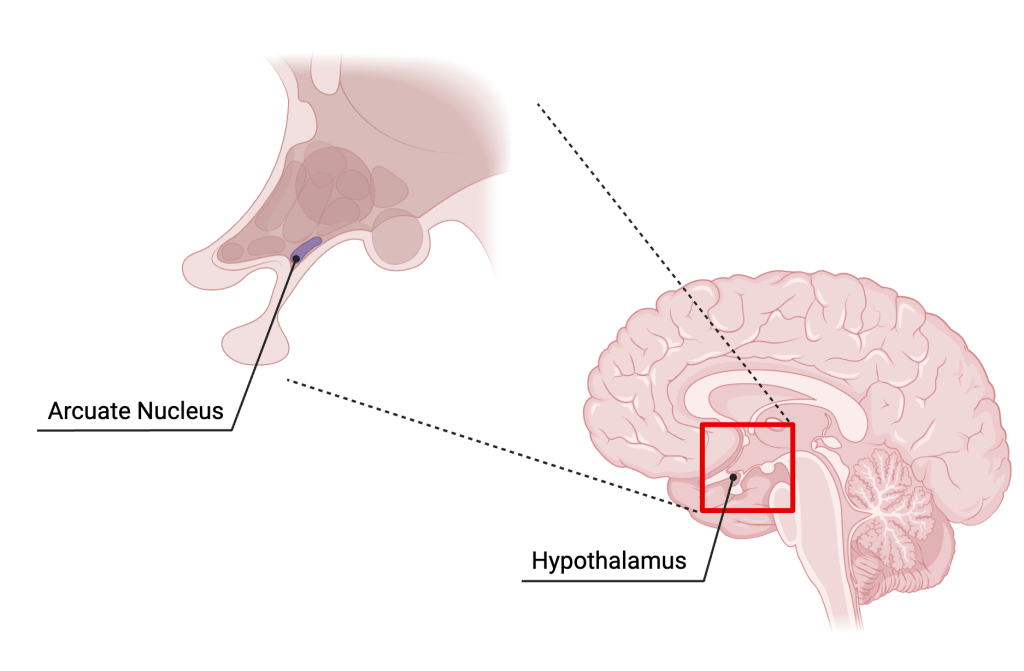
When you first sit down to eat, you’re probably feeling hungry. As you make your way through all those yummy Thanksgiving dishes, you slowly become less hungry. In other words, you start to feel more full. These feelings of hunger and fullness are regulated by a structure deep in the brain called the hypothalamus (Figure 1), which is responsible for keeping your body in a stable state called homeostasis. The hypothalamus is made up of different nuclei, or specialized clusters of neurons, that regulate a variety of different functions like sleep, temperature, blood pressure, hunger, and thirst. One of the main ways the hypothalamus regulates these different functions is by releasing chemical messengers, such as hormones.1 You can think of these messengers that are released from the hypothalamus as directors. To coordinate the aforementioned bodily functions, these chemical messengers carry information to other structures in the brain, or even other organs in your body, and tell them what they need to do and when they need to do it.2
When you sit down for dinner, you’re feeling hungry because neurons in the hypothalamic nucleus that regulates appetite, called the arcuate nucleus, are releasing chemical messengers that stimulate an appetite (Figure 1). These appetite-stimulating messengers are called agouti-related peptide (AgRP) and neuropeptide Y (NPY). As you fill your belly with delicious Thanksgiving dishes, your hunger gradually fades as the arcuate nucleus stops sending the appetite-stimulating messengers AgRP and NPY, and instead starts sending appetite-suppressing messengers.3 The arcuate nucleus knows when to make this switch because as you eat, digestive processes in your gut produce satiety signals that are released into the circulation and picked up by the arcuate nucleus in the brain.4 The appetite-suppressing messenger that neurons in the arcuate nucleus then start producing is called pro-opiomelanocortin (POMC).3 POMC is what’s causing those feelings of fullness after dinner.
POMC neurons and the dessert stomach
So if neurons in the arcuate nucleus are releasing POMC, which suppresses your appetite, why can you magically “find room” when desserts are on the table? What makes you “need something sweet” even when you’re full? Interestingly, researchers have found evidence that POMC, the chemical that is responsible for causing you to feel full after you stuffed yourself with turkey, is the same chemical that makes you crave that piece of pumpkin pie. How is this possible? It turns out that POMC can be cleaved, or split, into different chemicals that result in these seemingly opposite effects.5 Which downstream chemical POMC gets cleaved into is dependent on the types of enzymes (the proteins that perform the cleaving of POMC) that are present.6 Think of the enzymes as chefs! Like enzymes, different types of chefs often specialize in making different kinds of food. One chef’s specialty might be bread, while another chef’s might be steak. Similarly, different types of enzymes specialize in making different chemicals, even though the starting ingredient, POMC, might be the same. Which chemical POMC is cleaved into therefore largely depends on the kind of enzymes that are present in the POMC producing neuron.
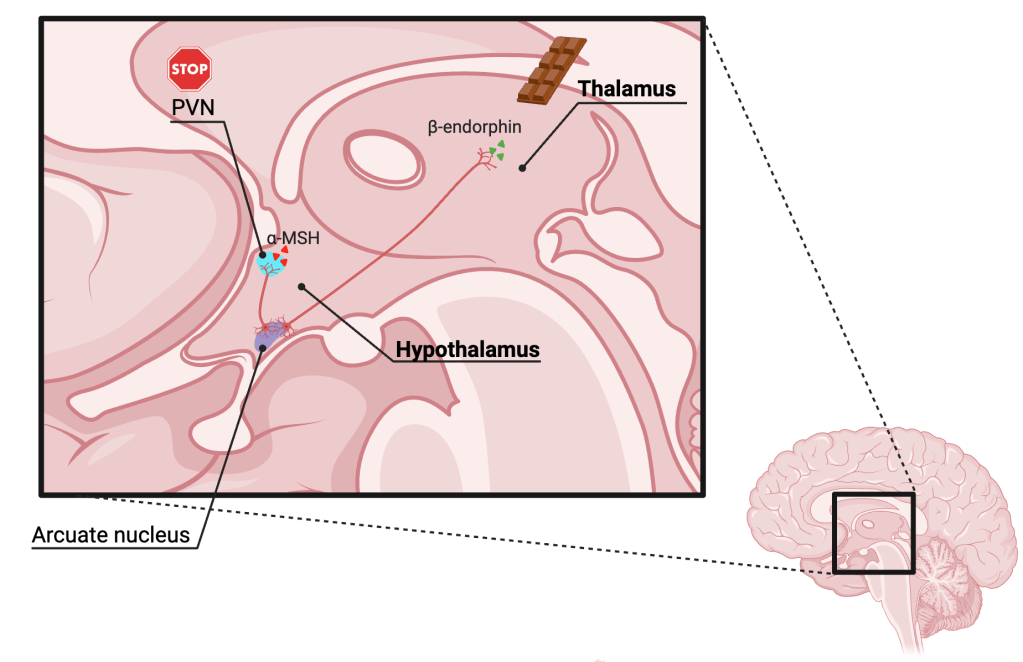
Now what are some of these downstream chemicals? Some enzymes can cleave POMC into a chemical called α-melanocyte-stimulating hormone (α-MSH), which can be sent from the arcuate nucleus to another region within the hypothalamus called the paraventricular nucleus of the hypothalamus (PVN).3 The PVN contains receptors that are activated by α-MSH, causing you to feel full and reduce food intake.3 However, other types of enzymes cleave POMC into a different chemical, called β-endorphin, which can be sent from the arcuate nucleus to a different brain structure entirely called the thalamus, where it activates receptors that stimulate sugar cravings (Figure 2).7 Though both of these chemicals are derived from the same starting ingredient (POMC), α-MSH has an appetite-suppressing effect whereas β-endorphin stimulates sugar cravings.
Why are you hardwired to crave sugar?
So we’ve established how POMC can suppress your appetite while stimulating sugar cravings at the same time. But another pressing question might be why would POMC do this? Why would your brain have evolved so that you want to eat sugary, unhealthy foods after you’ve already consumed a full meal? To answer this question, we have to look back in time.
These days, food is abundant and relatively easy to come by, especially in America where fast-food chains like McDonald’s or Burger King can be found on just about every corner. But of course, this wasn’t always the case. Before you could use Uber Eats or DoorDash to have your favorite meal delivered right to your doorstep, before industrialization and the rise of processed food, food was much harder to come by. Twelve thousand years ago, before the rise of agriculture, our ancient ancestors relied on hunting and gathering food.8 Food was scarce, and a significant amount of time and energy was devoted to finding the next meal. Under these circumstances, it’s likely that eating sugar (even if you were full) was beneficial as sugar is easily converted into usable energy, which is crucial when you need to have enough energy to hunt for every meal.7 Unlike other more complex nutrients such as carbohydrates, fat, or protein, which take longer for your body to break down, sugar has a very simple molecular structure that can be quickly metabolized, which might explain why humans have evolved to specifically crave sugar, and why that craving can sometimes overpower feelings of fullness.
But modern-day humans don’t typically rely on hunting and gathering, or even farming, to get their food. They simply buy it at the store. So this once beneficial sugar craving can actually be detrimental in a modern environment where food is abundant, contributing to binge eating and rising obesity rates.7 The good news is that since scientists now have a much better understanding of where those sugar cravings are coming from, they can use this knowledge to create therapies for obesity. For example, drugs that prevent POMC from being cleaved into β-endorphin or that block receptors in the thalamus from receiving those signals could help reduce sugar intake by eliminating cravings, which could ultimately result in weight loss.
Enjoy that dessert (in moderation)!
So this holiday season, when the desserts start rolling out and you’re suddenly able to find room for those cookies or that piece of pie – despite the fact that two minutes ago you swore you’d never be able to eat again – you can thank POMC and specifically the β-endorphin it turns into for giving you that extra stomach! And while you should feel free to indulge (I know I will be; the holidays only come once a year after all), remember to try not to let those sugar cravings get too out of hand. While they may have helped your ancient ancestors survive, sugar cravings work against you in today’s world of abundant, highly processed foods.
References
- Hypothalamus: What It Is, Function, Conditions & Disorders. Cleveland Clinic https://my.clevelandclinic.org/health/body/22566-hypothalamus.
- Hormones: What They Are, Function & Types. Cleveland Clinic https://my.clevelandclinic.org/health/articles/22464-hormones.
- Timper, K. & Brüning, J. C. Hypothalamic circuits regulating appetite and energy homeostasis: pathways to obesity. Dis. Model. Mech. 10, 679–689 (2017).
- Li, S. et al. The Mechanism of the Gut-Brain Axis in Regulating Food Intake. Nutrients 15, 3728 (2023).
- Jouque, V. et al. Beyond satiety: unraveling the complex roles of POMC neurons in behavior and metabolism. Rev. Endocr. Metab. Disord. 27, 367–381 (2026).
- Lindberg, I. & Fricker, L. D. Obesity, POMC, and POMC-processing Enzymes: Surprising Results From Animal Models. Endocrinology 162, bqab155 (2021).
- Minère, M. et al. Thalamic opioids from POMC satiety neurons switch on sugar appetite. Science 387, 750–758 (2025).
- Hunter-Gatherer Culture. https://education.nationalgeographic.org/resource/hunter-gatherer-culture.
Perplexity AI was used to find sources.
Cover photo by Element5 Digital from pexels.
Figures 1 and 2 created by Hayley Lenhard using Biorender

