
October 20th, 2026
Written by Nita Rome
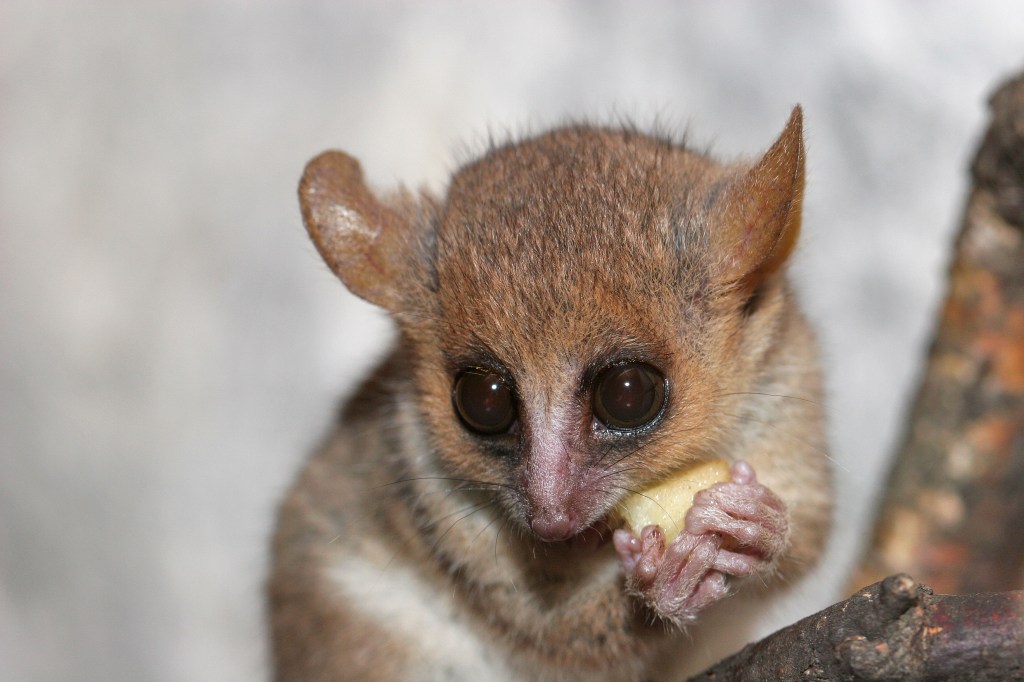
A few weeks ago, I had the chance to visit the Duke Lemur Center in Durham, North Carolina. I had loved Zoboomafoo (a PBS show featuring a lemur named Zoboomafoo) when I was a kid, so I was particularly excited to see “the Zoboomafoo lemurs”, aka the Coquerel’s sifakas. After seeing Zoboomafoo’s great-niece (and learning that Zoboomafoo was **gasp** a stage name! His real name was Jovian!), I had the opportunity to see and learn about several other types of lemurs (Fun fact: Prince Julien from the Madagascar movies is a ring-tailed lemur!). However, it was when the terms “neuroimaging” and “Alzheimer’s research” were mentioned in reference to the gray mouse lemur that my neuro-spidey senses started tingling. I was familiar with the common animal models in neuroscience research, like mice and monkeys, but why lemurs? And why this adorable little mouse lemur specifically?
As it turns out, gray mouse lemurs may offer answers about aging and Alzheimer’s disease that other animal models cannot provide. For instance, much of Alzheimer’s research and treatment development has relied on mouse models. However, these approaches are inherently limited by the fact that, put simply, mouse and human brains age very differently. Monkeys, on the other hand, are more similar to us, yet their long lifespans present research challenges of their own.
As a small primate with a short life span, the gray mouse lemur represents a balance between biological similarity to humans and the practicalities of research timelines. Consequently, the gray mouse lemur may be a boon for researching the aging brain.
A scientifically mighty primate
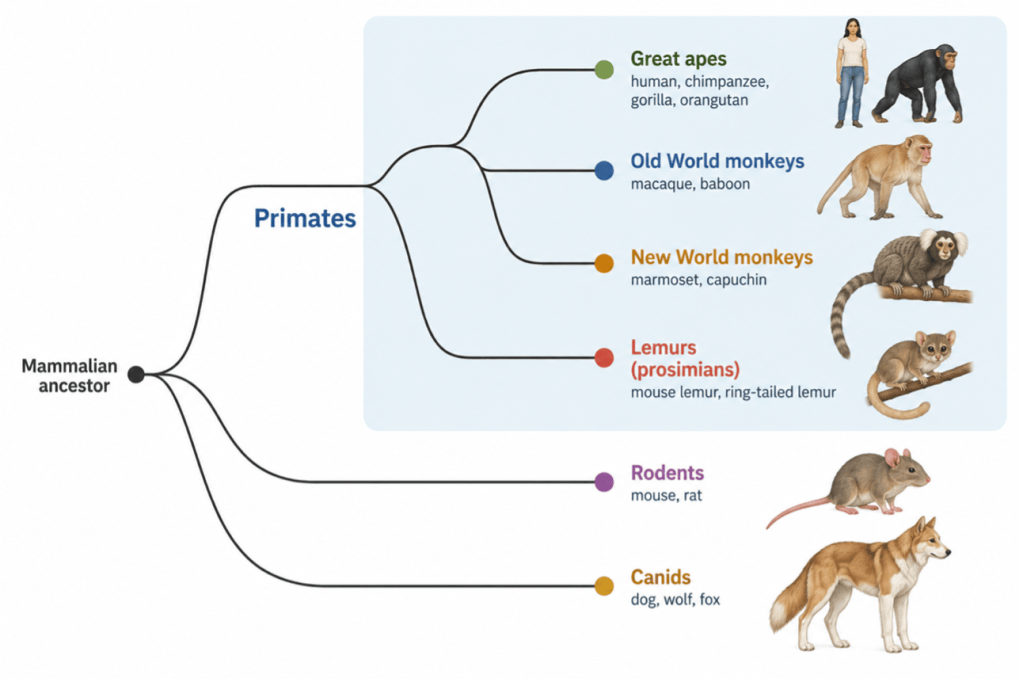
As mentioned above, gray mouse lemurs are primates, meaning they are part of an evolutionary group of animals that also includes monkeys, apes, and humans. Consequently, there are many ways in which humans are biologically more similar to lemurs than other mammals like dogs or rodents (Figure 1).
But of the primates, why should we care specifically about gray mouse lemurs? A main reason is, in fact, their shorter lifespans. At first, it may seem counterintuitive to research aging by studying the primate with the shortest lifespan. Yet because they don’t live as long, everything happens faster: they reproduce faster, they grow faster, and consequently, they age faster. While other primates can live between 20 and 60 years depending on the species, gray mouse lemurs are considered old at about 7 years of age and tend to live only 8-12 years1,2. Since they age over the course of years and not decades, studying these animals is not only more feasible, but may provide answers more quickly.
Gray mouse lemurs as a natural model for Alzheimer’s disease
Just as some people unfortunately develop dementias like Alzheimer’s disease (AD) in their old age, the cognitive abilities of some, but not all, gray mouse lemurs greatly deteriorate over time. Many of the specific cognitive deficits that are common in AD can also be found in a subset of old lemurs, such as generalization, which is the ability to apply rules learned in one context to a different situation, and spatial memory, the ability to remember where something is or how to get somewhere3,4.
The brains of some gray mouse lemurs also show some of the neural patterns associated with AD in humans. One of the major defining factors for Alzheimer’s disease is the presence of clumps of proteins in the brain called amyloid-beta (Ab) plaques. These Ab plaques also form in the brains of many other primates as they get old, including mouse lemurs.
Significant decreases in the size of certain areas of the brain, also known as atrophy, have also been linked to AD. One such area is the hippocampus, a brain region known for its role in learning and memory. In humans, studies have shown that smaller hippocampal volume is associated with greater cognitive deficits in AD5. Similarly, a study in gray mouse lemurs not only found that some older lemurs had more atrophy in the hippocampus, but also that animals who had smaller hippocampi had worse spatial memory. This study in lemurs was pivotal; while it was known that atrophy in the brain was linked to cognitive decline in aging humans, this was the first time the same had been shown in non-human primates6! So overall, there is a lot of overlap in the way gray mouse lemurs and humans age, positioning them as a potential model for studying aging and AD.
Potential for gray mouse lemurs in research
Now that we know that gray mouse lemurs are a good model, what do we do? How can we best study them to fill in the gaps in our understanding of aging?
One type of research that these lemurs are uniquely suited for is longitudinal research, which follow the same subjects over a long period of time. By using brain imaging techniques and various behavioral tests over the course of a few years, researchers can track how mouse lemur brains change as they transition from adulthood into old age. These studies hold a lot of potential, as they would allow researchers to directly test how lifestyle factors early in life, such as food, exercise, and sociability, may impact the brain later in life. And this is only the tip of the iceberg.
All of this taken together, these tiny lemurs offer us a unique way to explore questions about aging. By following changes in their brains and behavior over the course of their lifespan, we can better understand what distinguishes normal aging from changes associated with neurodegenerative diseases like Alzheimer’s and dementia. Such novel insights could even lead to the development of effective treatments for AD! Only time will tell. And if you ever find yourself in Durham, North Carolina, I highly recommend a visit to the Duke Lemur Center!
References
- Languille, S. et al. The grey mouse lemur: A non-human primate model for ageing studies. Ageing Research Reviews 11, 150–162 (2012).
- Heuer, E., Rosen, R. F., Cintron, A. & Walker, L. C. Nonhuman Primate Models of Alzheimer-Like Cerebral Proteopathy. Curr Pharm Des 18, 1159–1169 (2012).
- Duke Lemur Center. Fabien Pifferi, ‘The Mouse Lemur as a Model for Research on Aging’. (2016).
- Gabrieli, J. D. E. Memory systems analyses of mnemonic disorders in aging and age-related diseases. Proc Natl Acad Sci U S A 93, 13534–13540 (1996).
- Scheltens, P. et al. Atrophy of medial temporal lobes on MRI in ‘probable’ Alzheimer’s disease and normal ageing: diagnostic value and neuropsychological correlates. J Neurol Neurosurg Psychiatry 55, 967–972 (1992).
- Picq, J., Aujard, F., Volk, A. & Dhenain, M. Age-related cerebral atrophy in non-human primates predicts cognitive impairments. Neurobiol Aging 33, 1096–1109 (2012).
Cover photo is by Arjan Haverkamp from flickr
ChatGPT was used to generate Figure 1 and for proofreading
Claude Sonnet 5.5 was used to find and organize sources and to verify that the Picq et al. 2012 study was the first to connect age-related atrophy to cognitive deficits in NHPs.

