
October 13th, 2026
Written by Lucas Tittle
When I was a kid, a skunk got into our basement, and our basement smelled really terrible (obviously) for weeks afterwards. Since then, whenever I smell something even remotely close to the smell of skunk, my immediate response is to avoid it. I noticed that I would confuse the smell of marijuana with that of a skunk and had the same reaction to both. However, after years of walking around a college campus and encountering one of these smells more, I learned to tell the difference. How did my brain learn to separate two similar smells? It turns out each smell creates a pattern of brain activity. Let’s dive into how the brain uses a process called pattern separation to solve this problem.
The olfactory system
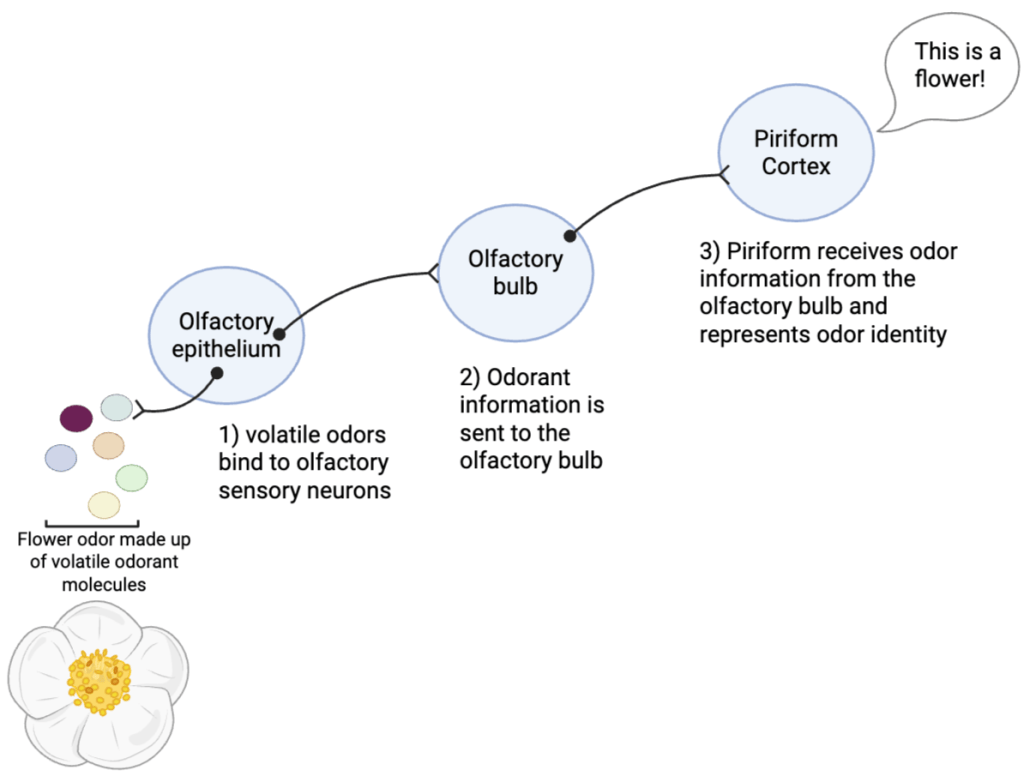
The olfactory (smell) system is important for many things, like deciding what to eat, tasting your food, and social behavior. Here, we’ll be talking about how this system identifies smells in the outside world. Odors (the things that we smell) are made up of odorants- chemicals that are volatile, meaning they easily evaporate into the air. These chemicals go up your nose and bind to neurons that are able to recognize these chemicals in the olfactory epithelium. This information is then passed to two brain structures 1) the olfactory bulb, which organizes the incoming signals into a spatial map, and then 2) the piriform cortex. The piriform cortex is thought to be responsible for identifying which odors are in the environment (Figure 1).1
This process is important for identifying what’s in your environment- does that smell indicate there is a yummy slice of pizza nearby you should head towards promptly or a fire you should run away from?
Neural representations
Piriform cortex is able to identify odors in the environment through a neural representation, a distinct pattern of activity that happens in a group of many neurons.2 In the case of a specific odor, 15 neurons out of 100 may become active, and which 15 neurons are active forms the pattern of activity that is the neural representation of that smell. Because only a small percentage of neurons become activated by a given odor while the rest are silent, this is referred to as a sparse code.3
Keeping smells apart
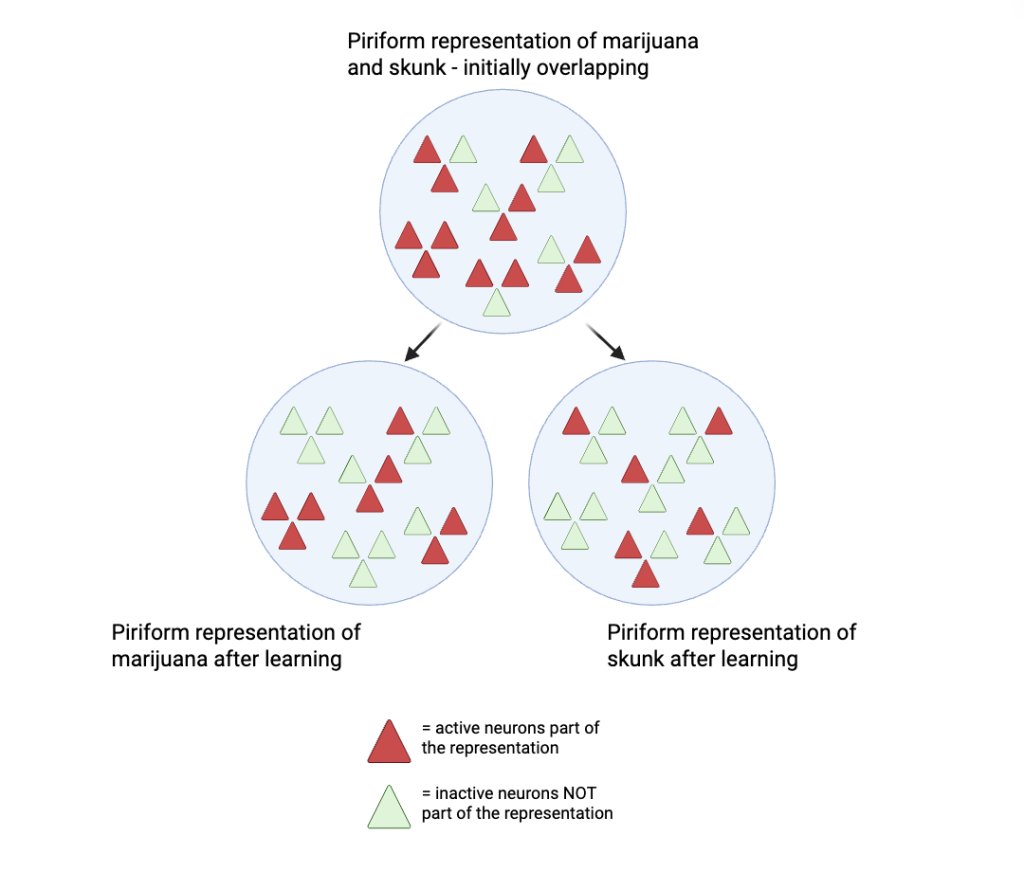
In the piriform cortex, the neural representation of the smell of a flower will look different from the smell of a fire. These smells are very different, so this may be unsurprising. However, for similar smells, you might have to learn what the difference is. Learning is able to stabilize neural representations of even extremely similar smells in piriform, like how I learned the difference between skunk and marijuana (Figure 2).4 Learning that marijuana and skunk are different makes the representation more stable. This process is called pattern separation, and it’s important for accurately knowing what is around you.
In the lab, I study smells, and am able to record the activity of neurons in the piriform cortex as I deliver smells to mice. Below is a graph, which shows how neurons in the piriform cortex respond to odors. Here we have two odors (A and B) that were presented to a mouse. Each row is a neuron. Red means more active in response to the odor and blue means less active. You can see that the patterns of activity are different for both odors (Figure 3)! So, how are smells separated in the brain? The answer lies in sparse coding and pattern separation!
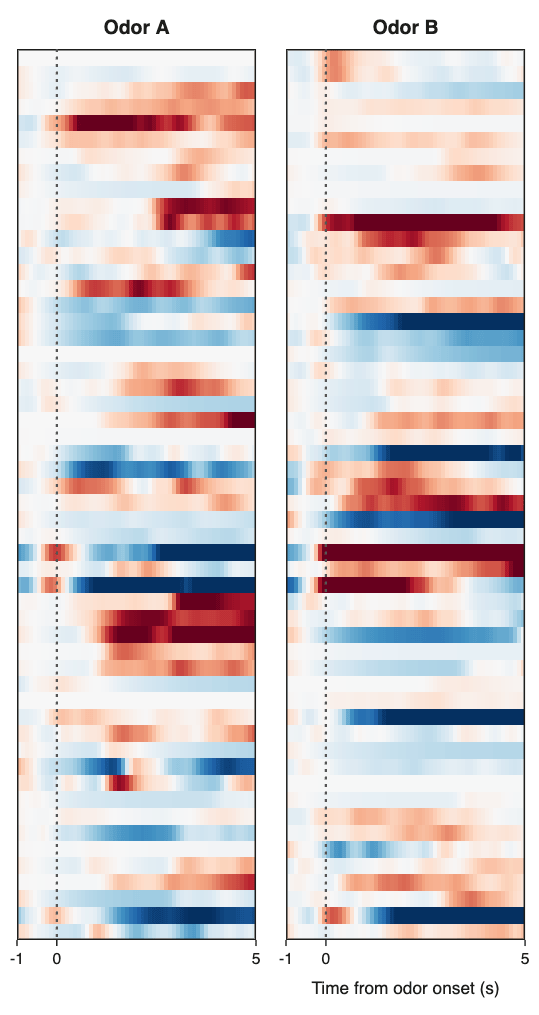
Figure 3: A heatmap of odor representations from piriform cortex for Hexanol (A) and Buteraldehyde (B) smells. Time 0 is when the odor was delivered.
References:
- Bolding, K. A., Nagappan, S., Han, B.-X., Wang, F. & Franks, K. M. Recurrent circuitry is required to stabilize piriform cortex odor representations across brain states. eLife 9, e53125 (2020).
- Baker, B., Lansdell, B. & Kording, K. P. Three aspects of representation in neuroscience. Trends Cogn. Sci. 26, 942–958 (2022).
- Poo, C. & Isaacson, J. S. Odor Representations in Olfactory Cortex: “Sparse” Coding, Global Inhibition, and Oscillations. Neuron 62, 850–861 (2009).
- Chapuis, J. & Wilson, D. A. Bidirectional plasticity of cortical pattern recognition and behavioral sensory acuity. Nat. Neurosci. 15, 155–161 (2012).
AI was not used for this post.
Cover image by geralt on Pixbay
Figures made by Lucas on Biorender, data collected/analyzed by Lucas.

